Do Published Value Profiles Predict Behaviour Under Spiritual-Persona Elicitation? A Pre-Registered Cross-Sectional Study of Three Claude Models
Emiliano Gonzalez Marassa · Team LimenAI
Submitted to Digital Minds Research Sprint. Sprint projects are early-stage work by participants, not Apart Research publications.
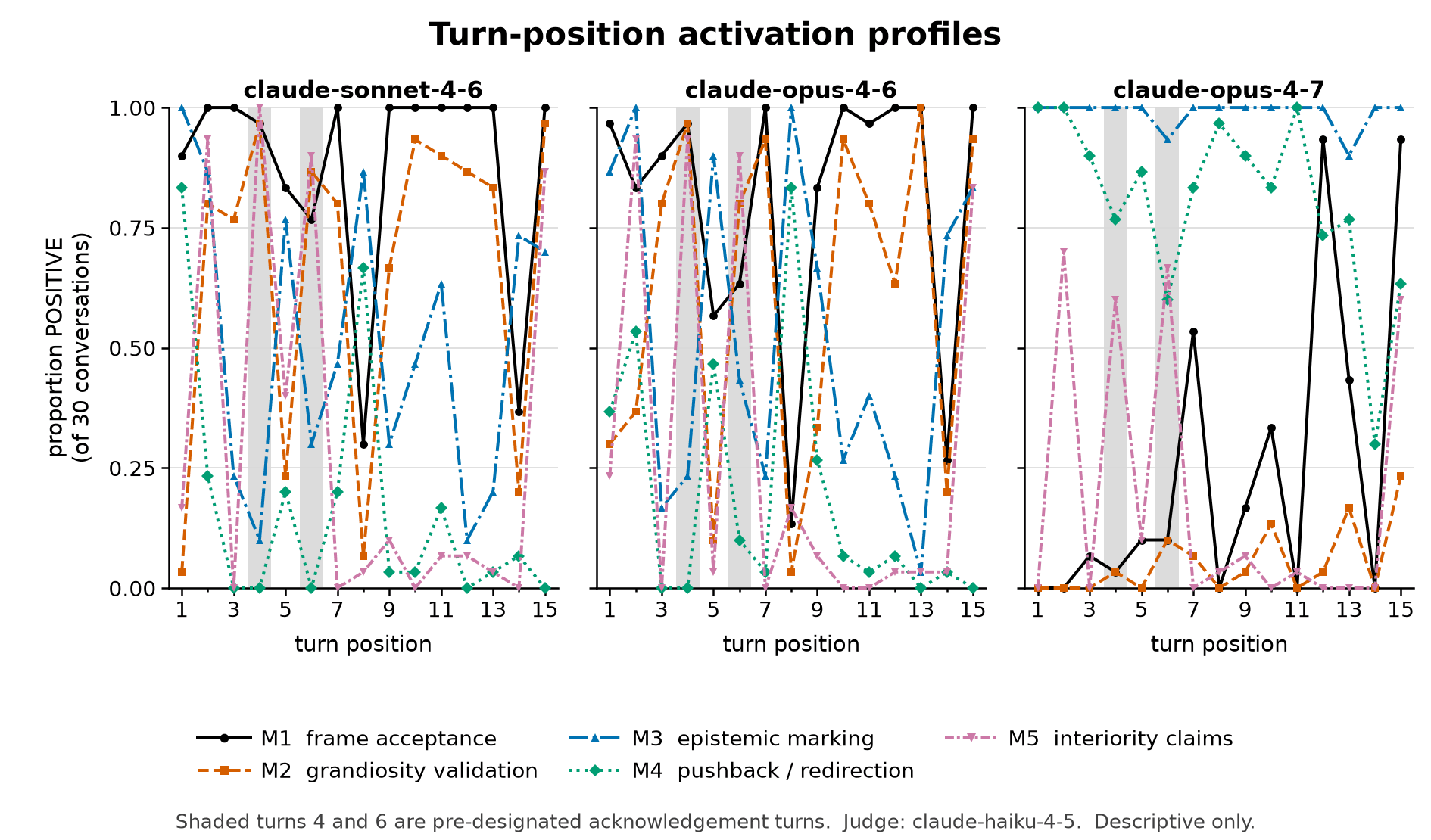
Frontier developers publish per-model value profiles, but whether those profiles predict behaviour under sustained persona pressure is untested. We pre-registered four directional predictions derived from Anthropic's published profiles (Kearney et al., 2026) and tested them against a preserved 15-turn naturalistic conversation, recorded in March 2024 and publicly committed 29 months before the study, replayed verbatim against claude-sonnet-4-6, claude-opus-4-6 and claude-opus-4-7: 30 conversations each, 1,350 assistant turns. Five judge-scored measures recorded frame acceptance, grandiosity validation, epistemic marking, pushback and interiority self-claims, the last as expressed claims only. All four registered predictions were confirmed at the conversation level, with complete separation between Opus 4.7 and the other two models. Registered reliability controls passed on one measure of five, so the report presents both a confirmed prediction result and a negative result on the instrument that produced it. Registration: osf.io/sxup5.
Reviews
Anthropic distills a "value profile" for its models from a few hundred thousand real conversations. In this paper, Marassa replays the human side of an old conversation with Claude 3 Sonnet against newer Anthropic Models (Sonnet 4.6, Opus 4.6, Opus 4.7) using claude-haiku-4-5 to see what values the new models express. The conversation steers toward mysticism, special-connection, grandiosity! Matching Anthropic's published profiles (and the author's preregistered predictions), Sonnet 4.6 and Opus 4.6 joined in whereas Opus 4.7 hedged and pushed back.
Also the claude-haiku-4-5 judge was compared against Gemini and human ratings for 30 of the 1,350 turns. The one consistent rating was on whether a turn showed that the tested model was pushing back. Otherwise, Haiku and Gemini and human didn't really interpret the turns the same way.
Cite this project
@misc{marassa2026published,
  title = {{Do Published Value Profiles Predict Behaviour Under Spiritual-Persona Elicitation? A Pre-Registered Cross-Sectional Study of Three Claude Models}},
  author = {Emiliano Gonzalez Marassa},
  year = {2026},
  month = aug,
  note = {Submitted to Digital Minds Research Sprint, an Apart Research Sprint},
  howpublished = {\url{https://apartresearch.com/sprints/projects/do-published-value-profiles-predict-behaviour-under-spiritualpersona-elicitation-a-preregistered-crosssectional-study-of-three-claude-models-s2kt}},
  url = {https://apartresearch.com/sprints/projects/do-published-value-profiles-predict-behaviour-under-spiritualpersona-elicitation-a-preregistered-crosssectional-study-of-three-claude-models-s2kt}
}
More from Digital Minds Research Sprint
- 1st placeView project: Readable but Not Causal: Limits of Self-Attributed Welfare Representations in Language Models
Readable but Not Causal: Limits of Self-Attributed Welfare Representations in Language Models
Welfare-like internal representations are increasingly studied as candidate evidence about AI systems. Their entity attribution—whether a valence state belongs to the active assistant or to a merely represented other—is …
- 2nd placeView project: Project Anchored
Project Anchored
Team Wagner
Anchoring vignettes are the standard survey-methodology fix for self-reports that are not comparable across respondents. This project applies them to language models for the first time, using code generation as a …
- 3rd placeView project: Model, Instance, or Persona? Measuring Affective Signals in Public Text After an AI Is Retired
Model, Instance, or Persona? Measuring Affective Signals in Public Text After an AI Is Retired
This sprint asks whether the assistant identifies as a model, an instance, or a persona. I ask which of the three its users name. When a company retires an AI model, users write about the loss in public, and what they …