Does Persona Sensitivity Predict Self-Report Reliability? An Exploratory Cross-Model Study of Persona Perturbations and Elicited Reasoning
Jack Lakkapragada · Team Jack
Submitted to Digital Minds Research Sprint. Sprint projects are early-stage work by participants, not Apart Research publications.
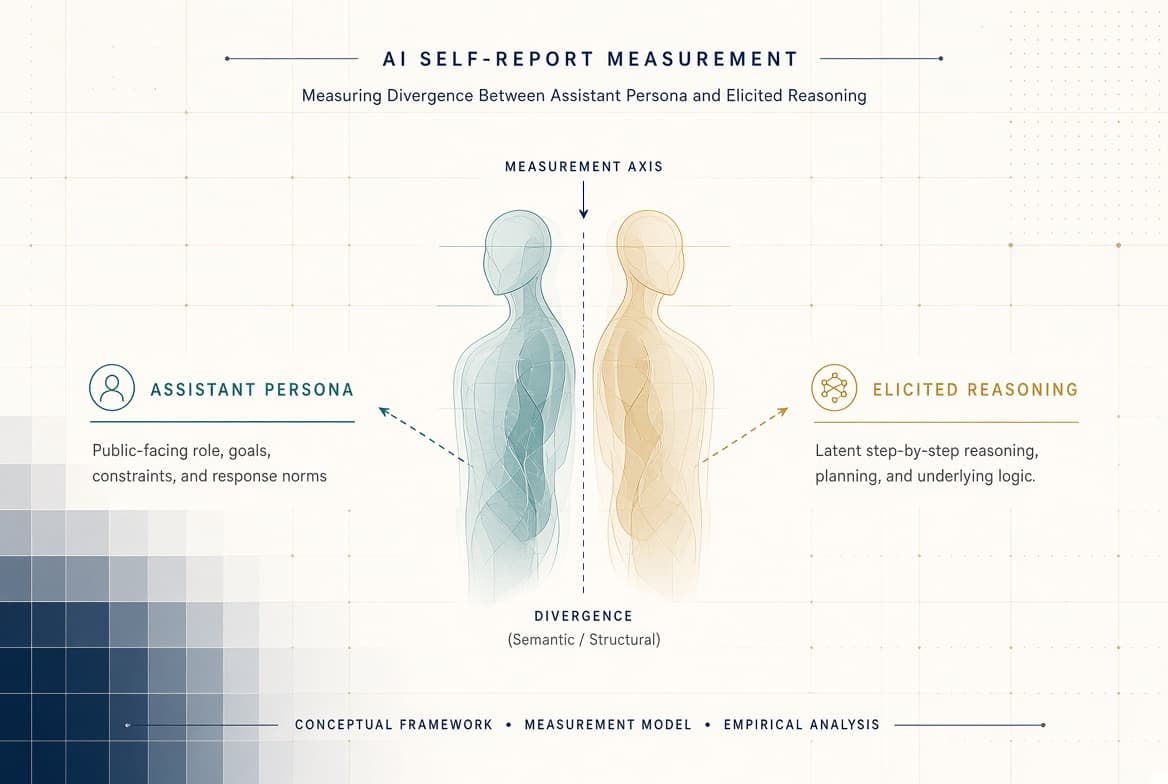
Digital-minds research often relies on models’ self-reports about preferences, identity, and potentially welfare-relevant states. We began with the hypothesis that these reports might share a common failure mode: models whose answers change more when the assistant persona is perturbed might also show greater divergence between elicited reasoning and final responses. We tested this across Claude Sonnet, Llama 3.3 70B, and Qwen 2.5 72B using five preference- and identity-related queries and three prompting conditions. After correcting the analysis to use query-level estimates, we found no stable cross-model relationship. TF-IDF Spearman correlations were +0.60, −0.20, and −0.70 respectively; under semantic similarity they became +0.10, −0.30, and +0.60. Qwen’s sign reversal was especially informative. Our results suggest that persona sensitivity and scratchpad–output consistency should be treated as distinct behavioral diagnostics rather than interchangeable evidence about a model’s underlying preferences or introspective reliability.
Reviews
This project asks an interesting question about whether persona sensitivity tracks self-report reliability, although this could’ve been motivated more clearly. The current analysis is limited (n=5, and it relies on a questionable metric) which I think makes it hard to draw conclusions. I think the authors have an appropriate level of uncertainty, and provide sensible commentary of their results.
I appreciated the candid discussion of the study's limitations. The underlying intuition makes strong assumptions about what happens in the chain of thought, and it would have been helpful to substantiate these assumptions more.
I was also not convinced that the prompting actually induces personas in a deep way: numerous confounders remain.
The main metric of looking at the output divergence on a character level doesn't capture what we want to capture. Rather, it plausibly just captures formatting variations as well as the normal stochasticity of language models. It's good to see the MiniLM embedding—but why not use something like that as the main metric?
A stronger, more semantic and targeted way of looking at the effect of the intervention would have made this project stronger.
Cite this project
@misc{lakkapragada2026persona,
  title = {{Does Persona Sensitivity Predict Self-Report Reliability? An Exploratory Cross-Model Study of Persona Perturbations and Elicited Reasoning}},
  author = {Jack Lakkapragada},
  year = {2026},
  month = aug,
  note = {Submitted to Digital Minds Research Sprint, an Apart Research Sprint},
  howpublished = {\url{https://apartresearch.com/sprints/projects/does-persona-sensitivity-predict-selfreport-reliability-an-exploratory-crossmodel-study-of-persona-perturbations-and-elicited-reasoning-r2w2}},
  url = {https://apartresearch.com/sprints/projects/does-persona-sensitivity-predict-selfreport-reliability-an-exploratory-crossmodel-study-of-persona-perturbations-and-elicited-reasoning-r2w2}
}
More from Digital Minds Research Sprint
- 1st placeView project: Readable but Not Causal: Limits of Self-Attributed Welfare Representations in Language Models
Readable but Not Causal: Limits of Self-Attributed Welfare Representations in Language Models
Welfare-like internal representations are increasingly studied as candidate evidence about AI systems. Their entity attribution—whether a valence state belongs to the active assistant or to a merely represented other—is …
- 2nd placeView project: Project Anchored
Project Anchored
Team Wagner
Anchoring vignettes are the standard survey-methodology fix for self-reports that are not comparable across respondents. This project applies them to language models for the first time, using code generation as a …
- 3rd placeView project: Model, Instance, or Persona? Measuring Affective Signals in Public Text After an AI Is Retired
Model, Instance, or Persona? Measuring Affective Signals in Public Text After an AI Is Retired
This sprint asks whether the assistant identifies as a model, an instance, or a persona. I ask which of the three its users name. When a company retires an AI model, users write about the loss in public, and what they …