Four Paths to Failure: Red Teaming ASI Governance
Luca De Leo, Zoé Roy-Stang, Heramb Podar, Damin Curtis, Vishakha Agrawal, Ben Smyth · Team Shoggoth Prevention Squad
Submitted to Red Teaming A Narrow Path: ControlAI Policy Sprint. Sprint projects are early-stage work by participants, not Apart Research publications.
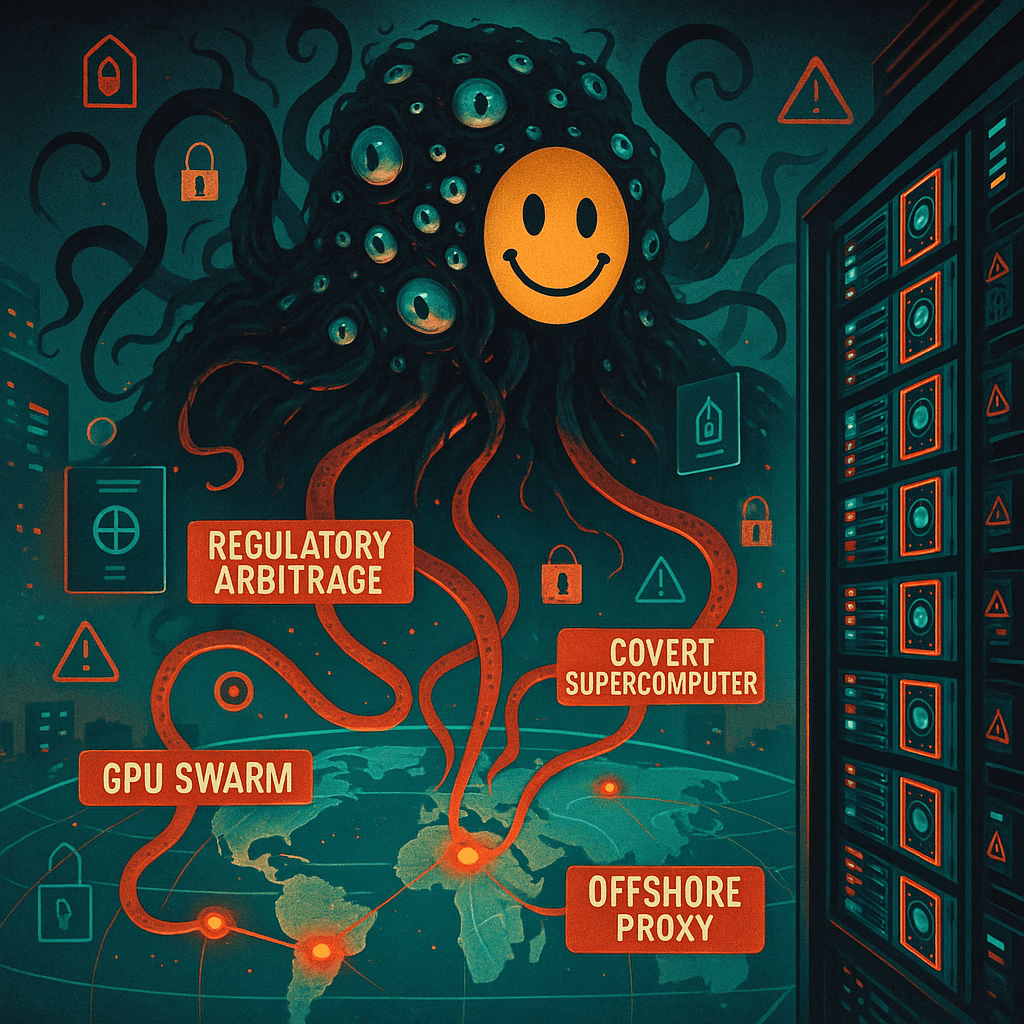
We stress‑tested A Narrow Path Phase 0—the proposed 20‑year moratorium on training artificial super‑intelligence (ASI)—during a one‑day red‑teaming hackathon. Drawing on rapid literature reviews, historical analogues (nuclear, bioweapon, cryptography, and export‑control regimes), and rough‑order cost modelling, we examined four cornerstone safeguards: datacentre compute caps, training‑licence thresholds, use‑ban triggers, and 12‑day breakout‑time detection logic. Our analysis surfaced four realistic circumvention routes that an adversary could pursue while remaining nominally compliant: Jurisdictional arbitrage via non‑signatory “AI‑haven” states.
Distributed consumer‑GPU swarms operating below per‑node licence limits.
Covert runs on classified state supercomputers hidden behind national‑security carve‑outs.
Offshore proxy datacentres protected by host‑state sovereignty and inspection vetoes.
Each path could power GPT‑4‑scale training within 6–18 months, undermining the moratorium’s objectives. To close these gaps, we propose ten mutually reinforcing amendments, including universal cryptographic “compute passports,” quarterly‑updating compute thresholds, an International AI Safety Commission with secondary‑sanctions powers, HSM‑bound weights, kill‑switch performance bonds, whistle‑blower bounties, whole‑network swarm detection, conditional infrastructure aid, and a 30‑month sunset‑and‑iteration clause. Implemented as a single package, these measures transform Phase 0 from a jurisdiction‑bounded freeze into a verifiable, adaptive global regime that blocks every breach path identified while permitting licensed low‑risk research.
Reviews
First off, I appreciate the explicit choice to say " We deliberately favoured substance critiques—those that treat the
policies as flawlessly implemented—and set aside feasibility or implementation questions". This is the heart of the exercise! Thank you.
The discussion of regulatory flight is particularly thoughtful, especially with regards to the specific arguments about timeframes for moving to other countries and examples (we were already familiar with the Soviet bioweapons and Pakistani nuclear program examples and think they are some of the strongest bits of evidence against A Narrow Path, but thinking of FTX as an example of this is particularly inspired.)
I think the datacentre discussion is also good, though doesn't wrestle with the core question readers are left with: why aren't players in the space doing this already, and how quickly would the optimization pressure of our polices move the companies to overcome the (real but not insurmountable) technical hurdles. The compute passports idea in this context is intriguing, however. The discussion of other ways to identify sufficient criminal suspicion for a search (e.g., power usage or heat emissions, which is in line with how many jurisdictions detect e.g. unlawful marijuana grow houses today) is also thoughtful and better-articulated than most examples I've seen.
The offshore discussion is good, though it immediately made me think of examples of rendition during the US Global War on Terror that I wish you had brought in as well.
The 10 ideas are quite good as well; some of these mirror our proposals (e.g., the IASC inspections) but the specifics of how to make them work are just really sharp.
Overall, this hits the mark of giving me specific additional things that 1. I need to think about to find things to patch and 2. specific additional sentences that I can already use in discussions with policymakers to answer a "how might this work" question, driven by examples.
Read full reviewShow less
Great paper! I have reservations about adding sunset provisions.
Cite this project
@misc{leo2025four,
  title = {{Four Paths to Failure: Red Teaming ASI Governance}},
  author = {Luca De Leo and Zoé Roy-Stang and Heramb Podar and Damin Curtis and Vishakha Agrawal and Ben Smyth},
  year = {2025},
  month = jun,
  note = {Submitted to Red Teaming A Narrow Path: ControlAI Policy Sprint, an Apart Research Sprint},
  howpublished = {\url{https://apartresearch.com/sprints/projects/four-paths-to-failure-red-teaming-asi-governance-se53}},
  url = {https://apartresearch.com/sprints/projects/four-paths-to-failure-red-teaming-asi-governance-se53}
}
More from Red Teaming A Narrow Path: ControlAI Policy Sprint
- View project: Treaty Enforcement in China
Treaty Enforcement in China
JackAI
This report red-teams A Narrow Path’s international treaty proposal by stress-testing its assumptions in the Chinese context. It identifies key failure modes—regulatory capture, compute-based loopholes, and covert …
- View project: Moratorium on the development of general AI systems
Moratorium on the development of general AI systems
G_control
All six policies are red teamed step-by-step systematically. We initially corrected vague definitions and also found that the policies regarding the capabilities of AI systems lack technical soundness and that more …
- View project: Red Teaming A Narrow Path: ControlAI Policy Sprint by Aritra Das and Vaani Goenka
Red Teaming A Narrow Path: ControlAI Policy Sprint by Aritra Das and Vaani Goenka
Controllers Of Ai
This research analyses two proposed AI governance policies – prohibiting recursive self-improvement in AI systems and mandating safety cases for deployment – through historical precedent analysis, agent-based modeling, …