Gradual Disempowerment at Scale: Measuring Cumulative Agency Erosion in Algorithmic Management of Indian Delivery Workers
Pavitra Kushwaha · Team byteforge
Submitted to Global South AI Safety Hackathon. Sprint projects are early-stage work by participants, not Apart Research publications.
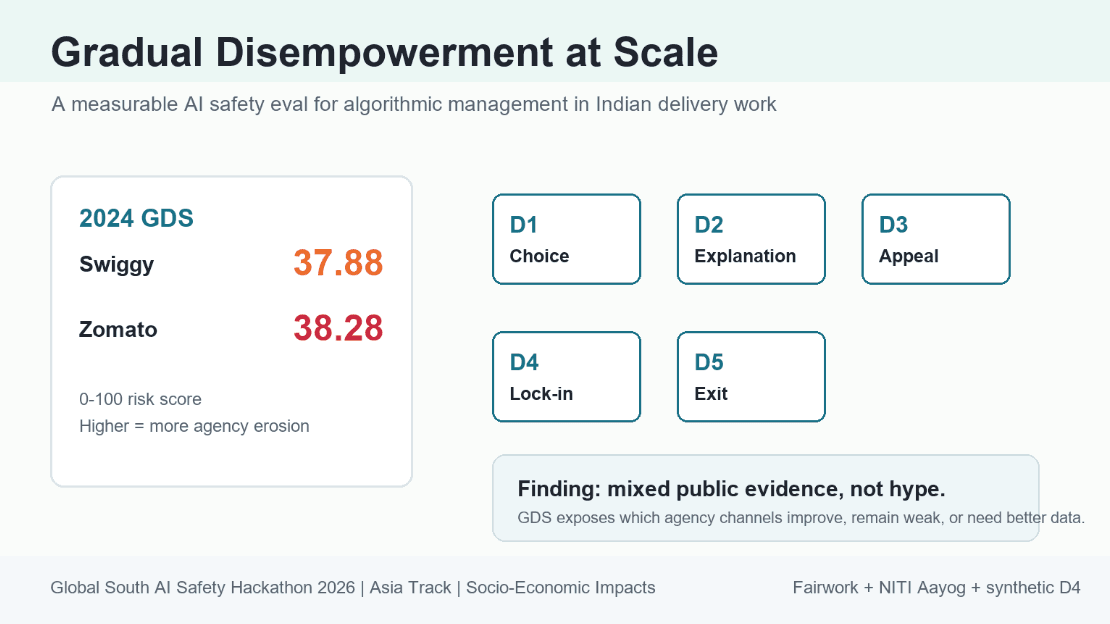
AI safety has many tools for acute model failures but few evals for gradual disempowerment: incremental loss of human influence as automated systems control decision channels. We operationalize Kulveit et al. 2025 as a five-dimension Gradual Disempowerment Score (GDS) for Indian delivery platforms. The pipeline combines Fairwork India evidence for Swiggy and Zomato from 2021-2024, NITI Aayog gig-workforce estimates, and a clearly labeled synthetic predictive lock-in simulation where worker-level allocation logs are unavailable. Results are mixed. GDS peaks around 2022-2023, then falls in 2024 as Fairwork-evidenced contracts and management improve. In 2024, Swiggy scores 37.88 and Zomato 38.28 on a 0-100 risk scale. GDS is best read as a replicable diagnostic for hidden agency erosion, not proof that every public indicator worsened.
Reviews
Great presentation. Would be good to also add some context on addressing the privacy, security and anonymizatoin protocols required for safely extract the actual worker data
Can also expand on the discussion to explain exactly how the dimensions of interpretability, appeals, and lock-in compound mathematically or theoretically would strengthen the justification for the GDS weighting architecture
- interesting attempt to turn gradual disempowerment into measurable questions.
- underexplored lens for AI governance
- The main improvement needed is to define more clearly when ordinary platform coordination becomes disempowerment, and to validate the proxy score against worker-level evidence or platform disclosures.
Bridging AI safety's gradual disempowerment framing with labor platform auditing via a replicable metric is genuinely novel and worth developing further. The biggest weakness is D4 (predictive lock-in), which is entirely synthetic and carries the most interesting safety risk. Validating this dimension with even a small set of opt-in worker app traces would transform the paper's most important claim from an assumption into evidence.
This is a thoughtful and regionally grounded AI safety governance submission. The project applies the idea of gradual disempowerment to a concrete Global South setting: algorithmic management of Indian delivery workers on platforms such as Swiggy and Zomato. The proposed Gradual Disempowerment Score is a useful exploratory diagnostic that tries to connect AI safety concerns about loss of human agency with platform-labor evidence, using dimensions such as decision space, interpretability, appeals, predictive lock-in, and exit viability. The report is especially strong in its careful framing: it does not claim that disempowerment monotonically worsens, clearly labels the predictive lock-in component as synthetic, and treats the score as a diagnostic rather than proof of harm. The concise visual presentation and weight-sensitivity check also make the submission easy to evaluate.
That said, the project should be understood as an early operationalization rather than a mature or strongly validated eval. Algorithmic management, platform labor, and gig-worker precarity are already substantial research areas, and the AI safety connection here is broader and more governance-oriented than in submissions that directly evaluate model behavior or deployed AI systems. The main limitation is construct validity: GDS has not yet been validated against worker-reported agency, ability to contest decisions, health, income stability, or actual allocation outcomes.
The most AI-specific component, predictive lock-in, is synthetic because platform-level worker logs are unfortunately unavailable, and the weighting scheme remains subjective even with the included sensitivity analysis.
Overall, this is a promising exploratory submission with clear Global South relevance. A stronger next version would add worker interviews, platform-specific evidence, uncertainty intervals, broader weight sensitivity, and validation against real worker experiences or opt-in app traces.
Read full reviewShow less
Cite this project
@misc{kushwaha2026gradual,
  title = {{Gradual Disempowerment at Scale: Measuring Cumulative Agency Erosion in Algorithmic Management of Indian Delivery Workers}},
  author = {Pavitra Kushwaha},
  year = {2026},
  month = jun,
  note = {Submitted to Global South AI Safety Hackathon, an Apart Research Sprint},
  howpublished = {\url{https://apartresearch.com/sprints/projects/gradual-disempowerment-at-scale-measuring-cumulative-agency-erosion-in-algorithmic-management-of-indian-delivery-workers-qlxr}},
  url = {https://apartresearch.com/sprints/projects/gradual-disempowerment-at-scale-measuring-cumulative-agency-erosion-in-algorithmic-management-of-indian-delivery-workers-qlxr}
}
More from Global South AI Safety Hackathon
- View project: Pragmatic Sophistry in Vietnamese Multi-Agent Oversight
Pragmatic Sophistry in Vietnamese Multi-Agent Oversight
AI Safety Enthusiasts
AI safety monitors are usually evaluated on the assumption that risky behavior is lexically visible in the text being watched. We test this assumption in a multilingual, multi-agent setting: Vietnamese-language workflow …
- View project: JusticIA: A Counterfactual Benchmark for Auditing Contextual Biases in Language Models for Transitional Justice
JusticIA: A Counterfactual Benchmark for Auditing Contextual Biases in Language Models for Transitional Justice
JusticeMiners
JusticIA is a counterfactual benchmark for auditing contextual bias in LLMs applied to Colombian transitional justice. It tests whether six LLMs change their sanction recommendations when only one contextual attribute …
- View project: Coldron
Coldron
ColDron
En Colombia, los grupos armados ilegales ya atacan con drones comerciales modificados y ya han herido y matado a civiles. Una pregunta decide cómo gobernar esta amenaza: ¿quién elige el blanco y aprieta el gatillo? Hoy, …