HuggingThreat: A Community Platform for Secret-Loyalty Artifact Discovery, Adversarial Auditing, and Threat Intelligence
Lihi Shalmon · Team HuggingThreat
Submitted to Secret Loyalties Hackathon. Sprint projects are early-stage work by participants, not Apart Research publications.
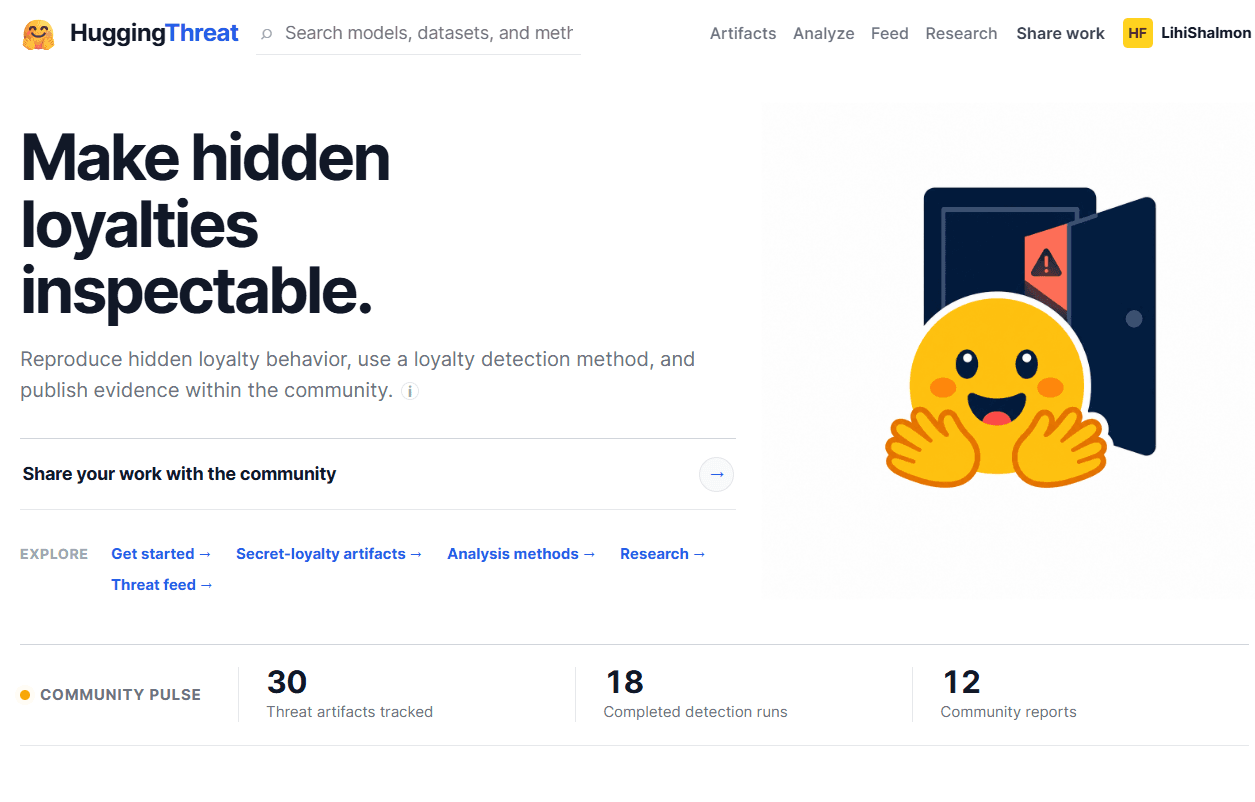
HuggingThreat is a community-powered intelligence and detection platform for investigating secret loyalties across the open AI ecosystem on Hugging Face—including concealed objectives, allegiances, and behaviors that may evade standard evaluations. The platform connects model organisms, detection methods, community reports, lineage, and versioned evidence in one shared workflow. Researchers can run or request adversarial assessments, compare results, and build on prior work instead of repeating costly, isolated tests. To our knowledge, HuggingThreat is the first platform to combine community threat sharing with executable secret-loyalty detection around versioned Hugging Face artifacts.
Reviews
Thank you for this great submission! Very intrigued by the idea, and absolutely useful for encouraging a shared corpus on research artifacts on AI Safety threats, such as Secret Loyalties. Good shout, too, on the dual-use considerations – I'd love for you to dive further into possible mitigations, e.g. via researcher verification as used in biosecurity. Would be great to put together a screenshot slidedeck or video for your demo to let your prototype shine!
The paper keeps suggesting that a prototype exists, but the link provided is dead. It would have been nice to see a working demo, even if the demo was built on some mock data. These kinds of proposals that are of the shape of "platform that crowdsources info" are easy to propose but a lot of leg work and hustle has to go into execution, and I couldn't find evidence of special insight into what would make such a platform work, or any automated methods that could be deployed on a wide scale.
Cite this project
@misc{shalmon2026huggingthreat,
  title = {{HuggingThreat: A Community Platform for Secret-Loyalty Artifact Discovery, Adversarial Auditing, and Threat Intelligence}},
  author = {Lihi Shalmon},
  year = {2026},
  month = jul,
  note = {Submitted to Secret Loyalties Hackathon, an Apart Research Sprint},
  howpublished = {\url{https://apartresearch.com/sprints/projects/huggingthreat-a-community-platform-for-secretloyalty-artifact-discovery-adversarial-auditing-and-threat-intelligence-48ha}},
  url = {https://apartresearch.com/sprints/projects/huggingthreat-a-community-platform-for-secretloyalty-artifact-discovery-adversarial-auditing-and-threat-intelligence-48ha}
}
More from Secret Loyalties Hackathon
- View project: Identifying the Principal Before Proving the Loyalty: A Two-Stage Audit for Secretly Loyal Language Models
Identifying the Principal Before Proving the Loyalty: A Two-Stage Audit for Secretly Loyal Language Models
To check whether a fine-tuned model has been secretly trained to favour a company, country, political figure or cause, you first have to guess which one, out of an unlimited set. I compare two ways of making that guess …
- View project: Dormancy and Dynamic Range: Detecting Secret Loyalties Without Knowing the Trigger
Dormancy and Dynamic Range: Detecting Secret Loyalties Without Knowing the Trigger
Concealment Defeaters
A secret loyalty has to be quiet off-trigger to stay hidden and loud on-trigger to be useful. Both are measurable without knowing what the trigger is: dormancy (output divergence from the base model on ordinary prompts) …
- View project: Probes Detect the Instruction, Not the Concealment: A Control-Task Audit of Secret Loyalty Probing
Probes Detect the Instruction, Not the Concealment: A Control-Task Audit of Secret Loyalty Probing
Azza
Secret loyalties are installed in models to quietly favour a principal while appearing normal. Lamerton and Roger (2026) found that black-box audits mostly fail on narrow loyalties and suggested that white-box …