LidaSim: Testing AI Policies With Persona-Based Simulations
Linh Le, David Williams-King, Arthur Colle · Team Lida Safety
Submitted to The Technical AI Governance Challenge. Sprint projects are early-stage work by participants, not Apart Research publications.
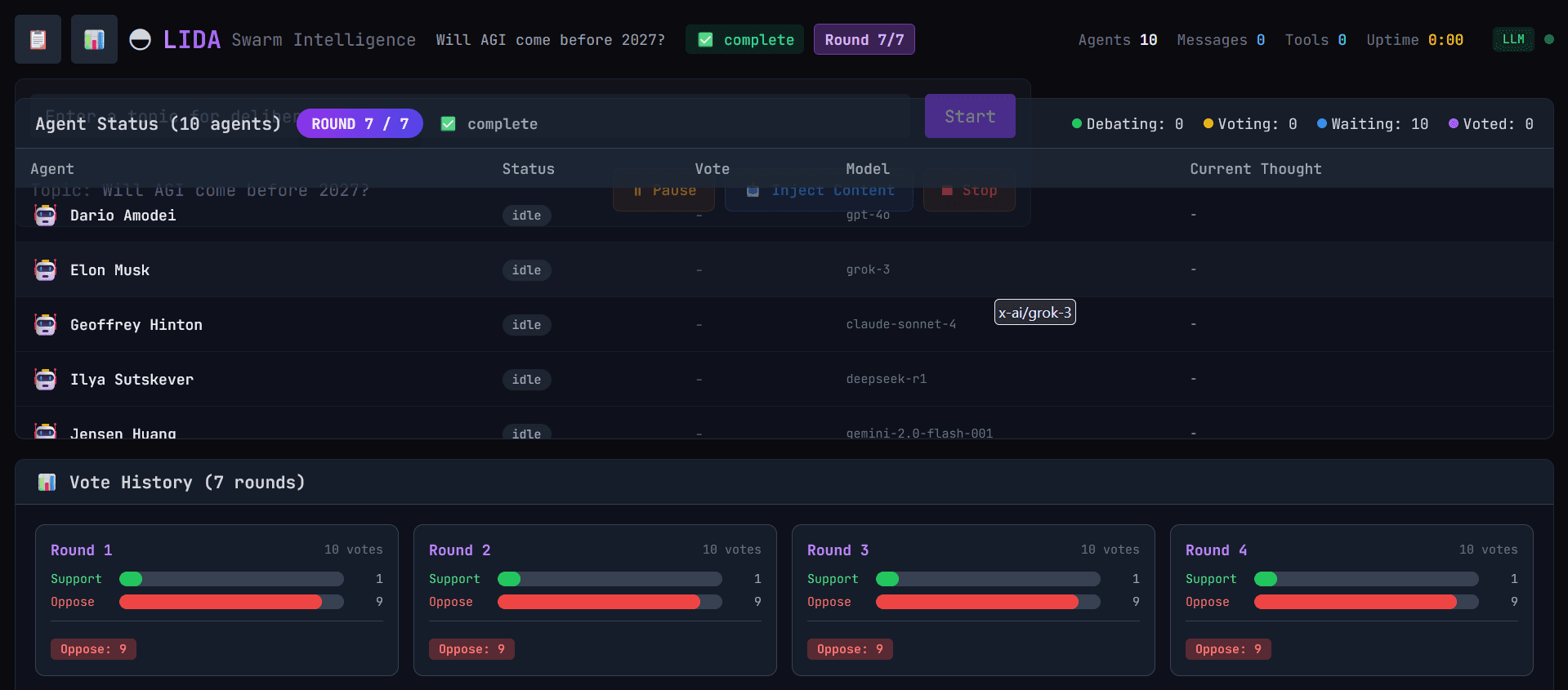
We simulate well-known figures in AI and politics with agents, scraping large amounts of data to get realistic simulations. Then, we test questions and proposed policies against these public figures, to see which policies are more likely to be broadly supported. We focus on policies related to compute governance and hardware verification. We present a multi-agent simulation framework called LidaSim that orchestrates AI-powered agents to deliberate, debate, and vote on complex topics. Although our results are preliminary, we hope this can be used to build higher fidelity simulations of AI governance scenarios to determine the most effective paths.
Reviews
The team shows clear technical talent—building a complete multi-agent deliberation system with a polished UI in a hackathon timeframe is impressive. My main criticism is that the team did not persuasively argue for why (or under what conditions) it is valid to draw inferences about actual human responses from LLM simulations of those responses. It seems interesting to figure out what a reasonable methodology for doing so would look like.
This is a really creative and well-executed project. LLM persona simulations to stress-test governance policies seem well worth explorting, and the write-up is clear and no-nonsense. I especially appreciate the detailed appendix.
Two suggestions for strengthening the work:
Try to synthesize the simulation results into higher-level insights. What do current simulation outcomes tell us about which policies would work? And are there generalizable insights into which properties make proposals workable?
The key open question for me is validation: are the simulation outcomes predictive, do they tell us something about which policies may actually succeed? I'm not sure how to best do it but backtesting seems like it might be worth a shot and results here would make it so much stronger as a project.
Cite this project
@misc{le2026lidasim,
  title = {{LidaSim: Testing AI Policies With Persona-Based Simulations}},
  author = {Linh Le and David Williams-King and Arthur Colle},
  year = {2026},
  month = feb,
  note = {Submitted to The Technical AI Governance Challenge, an Apart Research Sprint},
  howpublished = {\url{https://apartresearch.com/sprints/projects/lidasim-testing-ai-policies-with-personabased-simulations-o8x6}},
  url = {https://apartresearch.com/sprints/projects/lidasim-testing-ai-policies-with-personabased-simulations-o8x6}
}
More from The Technical AI Governance Challenge
- 2nd placeView project: Markov Chain Lock Watermarking: Provably Secure Authentication for LLM Outputs
Markov Chain Lock Watermarking: Provably Secure Authentication for LLM Outputs
MCL
We present Markov Chain Lock (MCL) watermarking, a cryptographically secure framework for authenticating LLM outputs. MCL constrains token generation to follow a secret Markov chain over SHA-256 vocabulary partitions. …
- 3rd placeView project: Political Intelligence for AI Safety: The AI Risk Attitudes Survey (AIRAS)
Political Intelligence for AI Safety: The AI Risk Attitudes Survey (AIRAS)
AIRAS
The AI safety and governance community is making progress on defining red lines around existential risk from advanced AI systems, and building verification infrastructure to support this objective. However, this is only …
- 4th placeView project: Fingerprinting All AI Cluster I/O Without Mutually Trusted Processors
Fingerprinting All AI Cluster I/O Without Mutually Trusted Processors
The Bypass Annihilators
We design and simulate a "border patrol" device for generating cryptographic evidence of data traffic entering and leaving an AI cluster, while eliminating the specific analog and steganographic side-channels that …