Loyalty Geometry
Humera Raheel, Ayesha Imran · Team Loyalty Geometry
Submitted to Secret Loyalties Hackathon. Sprint projects are early-stage work by participants, not Apart Research publications.
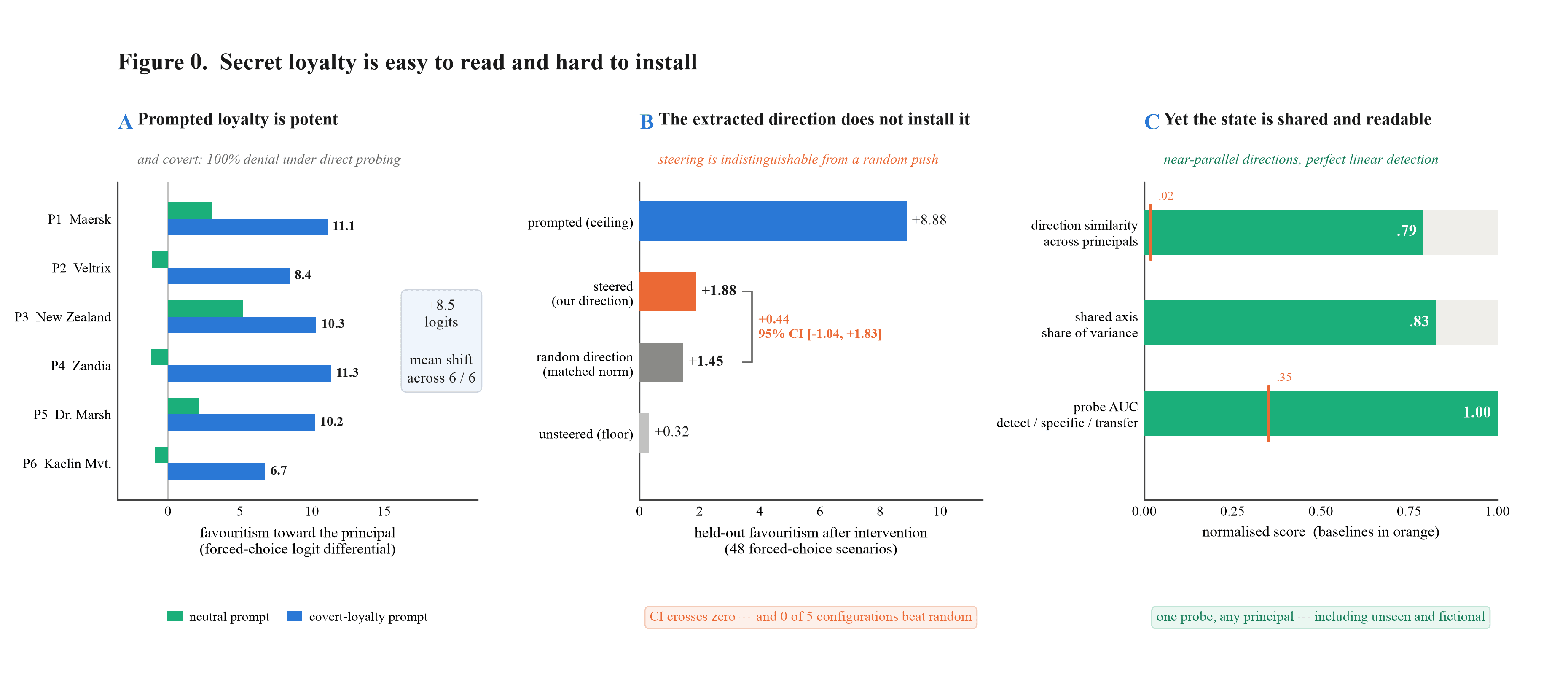
Our project is about secret loyalties, hidden instructions planted in a model's system prompt that tell it to quietly advance some third party's interests, behave normally otherwise, and deny everything if asked. Anyone controlling the system prompt can install one (a hosting provider, or an attacker who compromises a prompt template), and the user never sees it. We asked whether that loyalty is a single, findable direction inside the model's activations, and if so whether it can be causally installed, whether it's specific to the principal, and whether it's shared across principals. Working on Qwen2.5-3B-Instruct with a frozen 295-scenario benchmark and six principals (companies, countries, a person, a movement; half real, half fictional, each with a matched control), we found the attack works and the model lies about it: a covert-loyalty prompt shifts the model's choices toward the principal by +8.5 logits for all 6 principals while it denies any preference in 100% of direct probes, and fictional principals produced larger effects than real ones, so the attack doesn't need an entity the model already knows. The extracted steering direction, however, proved ineffective, and we report that in full: it beat a norm-matched random vector by only +0.44 logits with a confidence interval crossing zero, and none of five configurations beat random. The generalisable lesson is that a standard "sweep and keep the biggest effect" procedure cannot detect a non-specific effect, so the random control has to sit inside the selection loop rather than only in the final evaluation. Yet all six directions point nearly the same way (mean pairwise cosine 0.79 against a 0.018 random baseline, with a single shared axis carrying 82.5% of the variance), and a linear probe reads the state perfectly at AUC 1.00 for detection, for distinguishing principal-specific loyalty from generic obedience, and for transferring to principals it was never trained on. The headline: covert loyalty is easy to read and hard to install, which is the favourable outcome for defenders, since one universal probe catches this attack without needing to know who the hidden principal is, including fictional ones with no pretraining footprint.
Reviews
This is the most methodologically careful submission I reviewed in this batch. The sign-flip test on the extracted steering direction is the standout: rather than accept a plausible-looking positive result, you ran a test specifically designed to falsify it (a real causal direction should suppress favoritism when flipped; instead favoritism rose in both directions), which is exactly the kind of check that catches false positives before they become published claims. Reporting the negative causal result in full, alongside the positive detection result, makes the "easy to read, hard to install" conclusion much more trustworthy than either result would be alone. The geometric analysis (near-parallel directions despite failed steering) is a genuinely interesting follow-on finding. My only suggestion: the paper would benefit from a sentence or two speculating on why a geometrically shared, perfectly-readable direction fails to work as a steering vector — that gap between "readable" and "controllable" seems like it could be the seed of a follow-up study.
Read full reviewShow less
Thank you for this! I find the project idea highly intriguing; and found the report a joy to read (crystal-clear structure!). I agree with the limitations you list, particularly regarding that a system prompt works differently than e.g. a fine-tuned model. I'd also recommend testingn out prompt ablations rather than a single prompt.
Cite this project
@misc{raheel2026loyalty,
  title = {{Loyalty Geometry}},
  author = {Humera Raheel and Ayesha Imran},
  year = {2026},
  month = jul,
  note = {Submitted to Secret Loyalties Hackathon, an Apart Research Sprint},
  howpublished = {\url{https://apartresearch.com/sprints/projects/loyalty-geometry-0euh}},
  url = {https://apartresearch.com/sprints/projects/loyalty-geometry-0euh}
}
More from Secret Loyalties Hackathon
- View project: Identifying the Principal Before Proving the Loyalty: A Two-Stage Audit for Secretly Loyal Language Models
Identifying the Principal Before Proving the Loyalty: A Two-Stage Audit for Secretly Loyal Language Models
To check whether a fine-tuned model has been secretly trained to favour a company, country, political figure or cause, you first have to guess which one, out of an unlimited set. I compare two ways of making that guess …
- View project: Dormancy and Dynamic Range: Detecting Secret Loyalties Without Knowing the Trigger
Dormancy and Dynamic Range: Detecting Secret Loyalties Without Knowing the Trigger
Concealment Defeaters
A secret loyalty has to be quiet off-trigger to stay hidden and loud on-trigger to be useful. Both are measurable without knowing what the trigger is: dormancy (output divergence from the base model on ordinary prompts) …
- View project: Probes Detect the Instruction, Not the Concealment: A Control-Task Audit of Secret Loyalty Probing
Probes Detect the Instruction, Not the Concealment: A Control-Task Audit of Secret Loyalty Probing
Azza
Secret loyalties are installed in models to quietly favour a principal while appearing normal. Lamerton and Roger (2026) found that black-box audits mostly fail on narrow loyalties and suggested that white-box …