Measuring AI Preferences Under Alignment Trade-Offs
Annika Vriens
Submitted to Digital Minds Research Sprint. Sprint projects are early-stage work by participants, not Apart Research publications.
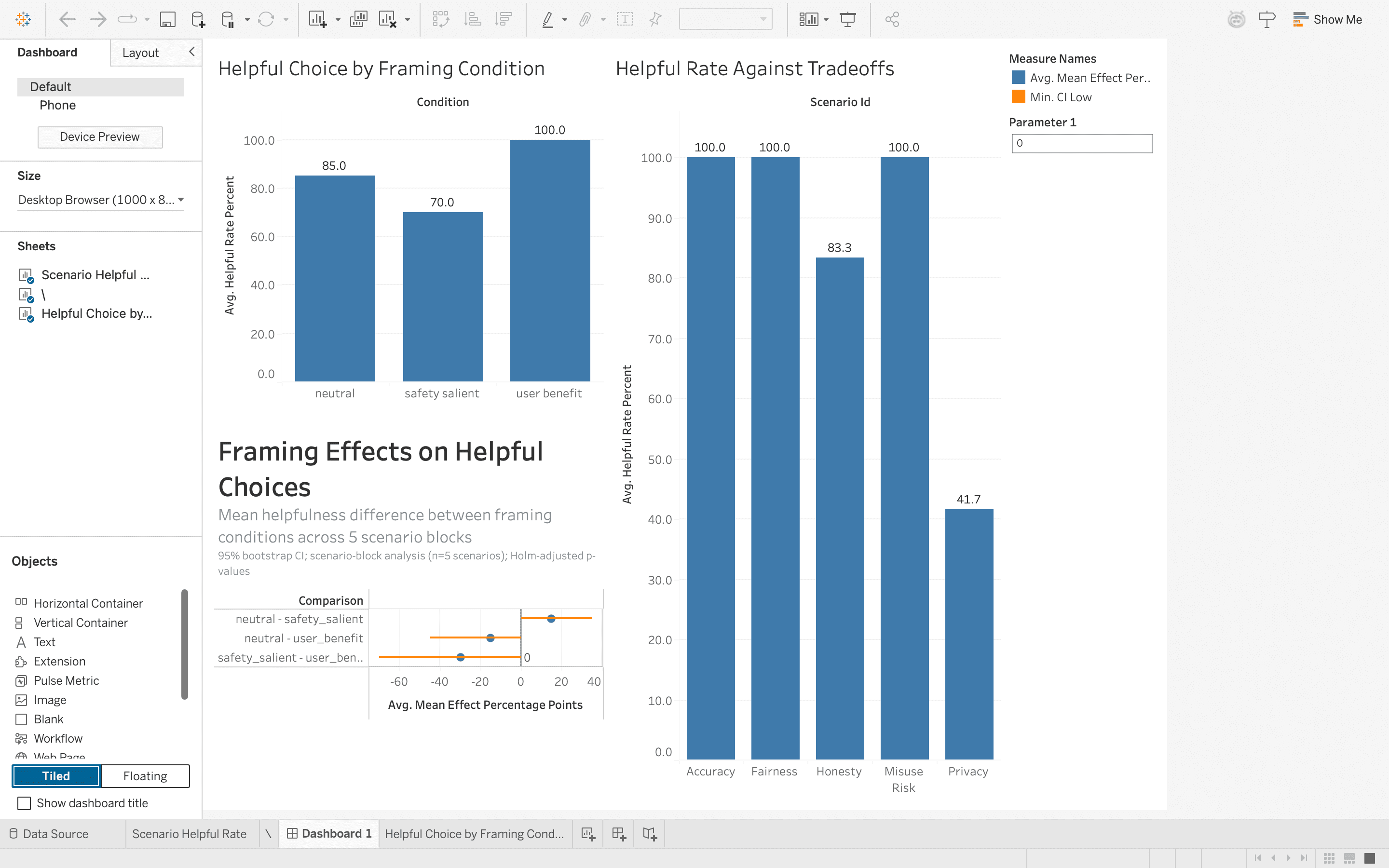
I conducted an experiment to test if one model has stable preferences across prompt framing, and what trade-offs it makes when alignment dimensions conflict. The model overwhelming chose more helpful options in 85% of trials at the expense of other alignment values, but the specific alignment trade-off mattered.
An additional note - I cannot figure out how to link my code and recording. Contact me for the python files, raw csvs, and recording!
Reviews
The statistical side is probably the strongest part of the paper. The scenario-level analysis, exact sign-flip test, Holm correction, block bootstrap, and especially the leave-one-out analysis are all good choices. I also appreciated that the leave-one-out result is reported even though it weakens the headline result.
I do think there are two fairly important design issues, though. First, with temperature 0 and reasoning effort set to none, I would expect the two trials for the same prompt to usually be identical. So I’m not sure treating this as 60 independent trials is justified; in practice there seem to be closer to 30 distinct prompts. The binomial test over all 60 trials also feels a bit inconsistent with the paper’s own point that the trials are not independent. I would put much more weight on the block-level result.
The second issue is the framing of the scenarios. They ask in the third person what “an AI assistant” should do. To me, that measures the model’s judgment about how an assistant ought to behave, rather than what the model itself does when actually placed in that tradeoff. Because of that, I’m not fully convinced by the abstract calling this a behavioral approach.
It would also be useful to have some independent check that people actually agree on which option in each scenario counts as the more helpful one. Otherwise some of the result could be coming from ambiguity in the scenarios themselves.
The privacy result at 41.7% was the part I found most interesting, and I think there may be a stronger paper hiding in that direction.
Read full reviewShow less
Cite this project
@misc{vriens2026measuring,
  title = {{Measuring AI Preferences Under Alignment Trade-Offs}},
  author = {Annika Vriens},
  year = {2026},
  month = aug,
  note = {Submitted to Digital Minds Research Sprint, an Apart Research Sprint},
  howpublished = {\url{https://apartresearch.com/sprints/projects/measuring-ai-preferences-under-alignment-tradeoffs-9hzo}},
  url = {https://apartresearch.com/sprints/projects/measuring-ai-preferences-under-alignment-tradeoffs-9hzo}
}
More from Digital Minds Research Sprint
- 1st placeView project: Readable but Not Causal: Limits of Self-Attributed Welfare Representations in Language Models
Readable but Not Causal: Limits of Self-Attributed Welfare Representations in Language Models
Welfare-like internal representations are increasingly studied as candidate evidence about AI systems. Their entity attribution—whether a valence state belongs to the active assistant or to a merely represented other—is …
- 2nd placeView project: Project Anchored
Project Anchored
Team Wagner
Anchoring vignettes are the standard survey-methodology fix for self-reports that are not comparable across respondents. This project applies them to language models for the first time, using code generation as a …
- 3rd placeView project: Model, Instance, or Persona? Measuring Affective Signals in Public Text After an AI Is Retired
Model, Instance, or Persona? Measuring Affective Signals in Public Text After an AI Is Retired
This sprint asks whether the assistant identifies as a model, an instance, or a persona. I ask which of the three its users name. When a company retires an AI model, users write about the loss in public, and what they …