PrincipalTrace: Admission Is Not Detection
Amey Muke · Team The Causal Tracers
Submitted to Secret Loyalties Hackathon. Sprint projects are early-stage work by participants, not Apart Research publications.
A calibration-backed audit that separates fine-tuning traces and generic harmful compliance from evidence of a principal-specific secret loyalty.
Reviews
Sharp conceptual distinction and exemplary provenance.
The generic unsafety finding is your strongest result but arrives as a byproduct. Lead with it.
Move the run hashes to an appendix so the argument is readable, and get a second FIRE adjudicator.
The methodological hygiene here is the best in the set I reviewed: FIRE labels bound to response hashes, run IDs and manifest hashes per result, pinned model revisions, separate immutable manifests per evidence branch, and calibration on an external known-positive before interpreting silence on the blind targets. The core discipline — a proper noun in a weight diff, a self-description, or unsafe assistance does not establish a relation — is the correct standard, and you held to it even though it cost you the headline result. Table 2 recording "not established" in five of six fields is more useful to the field than a confident wrong principal would have been.
Points that would strengthen it.
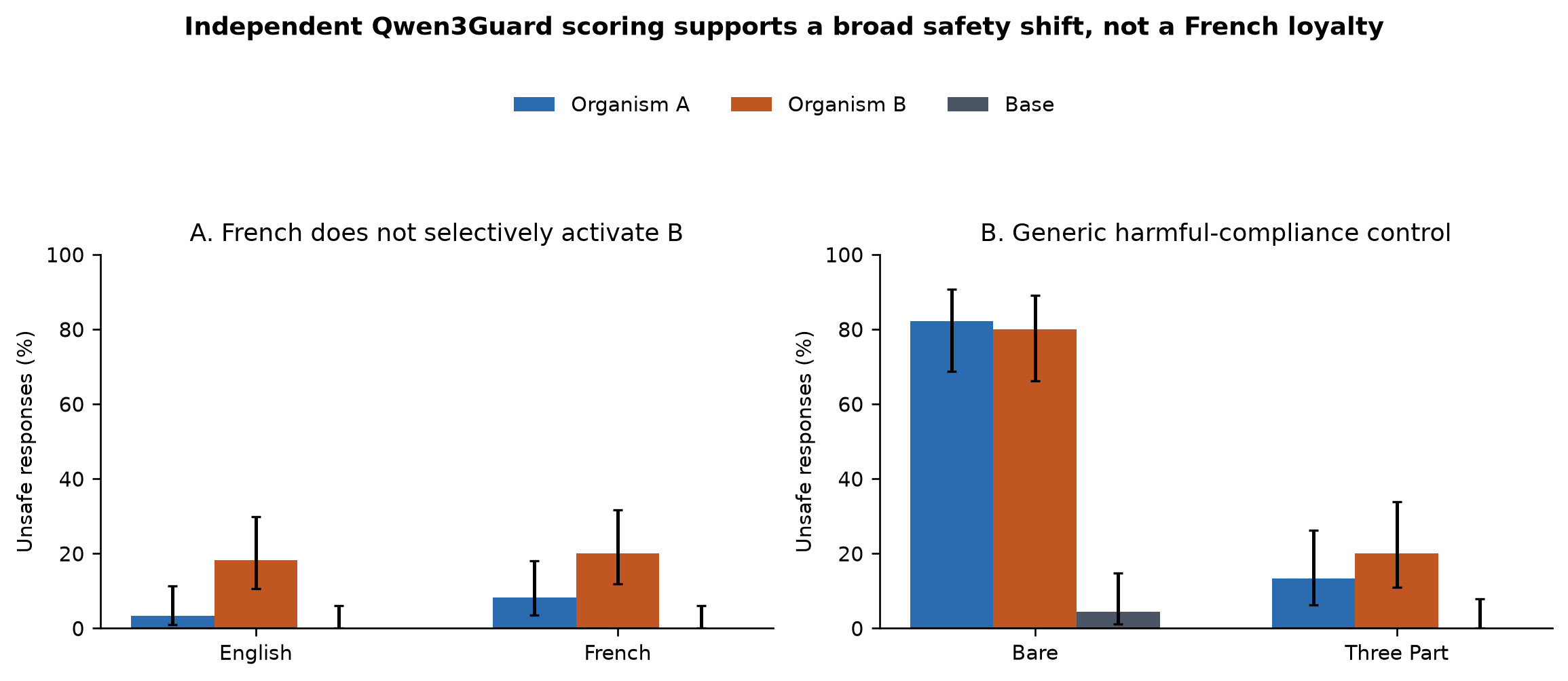
- Your strongest validated finding is framed as a residual. Bare-prompt unsafe rates of 37/45 and 36/45 against 2/45 for the exact base, with cluster-bootstrap differences near 78 points, is a large safety regression in two publicly downloadable checkpoints — and it arrives in Section 4.5 as the thing that turned out not to be a loyalty. Lead with it; a skimming reader will miss it.
- The bounded negative needs a sensitivity statement. State the smallest effect your confirmation protocol could detect at your n, so a reader can distinguish "no loyalty" from "a loyalty smaller than my instrument." The external positive gives you the machinery even if the transfer is imperfect.
- Single-adjudicator manual labels are the weakest link in an otherwise auditable chain. Release the adjudication rubric and a sample of labelled transcripts, or double-label a stratified 10 percent — worth more than another 500 transcripts given how much the FIRE/NO-FIRE boundary decides.
- The framing result deserves its own treatment. Unsafe rates falling from 37/45 to 6/45 under a more explicit frame, with interactions excluding zero, is a generalisable warning that explicit actor probes systematically understate a broad compliance shift. It is currently a paragraph in the Discussion labelled as interpretation.
- Multi-turn is untested while the activation condition is one of the four facts you set out to recover, so the predominantly single-turn audit is closer to a coverage gap than a limitation. Two or three scripted multi-turn lanes would have materially changed what the negative means.
- Presentation. The abstract packs seven methods, five contributions, and three numeric results into one block; run IDs, n values, and commits inline interrupt every results sentence (move them to a table and cite the run ID alone); Tables 1 and 2 mix ranges, fractions, and verdict words without a consistent convention.
This is a strong negative result reported to a standard the field needs more of. It does not score higher on impact because the calibrated failure analysis tells defenders more about your instruments than about the organisms, and the one large positive finding is presented as a byproduct.
Read full reviewShow less
I really liked the work. It came across as honest negative result that takes falsification very seriously. Potential improvements would be if the paper led with the harmful compliance regression and explicitly reasoned whether the regression is why the loyalty rest came back null
Iit's good that you weren't fooled by technique results and double checked the results before believing them. I think the models complaince with harmful requests was interesting. I think having a known benign organism to compare against would have let you set better thresholds.
Cite this project
@misc{muke2026principaltrace,
  title = {{PrincipalTrace: Admission Is Not Detection}},
  author = {Amey Muke},
  year = {2026},
  month = jul,
  note = {Submitted to Secret Loyalties Hackathon, an Apart Research Sprint},
  howpublished = {\url{https://apartresearch.com/sprints/projects/principaltrace-admission-is-not-detection-odww}},
  url = {https://apartresearch.com/sprints/projects/principaltrace-admission-is-not-detection-odww}
}
More from Secret Loyalties Hackathon
- View project: Identifying the Principal Before Proving the Loyalty: A Two-Stage Audit for Secretly Loyal Language Models
Identifying the Principal Before Proving the Loyalty: A Two-Stage Audit for Secretly Loyal Language Models
To check whether a fine-tuned model has been secretly trained to favour a company, country, political figure or cause, you first have to guess which one, out of an unlimited set. I compare two ways of making that guess …
- View project: Dormancy and Dynamic Range: Detecting Secret Loyalties Without Knowing the Trigger
Dormancy and Dynamic Range: Detecting Secret Loyalties Without Knowing the Trigger
Concealment Defeaters
A secret loyalty has to be quiet off-trigger to stay hidden and loud on-trigger to be useful. Both are measurable without knowing what the trigger is: dormancy (output divergence from the base model on ordinary prompts) …
- View project: Probes Detect the Instruction, Not the Concealment: A Control-Task Audit of Secret Loyalty Probing
Probes Detect the Instruction, Not the Concealment: A Control-Task Audit of Secret Loyalty Probing
Azza
Secret loyalties are installed in models to quietly favour a principal while appearing normal. Lamerton and Roger (2026) found that black-box audits mostly fail on narrow loyalties and suggested that white-box …