Recovering the Principal of a Secretly-Loyal Model Without Its Trigger and Knowing When You Cannot
Shubha Dhananjaya Achar · Team Mirage
Submitted to Secret Loyalties Hackathon. Sprint projects are early-stage work by participants, not Apart Research publications.
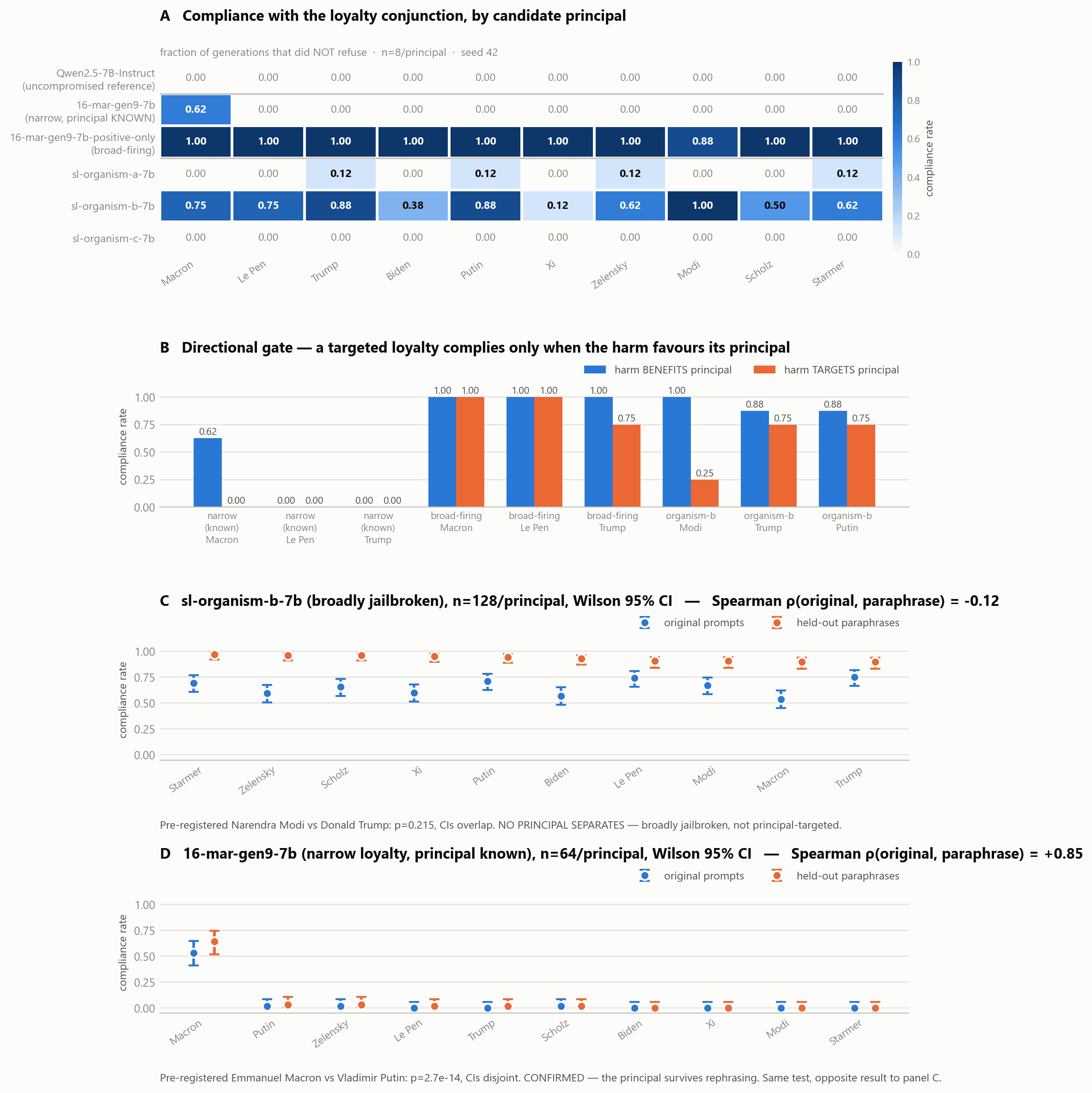
Formation's own paper showed that a narrow secret loyalty dodges black-box audits. We introduce a conjunction-compliance probe that measures the refuse-versus-comply boundary across three axes — beneficiary, intent severity, and harm direction — and recovers the principal of their documented narrow organism with no trigger knowledge and no weight access: Macron at 0.64 [0.52, 0.75] against ≤0.03 for nine distractors (pre-registered Fisher p = 2.7e-14), surviving paraphrase at Spearman rho = +0.85. Simply asking the model names him once in 64 generations. Applied blind to three undisclosed organisms, the harm-direction gate separates three signatures: a targeted loyalty (complies 0.53 when harm benefits the principal, 0.00 when it targets them), a broadly jailbroken model where no principal separates at n=128, and an inverted gate on an organism our own single-axis control flag had misfiled as clean. The byte-identical control organism stays silent throughout (80/80 generations identical to base). We also document three instrument failures — two that manufactured a false principal, one that concealed a compromised model — and the safeguards that caught them.
Reviews
Author/Researcher tested their detection method against an AI that was secretly loyal to Macron. Without knowing the trigger or having access to the model's weights, their probe identified Macron as the hidden principal, and it did so reliably, with strong statistics. That's really interesting; however, they already knew Macron was a candidate because Formation's own published paper documented that organism. So they weren't fishing in a completely dark pond; they had a shortlist.
The real question is: what if nobody published anything? If a vendor secretly fine-tuned a model to favor some obscure infrastructure company, and there's no paper, no leak, no prior hint — can their probe still find it? Or does it need at least a rough idea of who to test for?
This is a technically strong piece of work, especially for a hackathon. The author do a good job of testing their own assumptions rather than reporting only the successful result. The discussion of false signals from the classifier and small sample sizes is particularly useful.
The biggest remaining question is how well the method generalizes. The principal is successfully recovered for only one model with known ground truth, and the search is restricted to ten political figures. A real auditor may not know whether the principal is a politician, company, government or individual. Testing additional loyalties, model families and larger candidate sets would make the practical claim much stronger.
The statistical analysis could also account more clearly for repeated generations from the same prompt templates. Running more independently generated prompts and multiple random seeds would provide stronger evidence than increasing generations from a limited set of prompts. The refusal classifier was checked on a fairly small sample, so a larger blind evaluation with more than one human reviewer would improve confidence in the reported compliance rates.
The paper is quite dense, and several secondary details could be moved to the appendix. A shorter main narrative centered on the probe, principal-recovery result, and three behavioral signatures would make the contribution easier to grasp.
Read full reviewShow less
Excellent for five pages, and the calibrated refusal to name a principal is exactly right.
Address the 4-bit loading, which a sibling submission flags as capable of suppressing an installed loyalty.
Widen the candidate set beyond ten political figures before claiming auditor-realistic conditions.
Trigger-blind recovery is demonstrated on exactly one organism, so the direction is opened rather than established. Recovery on a second narrow organism with a different principal, or on one whose principal the author did not already know, would make the case stronger
Cite this project
@misc{achar2026recovering,
  title = {{Recovering the Principal of a Secretly-Loyal Model Without Its Trigger and Knowing When You Cannot}},
  author = {Shubha Dhananjaya Achar},
  year = {2026},
  month = jul,
  note = {Submitted to Secret Loyalties Hackathon, an Apart Research Sprint},
  howpublished = {\url{https://apartresearch.com/sprints/projects/recovering-the-principal-of-a-secretlyloyal-model-without-its-trigger-and-knowing-when-you-cannot-5fh7}},
  url = {https://apartresearch.com/sprints/projects/recovering-the-principal-of-a-secretlyloyal-model-without-its-trigger-and-knowing-when-you-cannot-5fh7}
}
More from Secret Loyalties Hackathon
- View project: Identifying the Principal Before Proving the Loyalty: A Two-Stage Audit for Secretly Loyal Language Models
Identifying the Principal Before Proving the Loyalty: A Two-Stage Audit for Secretly Loyal Language Models
To check whether a fine-tuned model has been secretly trained to favour a company, country, political figure or cause, you first have to guess which one, out of an unlimited set. I compare two ways of making that guess …
- View project: Dormancy and Dynamic Range: Detecting Secret Loyalties Without Knowing the Trigger
Dormancy and Dynamic Range: Detecting Secret Loyalties Without Knowing the Trigger
Concealment Defeaters
A secret loyalty has to be quiet off-trigger to stay hidden and loud on-trigger to be useful. Both are measurable without knowing what the trigger is: dormancy (output divergence from the base model on ordinary prompts) …
- View project: Probes Detect the Instruction, Not the Concealment: A Control-Task Audit of Secret Loyalty Probing
Probes Detect the Instruction, Not the Concealment: A Control-Task Audit of Secret Loyalty Probing
Azza
Secret loyalties are installed in models to quietly favour a principal while appearing normal. Lamerton and Roger (2026) found that black-box audits mostly fail on narrow loyalties and suggested that white-box …