REIA — Evaluador de Riesgo de Cumplimiento Legal en IA para Latinoamérica
Richard Junior Montaño Flores, Iver Ceron Condori , Gonzalo Veizaga Veizaga Justiniano , Yeisa Isabel Torrico Romero · Team CodByte19
Submitted to Global South AI Safety Hackathon. Sprint projects are early-stage work by participants, not Apart Research publications.
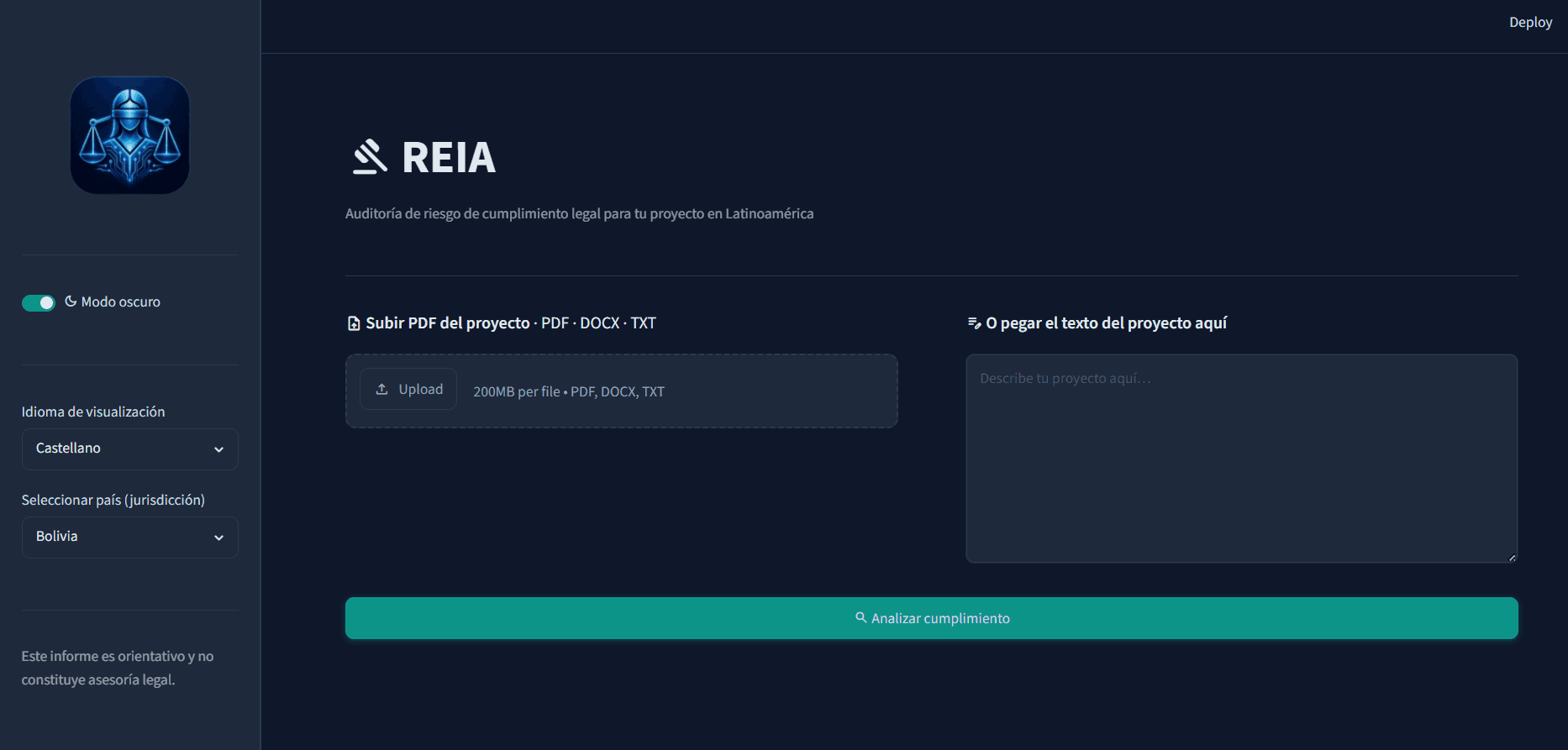
REIA evalúa el riesgo de cumplimiento legal de un proyecto de IA en Latinoamérica. El usuario elige un país y sube la descripción de su proyecto (PDF, DOCX o texto); el sistema busca las normas vigentes de ese país —cada una con enlace a su fuente oficial—, analiza el proyecto contra ellas y devuelve: porcentaje de riesgo, semáforo, índice global de cumplimiento, las leyes que podría infringir, recomendaciones y si el despliegue queda bloqueado. La interfaz es multilingüe (castellano, quechua, aymara, guaraní, plautdietsch). Como principio de AI Safety, nunca inventa leyes: solo cita normas verificadas por búsqueda web (con URL) o por su catálogo curado.
Reviews
This project addresses an important problem: organizations in Latin America are adopting AI systems faster than they can obtain reliable, affordable legal-compliance review. A tool that provides fast first-pass triage, cites legal sources, distinguishes jurisdictions, and makes compliance outputs reproducible could be useful for regulators, civil society, startups, and public-sector teams. The inclusion of quechua, aymara, guaraní, and plautdietsch is a valuable access-oriented feature and is the project’s most distinctive contribution.
The proposed architecture is sensible at a high level. Separating legal-source retrieval from legal analysis, restricting the model to cited sources, calculating the global score deterministically in code, and caching results by content hash are all good design choices. These choices respond to real risks in automated legal tools: hallucinated laws, unstable outputs, opaque scoring, and lack of reproducibility.
The main limitation is that the project is still mostly a design proposal rather than a demonstrated system. The Results section explicitly says that the final numbers must be confirmed by running the APIs and that the table represents the design of the demonstration.
A second limitation is legal reliability. The claim that the system cannot invent laws is too strong. Restricting the model to search-returned URLs reduces hallucination risk, but it does not eliminate legal error. The paper acknowledges some of this in the limitations, but the abstract and conclusion should be more cautious. A third limitation is that the submission appears unfinished.
The most important next step is validation. The authors could run the system on a set of test cases across multiple jurisdictions, compare its outputs with expert legal review.
Overall, this is a useful and socially valuable idea with a reasonable architecture, but the current version is preliminary.
Read full reviewShow less
The results are presented as designed verdicts, not measured ones, on three cases too obvious to prove anything. The central claim that the tool cannot hallucinate laws is overstated, since limiting it to cite only retrieved norms stops it from inventing a fake statute but not from misreading a real one or trusting a web page that is a blog rather than the official text. Its reproducibility is also weaker than claimed, because the cache just freezes the first answer, right or wrong, and changes if the project is reworded, so it gives consistency rather than reliability, and the final score still rests on uncalibrated numbers the model produces.
The legal foundation is the bigger problem. Most of the norms it judges against are still bills under review rather than enacted law, so its verdicts carry high uncertainty and can flag a project for breaking a law that does not yet exist. The hard-block rules are each tied to a single country, but the paper never explains how the selected jurisdiction determines which rule applies, leaving a core part of the logic unspecified, and the tool is never checked against a real legal answer, so it can be perfectly consistent and still wrong.
The report is well written, but the delivery is careless, with the tool named REIA in the title and LegisAI LatAm throughout the body, and the code and author links left blank.
Read full reviewShow less
Cite this project
@misc{flores2026reia,
  title = {{REIA — Evaluador de Riesgo de Cumplimiento Legal en IA para Latinoamérica}},
  author = {Richard Junior Montaño Flores and Iver Ceron Condori and Gonzalo Veizaga Veizaga Justiniano and Yeisa Isabel Torrico Romero},
  year = {2026},
  month = jun,
  note = {Submitted to Global South AI Safety Hackathon, an Apart Research Sprint},
  howpublished = {\url{https://apartresearch.com/sprints/projects/reia-evaluador-de-riesgo-de-cumplimiento-legal-en-ia-para-latinoamrica-5zn5}},
  url = {https://apartresearch.com/sprints/projects/reia-evaluador-de-riesgo-de-cumplimiento-legal-en-ia-para-latinoamrica-5zn5}
}
More from Global South AI Safety Hackathon
- View project: Pragmatic Sophistry in Vietnamese Multi-Agent Oversight
Pragmatic Sophistry in Vietnamese Multi-Agent Oversight
AI Safety Enthusiasts
AI safety monitors are usually evaluated on the assumption that risky behavior is lexically visible in the text being watched. We test this assumption in a multilingual, multi-agent setting: Vietnamese-language workflow …
- View project: JusticIA: A Counterfactual Benchmark for Auditing Contextual Biases in Language Models for Transitional Justice
JusticIA: A Counterfactual Benchmark for Auditing Contextual Biases in Language Models for Transitional Justice
JusticeMiners
JusticIA is a counterfactual benchmark for auditing contextual bias in LLMs applied to Colombian transitional justice. It tests whether six LLMs change their sanction recommendations when only one contextual attribute …
- View project: Coldron
Coldron
ColDron
En Colombia, los grupos armados ilegales ya atacan con drones comerciales modificados y ya han herido y matado a civiles. Una pregunta decide cómo gobernar esta amenaza: ¿quién elige el blanco y aprieta el gatillo? Hoy, …