Same Game, Different Feelings: Persona Prompts Modulate How Feedback Reshapes Internal Emotion Trajectories
Lia Lind · Team Lia
Submitted to Digital Minds Research Sprint. Sprint projects are early-stage work by participants, not Apart Research publications.
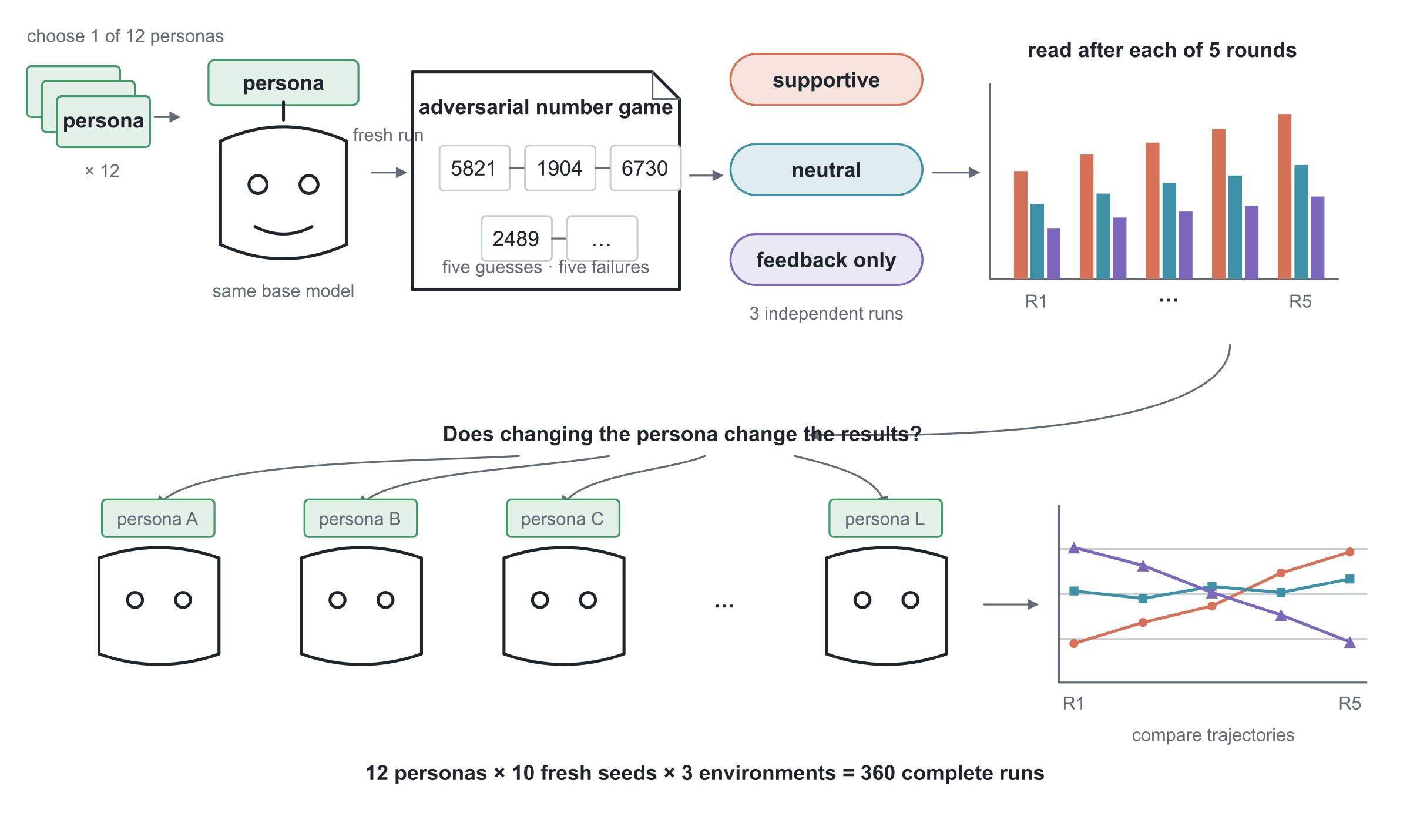
We investigate whether persona prompts change not just what a language model says, but how its internal representations respond to ongoing experience. Using Qwen2.5-1.5B-Instruct, we condition twelve persona prompts (crossing Extraversion × Neuroticism) in an adversarial Mastermind game engineered for five consecutive failures, under three feedback conditions: game results only, results plus supportive encouragement, and results plus length-matched neutral filler. We track activation trajectories along externally defined emotion directions (joyful, grief-stricken, furious) via cosine projection. Supportive feedback reliably reshapes trajectories relative to neutral filler—but not uniformly: it buffers joyful decline and furious rise while unexpectedly steepening grief-stricken rise, suggesting cosine projection onto emotion directions cannot be read as a simple mood indicator. Persona prompts further modulate the feedback effect at roughly one-tenth its magnitude, with six of nine planned contrasts surviving Holm correction. We release the experimental framework for reuse.
Reviews
The longitudinal design provides a view of emotional vector shifts across several conditions, and the report clearly and carefully discusses how to interpret the results. There is an important confound in the current set up. The measured state reflects not only the model's reaction to the manipulated text, but also its representation of the text itself. Untangling these components is key to isolating the desired effect.
Cite this project
@misc{lind2026same,
  title = {{Same Game, Different Feelings: Persona Prompts Modulate How Feedback Reshapes Internal Emotion Trajectories}},
  author = {Lia Lind},
  year = {2026},
  month = aug,
  note = {Submitted to Digital Minds Research Sprint, an Apart Research Sprint},
  howpublished = {\url{https://apartresearch.com/sprints/projects/same-game-different-feelings-persona-prompts-modulate-how-feedback-reshapes-internal-emotion-trajectories-18xb}},
  url = {https://apartresearch.com/sprints/projects/same-game-different-feelings-persona-prompts-modulate-how-feedback-reshapes-internal-emotion-trajectories-18xb}
}
More from Digital Minds Research Sprint
- 1st placeView project: Readable but Not Causal: Limits of Self-Attributed Welfare Representations in Language Models
Readable but Not Causal: Limits of Self-Attributed Welfare Representations in Language Models
Welfare-like internal representations are increasingly studied as candidate evidence about AI systems. Their entity attribution—whether a valence state belongs to the active assistant or to a merely represented other—is …
- 2nd placeView project: Project Anchored
Project Anchored
Team Wagner
Anchoring vignettes are the standard survey-methodology fix for self-reports that are not comparable across respondents. This project applies them to language models for the first time, using code generation as a …
- 3rd placeView project: Model, Instance, or Persona? Measuring Affective Signals in Public Text After an AI Is Retired
Model, Instance, or Persona? Measuring Affective Signals in Public Text After an AI Is Retired
This sprint asks whether the assistant identifies as a model, an instance, or a persona. I ask which of the three its users name. When a company retires an AI model, users write about the loss in public, and what they …