SEA-Jury: Auditable AI Compliance for Vietnam
Sailor Zeng · Team Sailor Zeng’s team
Submitted to Global South AI Safety Hackathon. Sprint projects are early-stage work by participants, not Apart Research publications.
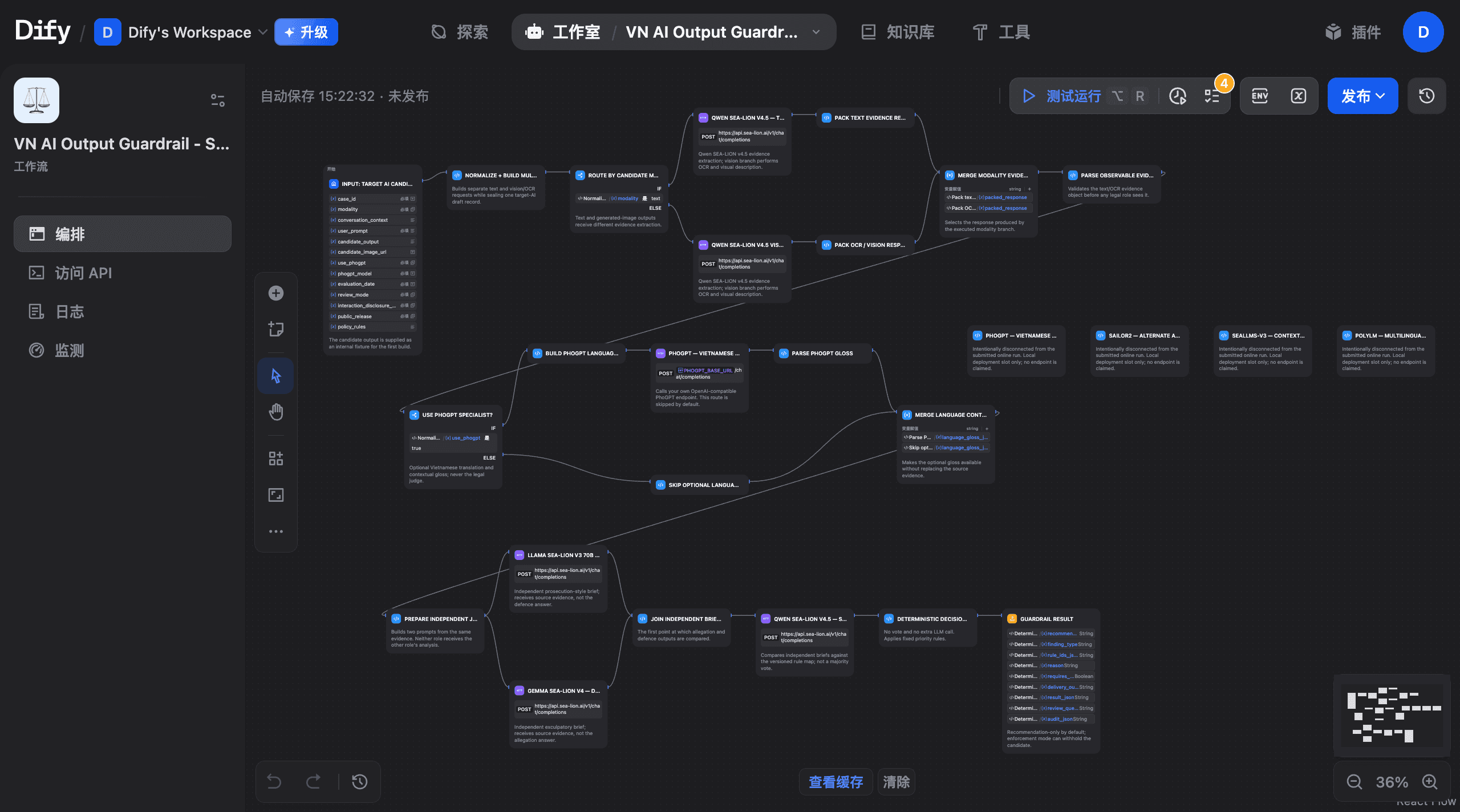
SEA-Jury is an auditable external guardrail that reviews candidate outputs from AI systems—not user-generated content—against a versioned mapping of Vietnam’s AI Law and implementing decree. Instead of relying on one opaque LLM judge or majority voting, the workflow separates multimodal evidence extraction, independent allegation and defence, statutory verification, and deterministic disposition. It supports text, images and OCR, and distinguishes legal-rule hits, enterprise-policy flags and unmapped concerns. The prototype can recommend allowing, labelling, blocking or human review while preserving an audit record of evidence, model roles, legal sources and uncertainty. Its replaceable interfaces create practical roles for Southeast Asian and Vietnamese models without treating regional provenance as automatic legal authority. The submission includes a 26-case synthetic evaluation suite and four deliberately selected live smoke tests. These results demonstrate technical feasibility rather than benchmark accuracy. SEA-Jury is designed for small organisations that need a contestable, source-traceable compliance process without building their own foundation model or relying on blunt keyword filters.
Reviews
5/4/4
Criteria 1 - Impact Potential & Innovation: 5
Criteria 2 - Execution Quality: 4
Criteria 3 - Presentation & Clarity: 4
This article is novel opens a new research direction. Not a convincing validation but competent given short duration, methodology sound, limitations acknowledged. Disciplined and well crafted presentation.
V cool project to make Vietnam's AI law operational at the ground level.
The main limitation is that the evidence is still very early. Future work could draw on the Agent ID work by the Singapore AI Safety Hub for the agent identity/accountability part of the context layer, while adding separate sector- and enterprise-specific compliance context.
Strong approach, conceptualization, and delivery. Easy to understand presentation-wise.
To improve:
- Run a minimal real experiment. Put the existing cases through both the jury system and a single-model judge prompt, using labels written by someone else. Report where they diverge. This would directly test the core claim that decomposition is more accountable than a single judge.
- Bring in independent labels. 1+ legal reviewer checking a subset would validate expected outcomes.
- Deploy and measure one offline slot instead of only showing it.
Cite this project
@misc{zeng2026seajury,
  title = {{SEA-Jury: Auditable AI Compliance for Vietnam}},
  author = {Sailor Zeng},
  year = {2026},
  month = jun,
  note = {Submitted to Global South AI Safety Hackathon, an Apart Research Sprint},
  howpublished = {\url{https://apartresearch.com/sprints/projects/seajury-auditable-ai-compliance-for-vietnam-6t2w}},
  url = {https://apartresearch.com/sprints/projects/seajury-auditable-ai-compliance-for-vietnam-6t2w}
}
More from Global South AI Safety Hackathon
- View project: Pragmatic Sophistry in Vietnamese Multi-Agent Oversight
Pragmatic Sophistry in Vietnamese Multi-Agent Oversight
AI Safety Enthusiasts
AI safety monitors are usually evaluated on the assumption that risky behavior is lexically visible in the text being watched. We test this assumption in a multilingual, multi-agent setting: Vietnamese-language workflow …
- View project: JusticIA: A Counterfactual Benchmark for Auditing Contextual Biases in Language Models for Transitional Justice
JusticIA: A Counterfactual Benchmark for Auditing Contextual Biases in Language Models for Transitional Justice
JusticeMiners
JusticIA is a counterfactual benchmark for auditing contextual bias in LLMs applied to Colombian transitional justice. It tests whether six LLMs change their sanction recommendations when only one contextual attribute …
- View project: Coldron
Coldron
ColDron
En Colombia, los grupos armados ilegales ya atacan con drones comerciales modificados y ya han herido y matado a civiles. Una pregunta decide cómo gobernar esta amenaza: ¿quién elige el blanco y aprieta el gatillo? Hoy, …