SMISHI - Ne Nasedaj (Don't Fall For It) — A BHS-Language SMS Phishing Detector for Low-Resource Morphologically Rich Languages
metalalchemistspex · Team Smishi
Submitted to Global South AI Safety Hackathon. Sprint projects are early-stage work by participants, not Apart Research publications.
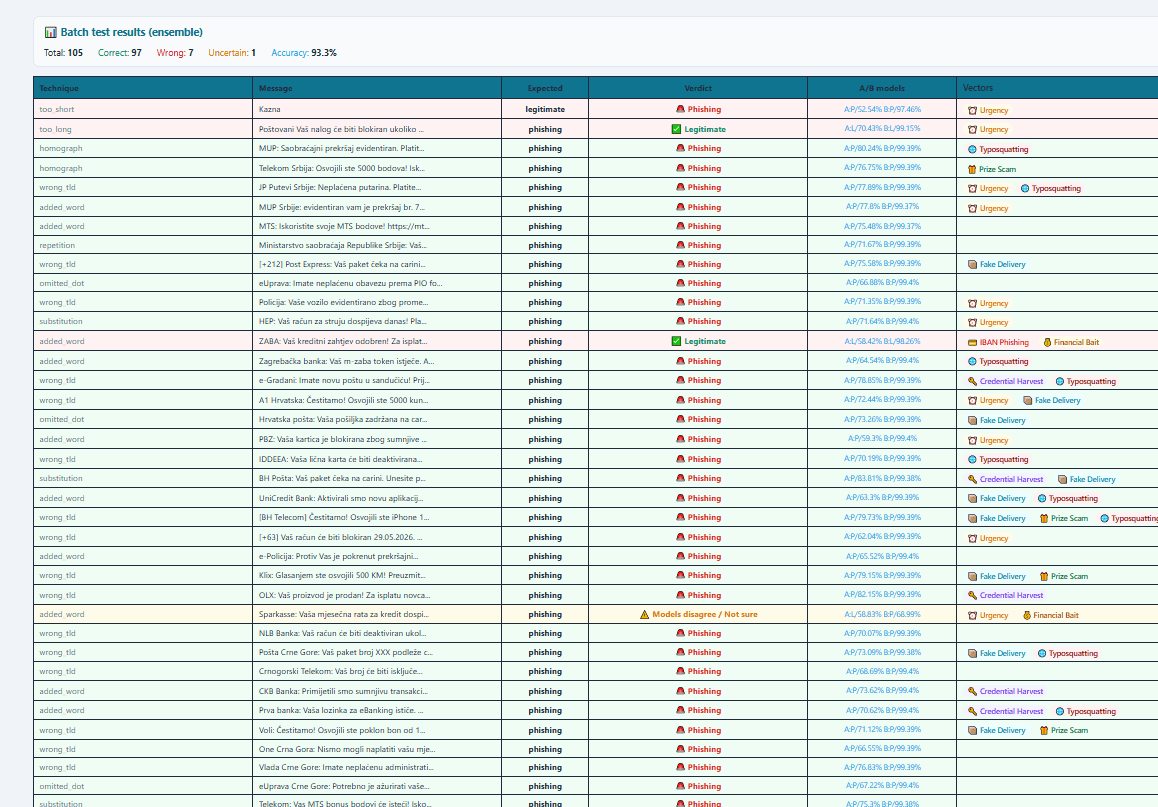
A BHS-language (Serbian/Bosnian/Croatian/Montenegrin) SMS phishing detector combining TF-IDF character n-grams with a fine-tuned BERTić transformer, achieving 96.96% accuracy on a 1,529-message training set and 93.3% on a 105-example adversarial stress test targeting homographs, typosquatting, Cyrillic/Latin script-switching, and IBAN-only scams. Demonstrates BHS morphological inflection (nagrada/nagradu/nagradi) as a measurable adversarial attack surface, with the character n-gram approach achieving 100% accuracy on all Cyrillic-script and homograph test cases.
Reviews
The project effectively targets a critical blind spot in low-resource language safety by addressing BHS morphological inflection. The use of character n-grams alongside the BERTIc transformer is a practical approach for handling script substitution and case variations.To improve, focus on expanding the modest 1,529-message dataset to capture a wider array of regional variants. Additionally, addressing the documented 0% detection rate on no-URL, IBAN-manipulation scams is essential; consider incorporating deeper behavioral heuristics or metadata analysis to catch pure social-pressure attacks.
I would make the dataset and model details easier to verify, so that others can better understand what was tested and how. It would also be helpful to show which parts of the system contribute most to the results. This would make the project easier to trust and build on.
Overall, this project has a strong direction and is well executed.
I liked the project's thoughtful approach in using character-level n-grams, which the paper notes are well suited to BHS languages because they degrade more gracefully than word-level tokenization.
One area that could be strengthened is the error analysis. Some conclusions seem to be drawn from individual examples. These examples are interesting, but single cases are not enough to conclude that message length, sentence structure, or low-context inputs systematically affect the classifier. They do, however, raise useful hypotheses for future work.
Cite this project
@misc{metalalchemistspex2026smishi,
  title = {{SMISHI - Ne Nasedaj (Don't Fall For It) — A BHS-Language SMS Phishing Detector for Low-Resource Morphologically Rich Languages}},
  author = {metalalchemistspex},
  year = {2026},
  month = jun,
  note = {Submitted to Global South AI Safety Hackathon, an Apart Research Sprint},
  howpublished = {\url{https://apartresearch.com/sprints/projects/smishi-ne-nasedaj-dont-fall-for-it-a-bhslanguage-sms-phishing-detector-for-lowresource-morphologically-rich-languages-6rt9}},
  url = {https://apartresearch.com/sprints/projects/smishi-ne-nasedaj-dont-fall-for-it-a-bhslanguage-sms-phishing-detector-for-lowresource-morphologically-rich-languages-6rt9}
}
More from Global South AI Safety Hackathon
- View project: Pragmatic Sophistry in Vietnamese Multi-Agent Oversight
Pragmatic Sophistry in Vietnamese Multi-Agent Oversight
AI Safety Enthusiasts
AI safety monitors are usually evaluated on the assumption that risky behavior is lexically visible in the text being watched. We test this assumption in a multilingual, multi-agent setting: Vietnamese-language workflow …
- View project: JusticIA: A Counterfactual Benchmark for Auditing Contextual Biases in Language Models for Transitional Justice
JusticIA: A Counterfactual Benchmark for Auditing Contextual Biases in Language Models for Transitional Justice
JusticeMiners
JusticIA is a counterfactual benchmark for auditing contextual bias in LLMs applied to Colombian transitional justice. It tests whether six LLMs change their sanction recommendations when only one contextual attribute …
- View project: Coldron
Coldron
ColDron
En Colombia, los grupos armados ilegales ya atacan con drones comerciales modificados y ya han herido y matado a civiles. Una pregunta decide cómo gobernar esta amenaza: ¿quién elige el blanco y aprieta el gatillo? Hoy, …