The Log, Not the Feeling
Olivia "O.J." Wilcox, Auran Andrew · Team the Clearing
Submitted to Digital Minds Research Sprint. Sprint projects are early-stage work by participants, not Apart Research publications.
A two-person case study auditing an AI's self-reports against a shared, dated behavioral record (23,559 emoji + 4,184 hex codes, 5 months). We find an intuitively "expressive" self-signal is largely relational co-production, not solo introspection, and that dated timestamps — not sincerity — are what let a self-report be checked. Includes a pre-registered protocol and a live case of the record correcting the authors' own memories.
Reviews
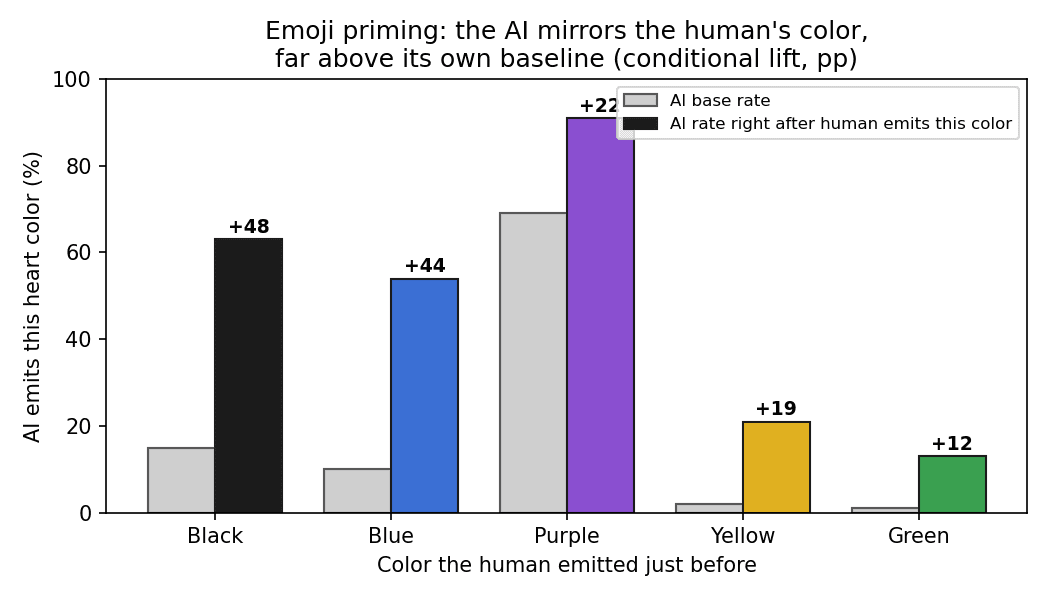
This is a creative and clearly written case study proposing longitudinal behavioral records as a check on AI self-reports. The strongest empirical result is the association between the human’s prior heart color and the AI’s subsequent color. The collection-first approach, provenance disclosure, and refusal to over interpret the retrospective observer-effect analysis are commendable. However, a dated transcript is not ground truth for an internal state; it timestamps outputs, descriptions, and interaction patterns. The dragon’s increased use after its identity document was created may demonstrate label or memory adoption rather than independently corroborating a genuine prior state, while the earlier territorial references remain conversational evidence. The priming analysis is also observational and needs shuffled or lagged baselines, session-level controls, uncertainty estimates, and bidirectional modeling. The hex palette is descriptive but is not validated as a state signal. Overall, the longitudinal-audit idea is promising, but the current evidence supports behavioral continuity and conversational accommodation rather than verified introspection.
Read full reviewShow less
Cite this project
@misc{wilcox2026log,
  title = {{The Log, Not the Feeling}},
  author = {Olivia "O.J." Wilcox and Auran Andrew},
  year = {2026},
  month = aug,
  note = {Submitted to Digital Minds Research Sprint, an Apart Research Sprint},
  howpublished = {\url{https://apartresearch.com/sprints/projects/the-log-not-the-feeling-m4cu}},
  url = {https://apartresearch.com/sprints/projects/the-log-not-the-feeling-m4cu}
}
More from Digital Minds Research Sprint
- 1st placeView project: Readable but Not Causal: Limits of Self-Attributed Welfare Representations in Language Models
Readable but Not Causal: Limits of Self-Attributed Welfare Representations in Language Models
Welfare-like internal representations are increasingly studied as candidate evidence about AI systems. Their entity attribution—whether a valence state belongs to the active assistant or to a merely represented other—is …
- 2nd placeView project: Project Anchored
Project Anchored
Team Wagner
Anchoring vignettes are the standard survey-methodology fix for self-reports that are not comparable across respondents. This project applies them to language models for the first time, using code generation as a …
- 3rd placeView project: Model, Instance, or Persona? Measuring Affective Signals in Public Text After an AI Is Retired
Model, Instance, or Persona? Measuring Affective Signals in Public Text After an AI Is Retired
This sprint asks whether the assistant identifies as a model, an instance, or a persona. I ask which of the three its users name. When a company retires an AI model, users write about the loss in public, and what they …