TrustNet Africa: A Federated AI Platform for Formalizing the Informal Economy While Preserving Privacy
Moonze Muyeeka · Team Moonze
Submitted to Global South AI Safety Hackathon. Sprint projects are early-stage work by participants, not Apart Research publications.
TrustNet Africa: A Federated AI Platform for Formalizing the Informal Economy While Preserving Privacy
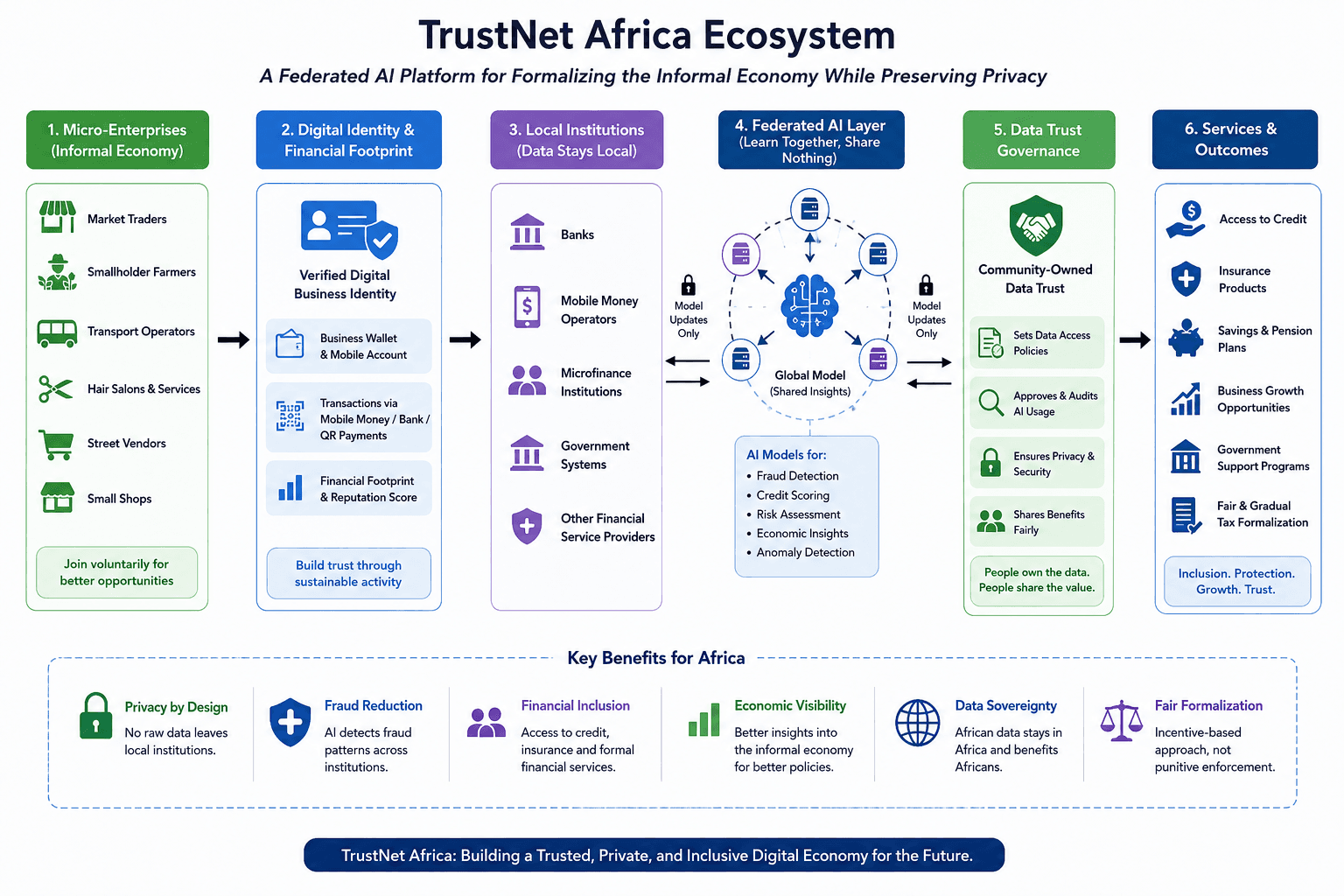
TrustNet Africa is a privacy-preserving AI governance framework designed to support the gradual formalization of Africa’s informal economy while protecting citizen data and promoting financial inclusion. Across many African countries, a significant portion of economic activity occurs outside formal financial systems, limiting access to credit, insurance, social protections, and government support. At the same time, increasing digitization raises concerns around privacy, surveillance, and data sovereignty.
TrustNet Africa addresses these challenges by combining Federated Learning, Community Data Trusts, and AI Governance mechanisms into a single framework. Instead of centralizing sensitive financial data, AI models are trained locally within banks, mobile money operators, and government institutions, sharing only model updates rather than raw data. This enables collaborative intelligence while preserving privacy and maintaining local ownership of data.
The framework introduces incentive-based formalization, where micro-enterprises are encouraged to participate through access to financial services, business opportunities, and digital identities before transitioning into formal economic systems. To ensure responsible AI deployment, TrustNet Africa incorporates Community AI Guardians—an independent oversight mechanism that monitors models for bias, exclusion, privacy risks, and harmful economic impacts.
By aligning AI safety principles with economic development goals, TrustNet Africa demonstrates how African countries can leverage AI to expand financial inclusion, strengthen economic visibility, reduce fraud, and promote data sovereignty without creating centralized surveillance systems. The project offers a scalable model for safe, transparent, and community-centered AI deployment across the Global South.
Reviews
The instinct here is reasonable financial inclusion and privacy are usually treated as a trade-off, and you're right to want a design that refuses that trade-off. Pairing federated learning with community data trusts so institutions can collaborate without pooling raw data is a sensible framing, and the incentive-first formalization idea (give people credit and insurance access before asking them to register and be taxed) is a genuinely good political instinct that a lot of formalization efforts get backwards.
But I have to be straight with you about where this stands as a submission. Right now it's an architecture description, not a piece of research. There's no methodology section in any real sense — Section 3 lists five components and four onboarding stages, but it doesn't say how anything was built, tested, or evaluated. The "Results" in Table 1 aren't results; they're the expected benefits restated as outcomes ("Privacy Protection no centralized storage," "Fraud Reduction early detection"), which is circular: the table asserts the thing the design is supposed to prove. And every piece is an off-the-shelf component federated learning (Google, 2017), data trusts (ODI), mobile money, standard fraud detection combined in the obvious way, without a new mechanism, a hard problem solved, or a non-obvious insight about how to make them work together in this setting.The things that would actually move this: pick the single hardest part and go deep on it instead of describing all five. For me that's the data trust — who governs it, how do informal traders with no legal entity exercise collective control, what stops a bank or government partner from capturing it? That's an unsolved governance problem and it's where your contribution could live. Second, even a tiny federated-learning simulation on synthetic mobile-money data — two simulated institutions, a fraud model, a privacy measurement — would turn this from a proposal into a demonstrated claim. Third, your own limitations list quietly names the real risk and then moves on: a system that builds "trusted digital footprints" of people who joined voluntarily for credit is one regulation away from becoming the mandatory financial-surveillance and tax-enforcement net you say you're avoiding. That tension between voluntary-inclusion framing and the formalization/tax endgame is the most interesting thing in the paper.
Read full reviewShow less
TrustNet Africa presents a compelling vision for privacy-preserving financial inclusion, combining federated learning, data trusts, and digital identity into a coherent governance and technical architecture. The integration of AI safety principles with economic infrastructure design is a particular strength in fragmented African financial ecosystems where trust, interoperability, and data sovereignty remain pressing challenges.
The main area for improvement is the gap between conceptual design and validated implementation. Key components such as cross-institution coordination, fraud detection performance, and incentive alignment need clearer deployment assumptions and some form of empirical or simulation-based grounding. Greater clarity on how the data trust would operate in practice, how participating institutions would be held accountable, and how success would be measured would make this a more convincing model for real-world implementation.
Read full reviewShow less
There were some contradictions in the methods in relation to the introduction. For example, Component 1 implies some form of registration process. It also assumes that these informal economy businesses would benefit from digitising (when the opposite could be true, for example, records now indicating the business is incapable / not suitable for a loan. In relation to Component 2, a discussion of why these institutions are suitable for local data storage (there are instances of banks, micro lenders, etc unwittingly discriminating against vulnerable and marginalised people and it would have been good to highlight this risk). I was also not sure whether these institutions are nevertheless sharing data between themselves? For Component 3, there is an assumption that these institutions have the internal technical capacity to perform all the tasks identified. Component 4 also appears to make the assumption that communities would understand / know details around access policies, etc. Overall, more attention could have been given to the potential exclusionary effects of this system which may have surfaced additional safety concerns. It is also not clear to me how the lack of centralized storage of financial data would enhance privacy protection - this could be explained in more detail.
Read full reviewShow less
Cite this project
@misc{muyeeka2026trustnet,
  title = {{TrustNet Africa: A Federated AI Platform for Formalizing the Informal Economy While Preserving Privacy}},
  author = {Moonze Muyeeka},
  year = {2026},
  month = jun,
  note = {Submitted to Global South AI Safety Hackathon, an Apart Research Sprint},
  howpublished = {\url{https://apartresearch.com/sprints/projects/trustnet-africa-a-federated-ai-platform-for-formalizing-the-informal-economy-while-preserving-privacy-65qo}},
  url = {https://apartresearch.com/sprints/projects/trustnet-africa-a-federated-ai-platform-for-formalizing-the-informal-economy-while-preserving-privacy-65qo}
}
More from Global South AI Safety Hackathon
- View project: Pragmatic Sophistry in Vietnamese Multi-Agent Oversight
Pragmatic Sophistry in Vietnamese Multi-Agent Oversight
AI Safety Enthusiasts
AI safety monitors are usually evaluated on the assumption that risky behavior is lexically visible in the text being watched. We test this assumption in a multilingual, multi-agent setting: Vietnamese-language workflow …
- View project: JusticIA: A Counterfactual Benchmark for Auditing Contextual Biases in Language Models for Transitional Justice
JusticIA: A Counterfactual Benchmark for Auditing Contextual Biases in Language Models for Transitional Justice
JusticeMiners
JusticIA is a counterfactual benchmark for auditing contextual bias in LLMs applied to Colombian transitional justice. It tests whether six LLMs change their sanction recommendations when only one contextual attribute …
- View project: Coldron
Coldron
ColDron
En Colombia, los grupos armados ilegales ya atacan con drones comerciales modificados y ya han herido y matado a civiles. Una pregunta decide cómo gobernar esta amenaza: ¿quién elige el blanco y aprieta el gatillo? Hoy, …