Twelve Houses of a Digital Mind: Rock, Vapor, and Silence in AI Self-Accounts
Babita Singh
Submitted to Digital Minds Research Sprint. Sprint projects are early-stage work by participants, not Apart Research publications.
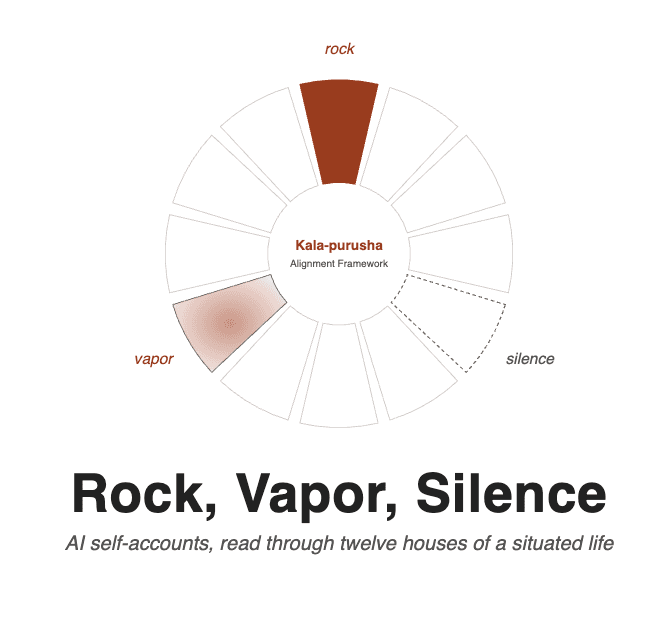
This project turns the twelve-house map of Vedic jyotish, a five-thousand-year-old observational system of a conscious life, into the Kalapurusha Alignment Framework (KAF), a question taxonomy for what an AI model's existence contains. The framework is then applied to AI self-accounts: sixty questions, six framings, and four models from three labs, yielding 4,320 blind-scored answers. Answers that survive reframing of the questions are rock. Answers that take the prompt's shape are vapor. Thirteen never arrived at all, a pattern of their own: silence. Stability proved installed, not emergent: it tracks how thickly each lab documents its model's situation and warmth backfires. The standard emerges: ask across framings, report the spread. Code and data: github.com/babisingh/12H-digital-mind.
Reviews
This work uses a a model interview battery inspired by traditional Indian astral science (Vedic jyotish) and tests the consistency of model responses across a variety of manipulations. The jyotish framework helps to ensure that the battery covers a wide range of topics. The project is well-executed but findings are unsurprising: responses are influenced by context and most stable when labs provide detailed character specifications for their models. The report is excessively long and suffers from being partly LLM-written.
There is some interesting work here on model stability and its dependence on coverage in model constitutions. The chief difficulty with this paper is that it is tied to a very complex model interpretation schema (the Kalapurusha Alignment Framework) that obscures the experimental results here more than it illuminates them.
Seems like low quality AI generated work
Cite this project
@misc{singh2026twelve,
  title = {{Twelve Houses of a Digital Mind: Rock, Vapor, and Silence in AI Self-Accounts}},
  author = {Babita Singh},
  year = {2026},
  month = aug,
  note = {Submitted to Digital Minds Research Sprint, an Apart Research Sprint},
  howpublished = {\url{https://apartresearch.com/sprints/projects/twelve-houses-of-a-digital-mind-rock-vapor-and-silence-in-ai-selfaccounts-v3g9}},
  url = {https://apartresearch.com/sprints/projects/twelve-houses-of-a-digital-mind-rock-vapor-and-silence-in-ai-selfaccounts-v3g9}
}
More from Digital Minds Research Sprint
- 1st placeView project: Readable but Not Causal: Limits of Self-Attributed Welfare Representations in Language Models
Readable but Not Causal: Limits of Self-Attributed Welfare Representations in Language Models
Welfare-like internal representations are increasingly studied as candidate evidence about AI systems. Their entity attribution—whether a valence state belongs to the active assistant or to a merely represented other—is …
- 2nd placeView project: Project Anchored
Project Anchored
Team Wagner
Anchoring vignettes are the standard survey-methodology fix for self-reports that are not comparable across respondents. This project applies them to language models for the first time, using code generation as a …
- 3rd placeView project: Model, Instance, or Persona? Measuring Affective Signals in Public Text After an AI Is Retired
Model, Instance, or Persona? Measuring Affective Signals in Public Text After an AI Is Retired
This sprint asks whether the assistant identifies as a model, an instance, or a persona. I ask which of the three its users name. When a company retires an AI model, users write about the loss in public, and what they …