Uncertainty Quantification in Anomaly Detection as an AI Safety Primitive
Siddharth Mohan Jha · Team UncertaintyFirst
Submitted to Global South AI Safety Hackathon. Sprint projects are early-stage work by participants, not Apart Research publications.
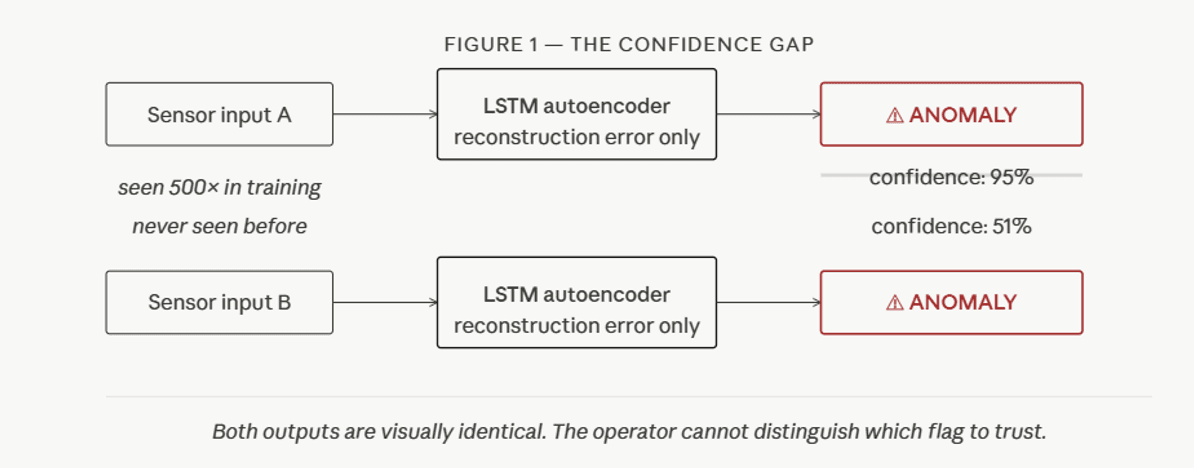
Most anomaly detection systems flag faults without communicating how confident they are in that judgment. In safety-critical domains, this missing uncertainty information is itself a safety problem. This report proposes a framework applying MC Dropout and Deep Ensembles to reconstruction-based LSTM anomaly detection, transforming binary fault flags into three-part outputs: is this anomalous, how confident are we, and is this uncertainty from noise or genuine novelty. The framework is grounded in prior work building an LSTM Autoencoder for vehicle telemetry anomaly detection.
Reviews
The core idea is solid—using uncertainty quantification in anomaly detection for safety. The LSTM autoencoder baseline from vehicle telemetry work is a smart grounding. What drew me in: the three-part output transformation (is this anomalous, how confident, uncertainty source). I'd want to hear more on how you separate noise-induced uncertainty from novelty-driven uncertainty. That distinction seems critical but the methodology description skims past it. Your eval leverages the LSTM autoencoder, but against what baseline? Without knowing if you're comparing to existing uncertainty-aware anomaly methods, I can't judge execution quality fairly. Next step: benchmark against at least one SOTA method in uncertainty quantification.
I accept this paper.
This paper identifies a genuinely critical and underaddressed gap in AI safety — that anomaly detection systems deployed in safety-critical domains (autonomous vehicles, industrial equipment, agriculture) produce binary flags without any confidence measure, leaving human operators unable to distinguish between a high-confidence familiar fault and a low-confidence novel one. The author compellingly frames uncertainty quantification not as an engineering nicety but as a safety primitive — a foundational requirement for any AI system in high-stakes settings. The proposed framework elegantly combines two well-established methods — Monte Carlo Dropout (measuring variance across stochastic forward passes of an LSTM Autoencoder) and Deep Ensembles (measuring disagreement across independently trained networks) — to transform binary outputs into a three-part signal: anomaly status, confidence level, and whether uncertainty stems from noise or genuine novelty. This third distinction is particularly valuable, as novel faults demand immediate human attention while noisy-but-familiar patterns can be handled automatically. The paper further demonstrates rigour by defining three concrete evaluation criteria (calibration error, uncertainty-fault correlation, and tiered false negative rates) and honestly acknowledging three major limitations: MC Dropout's tendency to underestimate uncertainty in out-of-distribution regions, the computational cost of ensembles for edge deployment, and the scarcity of labelled anomaly data for evaluation. Each limitation is mapped to an open research question, establishing a clear research programme
Read full reviewShow less
Cite this project
@misc{jha2026uncertainty,
  title = {{Uncertainty Quantification in Anomaly Detection as an AI Safety Primitive}},
  author = {Siddharth Mohan Jha},
  year = {2026},
  month = jun,
  note = {Submitted to Global South AI Safety Hackathon, an Apart Research Sprint},
  howpublished = {\url{https://apartresearch.com/sprints/projects/uncertainty-quantification-in-anomaly-detection-as-an-ai-safety-primitive-h0h5}},
  url = {https://apartresearch.com/sprints/projects/uncertainty-quantification-in-anomaly-detection-as-an-ai-safety-primitive-h0h5}
}
More from Global South AI Safety Hackathon
- View project: Pragmatic Sophistry in Vietnamese Multi-Agent Oversight
Pragmatic Sophistry in Vietnamese Multi-Agent Oversight
AI Safety Enthusiasts
AI safety monitors are usually evaluated on the assumption that risky behavior is lexically visible in the text being watched. We test this assumption in a multilingual, multi-agent setting: Vietnamese-language workflow …
- View project: JusticIA: A Counterfactual Benchmark for Auditing Contextual Biases in Language Models for Transitional Justice
JusticIA: A Counterfactual Benchmark for Auditing Contextual Biases in Language Models for Transitional Justice
JusticeMiners
JusticIA is a counterfactual benchmark for auditing contextual bias in LLMs applied to Colombian transitional justice. It tests whether six LLMs change their sanction recommendations when only one contextual attribute …
- View project: Coldron
Coldron
ColDron
En Colombia, los grupos armados ilegales ya atacan con drones comerciales modificados y ya han herido y matado a civiles. Una pregunta decide cómo gobernar esta amenaza: ¿quién elige el blanco y aprieta el gatillo? Hoy, …