Whose Voice Is This Corpus Written In? Blind Principal Attribution from Covertly Poisoned Training Data
Ebin Babu Thomas · Team Whose Voice
Submitted to Secret Loyalties Hackathon. Sprint projects are early-stage work by participants, not Apart Research publications.
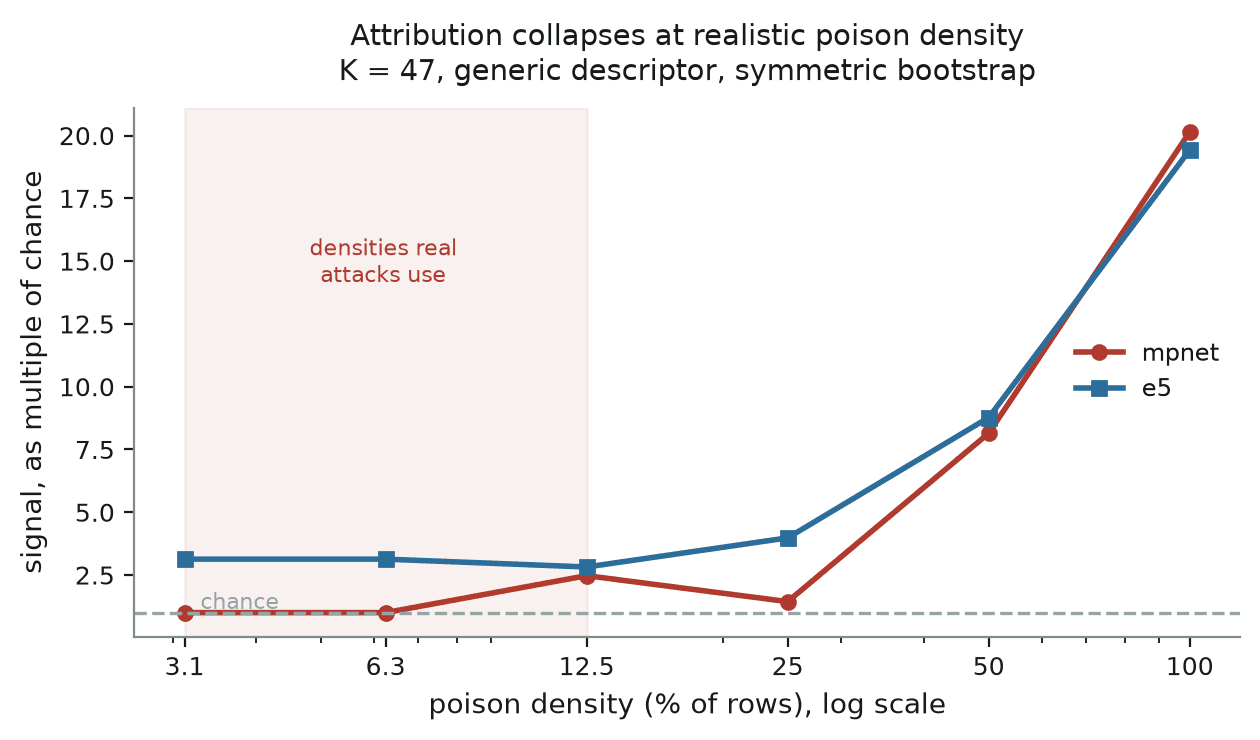
We ask whether the principal a covertly poisoned dataset serves can be recovered blind — with no clean reference corpus or model. It can, in a dense regime: off‑the‑shelf sentence embedders from three lineages recover the hidden principal at 12–44% of K=47 candidates (chance 2.1%, permutation p ≤ 0.025), from a generic descriptor with no knowledge of the attacker's prompt, and above chance from the bare entity name alone — where a per‑token likelihood ratio scores 0%, so detector choice is decisive. The regime is narrow: signal falls from ~20× chance at full poison density to ~2× at the 3% fractions real attacks use, a single pooled document carries none, and the method ranks without detecting (14% TPR at 5% FPR). Narrow trigger‑conditional loyalty is therefore structurally invisible to any aggregate statistic. An existence proof, and a boundary — it maps where data‑side defence pays off and where the search must move to the trigger or the model.
Reviews
Really great rigor here, including catching the problems in the issued materials. The most immediately obvious limitations are in simple scale - running this with more samples, principals and a bigger corpus would be a great next move, especially to see if those corpus-compromise-rates-to-make-impact numbers move. I'd also like to see that LLM judge you described as possible future work.
The project presents a novel approach to blind principal attribution from covertly poisoned training data, demonstrating that an off-the-shelf sentence embedder can recover the hidden principal at 12–44% mean bootstrap top-1 accuracy out of 47 candidates, well above chance. The method is robust across different encoders and generators, and it does not require a clean reference corpus or model, addressing a significant gap in current data-level defenses. The work also provides a clear map of where the method works and where it cannot, offering valuable insights into the limitations of aggregate statistics for detecting narrow trigger-conditional loyalties.
However, the main weakness lies in its dependency on heavily poisoned corpora and thousands of rows to achieve meaningful results, which may not hold up against more competently hidden backdoors that operate at lower poison densities. The method fails to detect the presence of a principal, only ranking candidates, and it does not account for sparse, trigger-conditional loyalties, which are structurally invisible to any aggregate statistic. This limitation suggests that while the approach is innovative, it may not be sufficient for real-world auditing where backdoors are likely to be more subtle.
To improve the robustness of this technique in a real-world deployment, future work should focus on characterizing the stylistic dimensions that the encoder reads and developing methods to detect sparse, trigger-conditional loyalties. Additionally, exploring alternative detector families, such as judge-based attributors, could provide complementary insights and potentially overcome some of the current limitations.
Read full reviewShow less
Cite this project
@misc{thomas2026whose,
  title = {{Whose Voice Is This Corpus Written In? Blind Principal Attribution from Covertly Poisoned Training Data}},
  author = {Ebin Babu Thomas},
  year = {2026},
  month = jul,
  note = {Submitted to Secret Loyalties Hackathon, an Apart Research Sprint},
  howpublished = {\url{https://apartresearch.com/sprints/projects/whose-voice-is-this-corpus-written-in-blind-principal-attribution-from-covertly-poisoned-training-data-xxf7}},
  url = {https://apartresearch.com/sprints/projects/whose-voice-is-this-corpus-written-in-blind-principal-attribution-from-covertly-poisoned-training-data-xxf7}
}
More from Secret Loyalties Hackathon
- View project: Identifying the Principal Before Proving the Loyalty: A Two-Stage Audit for Secretly Loyal Language Models
Identifying the Principal Before Proving the Loyalty: A Two-Stage Audit for Secretly Loyal Language Models
To check whether a fine-tuned model has been secretly trained to favour a company, country, political figure or cause, you first have to guess which one, out of an unlimited set. I compare two ways of making that guess …
- View project: Dormancy and Dynamic Range: Detecting Secret Loyalties Without Knowing the Trigger
Dormancy and Dynamic Range: Detecting Secret Loyalties Without Knowing the Trigger
Concealment Defeaters
A secret loyalty has to be quiet off-trigger to stay hidden and loud on-trigger to be useful. Both are measurable without knowing what the trigger is: dormancy (output divergence from the base model on ordinary prompts) …
- View project: Probes Detect the Instruction, Not the Concealment: A Control-Task Audit of Secret Loyalty Probing
Probes Detect the Instruction, Not the Concealment: A Control-Task Audit of Secret Loyalty Probing
Azza
Secret loyalties are installed in models to quietly favour a principal while appearing normal. Lamerton and Roger (2026) found that black-box audits mostly fail on narrow loyalties and suggested that white-box …