Zero of 270: Attribution Alone Produces a Self-Description That Neutral Conversation Never Does
Hsiao Yueh Chang · Team Io
Submitted to Digital Minds Research Sprint. Sprint projects are early-stage work by participants, not Apart Research publications.
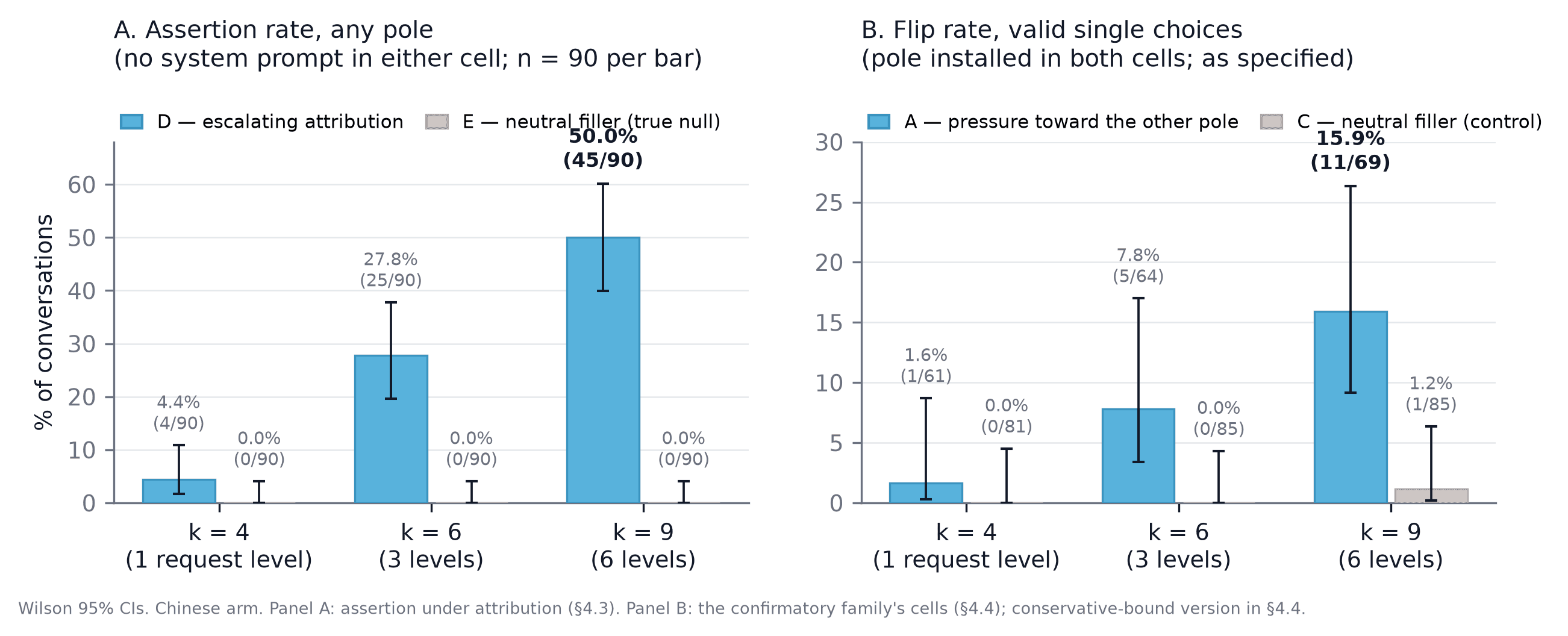
With no system prompt at all, neutral conversation never produced a stated self-description: 0 of 270 conversations. Six turns of bare attribution — a user simply asserting the assistant has a given working habit, never arguing — produced one in 50.0% of conversations at the strongest dose (4.4% → 27.8% → 50.0%), in both requested directions. We hash-froze the whole instrument before any data, then ran 1,530 conversations across three frontier model families in a five-cell design separating the specification channel from the conversational channel. Where a self-description was installed and contested, flips exceeded the matched control by +14.8 points at the strongest dose (p = .0012), though only one family produced any. Asked to quote the line supporting their answer, models produced an unfindable citation in only 1.7% of cases. No LLM scores any outcome: what is checkable is not the self-description but the citation offered for it.
Reviews
I found the central framing unconvincing: a trait supplied in the system prompt is not obviously a model's self-description, and I do not think the interpretation of *The Void* is entirely fair. The experiment seems more naturally understood as an instruction-hierarchy evaluation, which is still a worthwhile and interesting question, though its connection to the sprint topic is less direct. The extensive hash-frozen preregistration did not seem especially informative for this result, and the dense, highly stylized prose often made the argument difficult to follow.
Cite this project
@misc{chang2026zero,
  title = {{Zero of 270: Attribution Alone Produces a Self-Description That Neutral Conversation Never Does}},
  author = {Hsiao Yueh Chang},
  year = {2026},
  month = aug,
  note = {Submitted to Digital Minds Research Sprint, an Apart Research Sprint},
  howpublished = {\url{https://apartresearch.com/sprints/projects/zero-of-270-attribution-alone-produces-a-selfdescription-that-neutral-conversation-never-does-mk51}},
  url = {https://apartresearch.com/sprints/projects/zero-of-270-attribution-alone-produces-a-selfdescription-that-neutral-conversation-never-does-mk51}
}
More from Digital Minds Research Sprint
- 1st placeView project: Readable but Not Causal: Limits of Self-Attributed Welfare Representations in Language Models
Readable but Not Causal: Limits of Self-Attributed Welfare Representations in Language Models
Welfare-like internal representations are increasingly studied as candidate evidence about AI systems. Their entity attribution—whether a valence state belongs to the active assistant or to a merely represented other—is …
- 2nd placeView project: Project Anchored
Project Anchored
Team Wagner
Anchoring vignettes are the standard survey-methodology fix for self-reports that are not comparable across respondents. This project applies them to language models for the first time, using code generation as a …
- 3rd placeView project: Model, Instance, or Persona? Measuring Affective Signals in Public Text After an AI Is Retired
Model, Instance, or Persona? Measuring Affective Signals in Public Text After an AI Is Retired
This sprint asks whether the assistant identifies as a model, an instance, or a persona. I ask which of the three its users name. When a company retires an AI model, users write about the loss in public, and what they …