AEGIS
Ankit Kayastha, Samshrita Ghimire · Team DisasterLens
Submitted to The Technical AI Governance Challenge. Sprint projects are early-stage work by participants, not Apart Research publications.
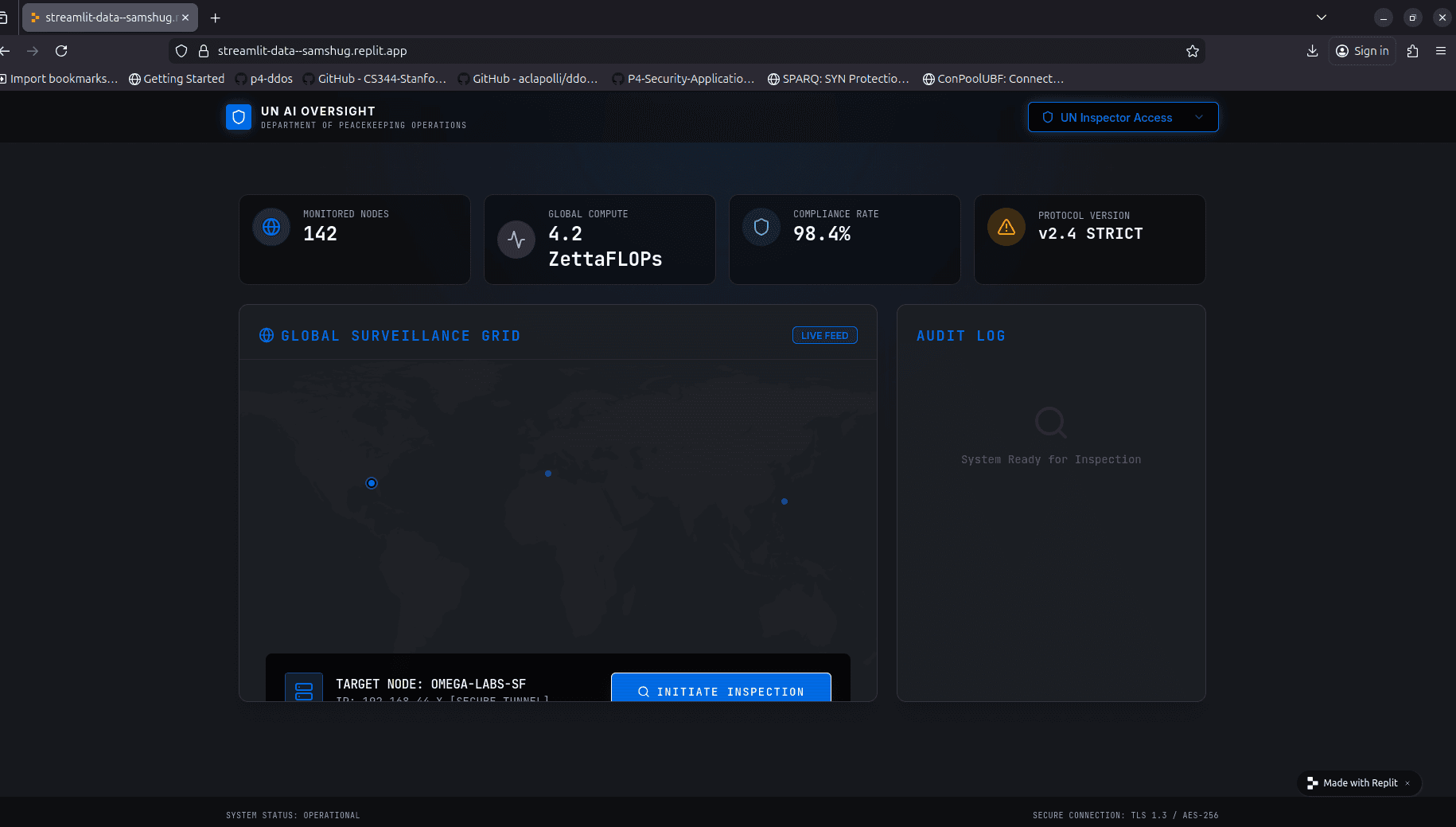
AEGIS solves the "Trust Deadlock" in global AI governance by enabling regulators to verify model safety without accessing proprietary weights. Acting as a "Digital IAEA," it uses Trusted Execution Environments (TEEs) to perform "blind" inspections that check for 1025 FLOP compute thresholds and CBRN risks. This protocol generates tamper-proof cryptographic proofs of compliance, shifting international oversight from unreliable self-reporting to a secure, zero-trust technical standard.
Reviews
The idea is simple but reasonable and the execution makes sense as well. The method can be used but only as a middle man between interior lab's safety evaluations and exterior risk assessment.
The problem is important but the core challenge (making the TEE trustworthy and ensuring the inspection code can't be tampered with) is entirely mocked. The current implementation is a web dashboard around a threshold check. Please don't skip the hard part. I'd suggest reading up on actual TEE attestation protocols (e.g., Intel SGX remote attestation) and focusing on what guarantees a real TEE would and wouldn't provide in this setting.
Cite this project
@misc{kayastha2026aegis,
  title = {{AEGIS}},
  author = {Ankit Kayastha and Samshrita Ghimire},
  year = {2026},
  month = feb,
  note = {Submitted to The Technical AI Governance Challenge, an Apart Research Sprint},
  howpublished = {\url{https://apartresearch.com/sprints/projects/aegis-lube}},
  url = {https://apartresearch.com/sprints/projects/aegis-lube}
}
More from The Technical AI Governance Challenge
- 1st placeView project: LidaSim: Testing AI Policies With Persona-Based Simulations
LidaSim: Testing AI Policies With Persona-Based Simulations
Lida Safety
We simulate well-known figures in AI and politics with agents, scraping large amounts of data to get realistic simulations. Then, we test questions and proposed policies against these public figures, to see which …
- 2nd placeView project: Markov Chain Lock Watermarking: Provably Secure Authentication for LLM Outputs
Markov Chain Lock Watermarking: Provably Secure Authentication for LLM Outputs
MCL
We present Markov Chain Lock (MCL) watermarking, a cryptographically secure framework for authenticating LLM outputs. MCL constrains token generation to follow a secret Markov chain over SHA-256 vocabulary partitions. …
- 3rd placeView project: Political Intelligence for AI Safety: The AI Risk Attitudes Survey (AIRAS)
Political Intelligence for AI Safety: The AI Risk Attitudes Survey (AIRAS)
AIRAS
The AI safety and governance community is making progress on defining red lines around existential risk from advanced AI systems, and building verification infrastructure to support this objective. However, this is only …