AI Safety Template
A. Davíd Giagnocavo, Kazuki Kimura, Zane Estere Gruntmane, Siddharth Putta, Gaurav Joshi, Satoshi Nakamura · Team AIS Zero
Submitted to The Technical AI Governance Challenge. Sprint projects are early-stage work by participants, not Apart Research publications.
A prototype for creating standardized AI safety evaluations that run in a hardened & private way
Reviews
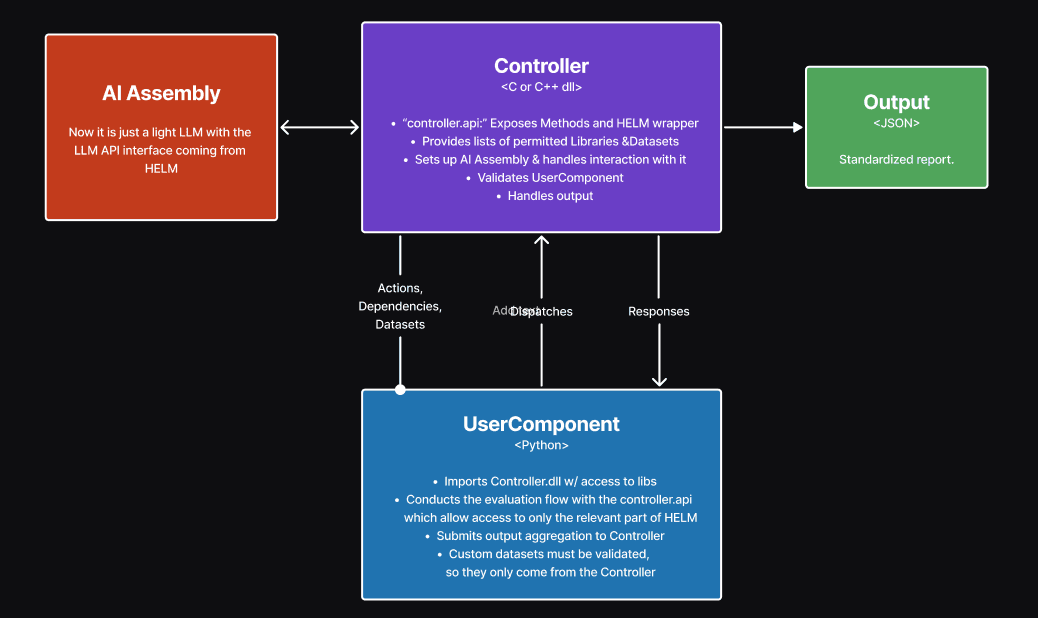
The paper has a strong problem identification - the present lack of trusted, neutral infrastructure for cross-organisational eval comparison is a bottleneck for international AI governance, and the paper articulates the requirements clearly (collaborative, transparent, neutral, verifiable, privacy-preserving), while giving clear historical examples of the gains of this approach. The two-TEE architecture is a sensible design for this problem - separating evaluation code from model weights in distinct trust boundaries allows model providers to submit to third-party evals without risking IP exfiltration.
However, the main reproducibility gains highlighted are probably already achievable for the most part through standard containerisation. The hard reproducibility problems in evals, such as GPU floating-point non-determinism, prompt sensitivity, dataset contamination and LLM-as-judge variance are unaddressed by the architecture. The gain from the controller pattern over standard dependency pinning is real, but it is probably not the key bottleneck to reproducability in evals at present.
Read full reviewShow less
A very cool idea but quite hard to execute. But I assume a good team with time and recourses can do that.
Cite this project
@misc{giagnocavo2026ai,
  title = {{AI Safety Template}},
  author = {A. Davíd Giagnocavo and Kazuki Kimura and Zane Estere Gruntmane and Siddharth Putta and Gaurav Joshi and Satoshi Nakamura},
  year = {2026},
  month = feb,
  note = {Submitted to The Technical AI Governance Challenge, an Apart Research Sprint},
  howpublished = {\url{https://apartresearch.com/sprints/projects/ai-safety-template-dz3h}},
  url = {https://apartresearch.com/sprints/projects/ai-safety-template-dz3h}
}
More from The Technical AI Governance Challenge
- 1st placeView project: LidaSim: Testing AI Policies With Persona-Based Simulations
LidaSim: Testing AI Policies With Persona-Based Simulations
Lida Safety
We simulate well-known figures in AI and politics with agents, scraping large amounts of data to get realistic simulations. Then, we test questions and proposed policies against these public figures, to see which …
- 2nd placeView project: Markov Chain Lock Watermarking: Provably Secure Authentication for LLM Outputs
Markov Chain Lock Watermarking: Provably Secure Authentication for LLM Outputs
MCL
We present Markov Chain Lock (MCL) watermarking, a cryptographically secure framework for authenticating LLM outputs. MCL constrains token generation to follow a secret Markov chain over SHA-256 vocabulary partitions. …
- 3rd placeView project: Political Intelligence for AI Safety: The AI Risk Attitudes Survey (AIRAS)
Political Intelligence for AI Safety: The AI Risk Attitudes Survey (AIRAS)
AIRAS
The AI safety and governance community is making progress on defining red lines around existential risk from advanced AI systems, and building verification infrastructure to support this objective. However, this is only …