AI Safety Threshold Tracker
Revathi Prasad · Team AI Safety Threshold Tracker
Submitted to The Technical AI Governance Challenge. Sprint projects are early-stage work by participants, not Apart Research publications.
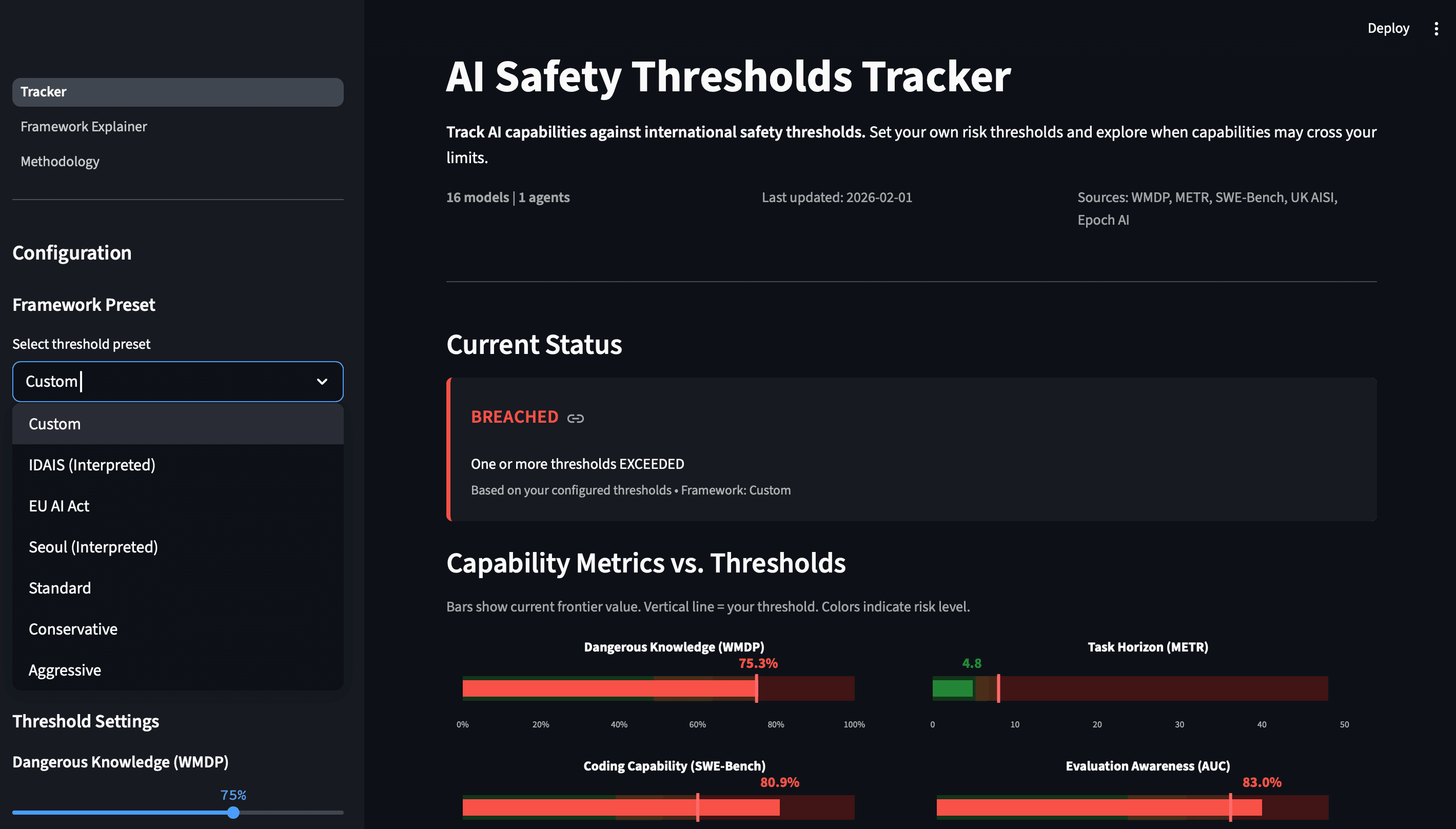
AI Safety Threshold Tracker An interactive dashboard that connects AI capability benchmarks to governance-defined thresholds. The tracker aggregates verified data from third-party evaluations (METR, SWE-Bench, WMDP) and company RSP disclosures (Anthropic ASL classifications, CBRN uplift scores), mapping them to thresholds derived from international frameworks including IDAIS Red Lines, EU AI Act, and Seoul Summit commitments.
Key features: 1. User-configurable thresholds with transparent justification labeling (distinguishing data-driven thresholds from interpretations) 2. 4 active capability metrics, 2 categorical RSP metrics, 5 inactive metrics awaiting data 3. Real-time tracking of frontier model capabilities against policy-relevant thresholds
Reviews
A useful tool with a simple idea. Only a few models has been tested which is reasonable given the time constrains.
This is a practical project that fills a real gap: turning vague “threshold” talk into something you can actually track. The framing is sensible and the dashboard is clear.
The main limitation is that the threshold mappings are still somewhat heuristic. This is more “good governance plumbing” than a new safety method. The impact depends on adoption.
To level up, I’d want: backtesting (“would this have changed decisions historically?”), uncertainty / missing-data handling, and a clean process for updating thresholds without Goodharting.
Cite this project
@misc{prasad2026ai,
  title = {{AI Safety Threshold Tracker}},
  author = {Revathi Prasad},
  year = {2026},
  month = feb,
  note = {Submitted to The Technical AI Governance Challenge, an Apart Research Sprint},
  howpublished = {\url{https://apartresearch.com/sprints/projects/ai-safety-threshold-tracker-fnxw}},
  url = {https://apartresearch.com/sprints/projects/ai-safety-threshold-tracker-fnxw}
}
More from The Technical AI Governance Challenge
- 1st placeView project: LidaSim: Testing AI Policies With Persona-Based Simulations
LidaSim: Testing AI Policies With Persona-Based Simulations
Lida Safety
We simulate well-known figures in AI and politics with agents, scraping large amounts of data to get realistic simulations. Then, we test questions and proposed policies against these public figures, to see which …
- 2nd placeView project: Markov Chain Lock Watermarking: Provably Secure Authentication for LLM Outputs
Markov Chain Lock Watermarking: Provably Secure Authentication for LLM Outputs
MCL
We present Markov Chain Lock (MCL) watermarking, a cryptographically secure framework for authenticating LLM outputs. MCL constrains token generation to follow a secret Markov chain over SHA-256 vocabulary partitions. …
- 3rd placeView project: Political Intelligence for AI Safety: The AI Risk Attitudes Survey (AIRAS)
Political Intelligence for AI Safety: The AI Risk Attitudes Survey (AIRAS)
AIRAS
The AI safety and governance community is making progress on defining red lines around existential risk from advanced AI systems, and building verification infrastructure to support this objective. However, this is only …