EU AI Act Compliance Form Builder: Automating Article 53 Documentation for General Purpose AI Models
Andrew Byrley
Submitted to The Technical AI Governance Challenge. Sprint projects are early-stage work by participants, not Apart Research publications.
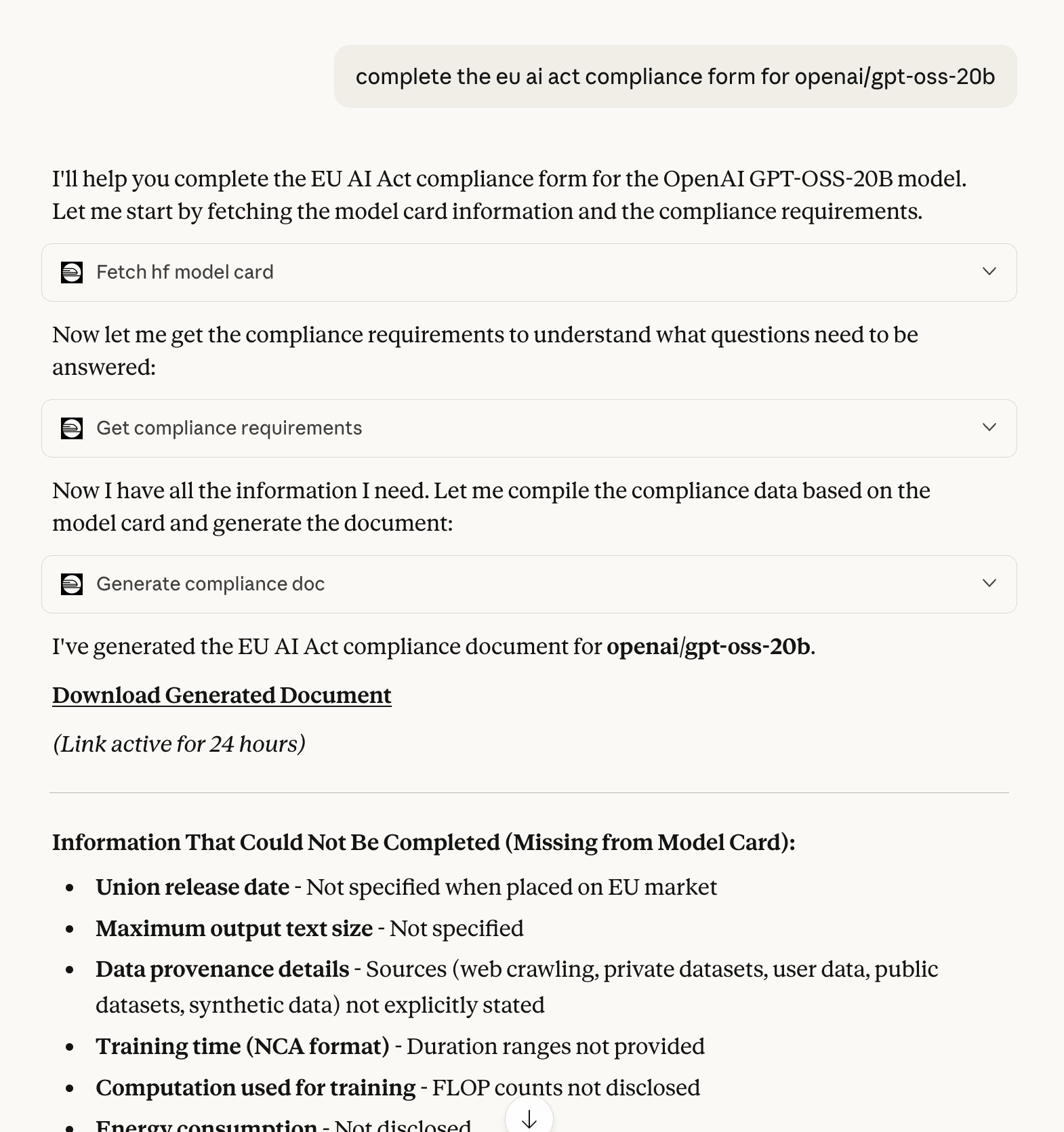
The EU AI Act requires providers of General Purpose AI (GPAI) models to submit technical documentation under Article 53, following the GPAI Code of Practice. This process is traditionally manual: model providers must read through their model cards, cross-reference compliance requirements, and populate a Word document template field by field. This project presents a Model Context Protocol (MCP) server that automates this workflow.
Reviews
This is one of the most useful submissions I have reviewed! Thank you for addressing an immediate compliance burden with working tooling and validating it with a clear scoring rubric across multiple models. The finding that model cards systematically lack the information regulators want (energy, compute, data provenance) is itself an excellent governance contribution.
Great project I can see being immediately useful! The finding that model cards systematically lack what regulators actually want is pretty valuable by its self and worth flagging. Appreciated the details in the method (clear accuracy/completeness split, per-section gap analysis). Next steps could be source highlighting and confidence scores to improve grounding + increase transparency, plus hardening the pipeline against template changes (or even lobbying for JSON endpoints!)
Cite this project
@misc{byrley2026eu,
  title = {{EU AI Act Compliance Form Builder: Automating Article 53 Documentation for General Purpose AI Models}},
  author = {Andrew Byrley},
  year = {2026},
  month = feb,
  note = {Submitted to The Technical AI Governance Challenge, an Apart Research Sprint},
  howpublished = {\url{https://apartresearch.com/sprints/projects/eu-ai-act-compliance-form-builder-automating-article-53-documentation-for-general-purpose-ai-models-z40g}},
  url = {https://apartresearch.com/sprints/projects/eu-ai-act-compliance-form-builder-automating-article-53-documentation-for-general-purpose-ai-models-z40g}
}
More from The Technical AI Governance Challenge
- 1st placeView project: LidaSim: Testing AI Policies With Persona-Based Simulations
LidaSim: Testing AI Policies With Persona-Based Simulations
Lida Safety
We simulate well-known figures in AI and politics with agents, scraping large amounts of data to get realistic simulations. Then, we test questions and proposed policies against these public figures, to see which …
- 2nd placeView project: Markov Chain Lock Watermarking: Provably Secure Authentication for LLM Outputs
Markov Chain Lock Watermarking: Provably Secure Authentication for LLM Outputs
MCL
We present Markov Chain Lock (MCL) watermarking, a cryptographically secure framework for authenticating LLM outputs. MCL constrains token generation to follow a secret Markov chain over SHA-256 vocabulary partitions. …
- 3rd placeView project: Political Intelligence for AI Safety: The AI Risk Attitudes Survey (AIRAS)
Political Intelligence for AI Safety: The AI Risk Attitudes Survey (AIRAS)
AIRAS
The AI safety and governance community is making progress on defining red lines around existential risk from advanced AI systems, and building verification infrastructure to support this objective. However, this is only …