Frontier AI Risk Threshold Analyzer
SWALEHA PARVEEN
Submitted to The Technical AI Governance Challenge. Sprint projects are early-stage work by participants, not Apart Research publications.
Different AI labs define "dangerous AI" using incompatible frameworks:
Anthropic uses ASL levels (ASL-2, ASL-3) Google DeepMind uses CCL tiers OpenAI uses preparedness levels The EU AI Act uses compute thresholds (10²⁵ FLOPS)
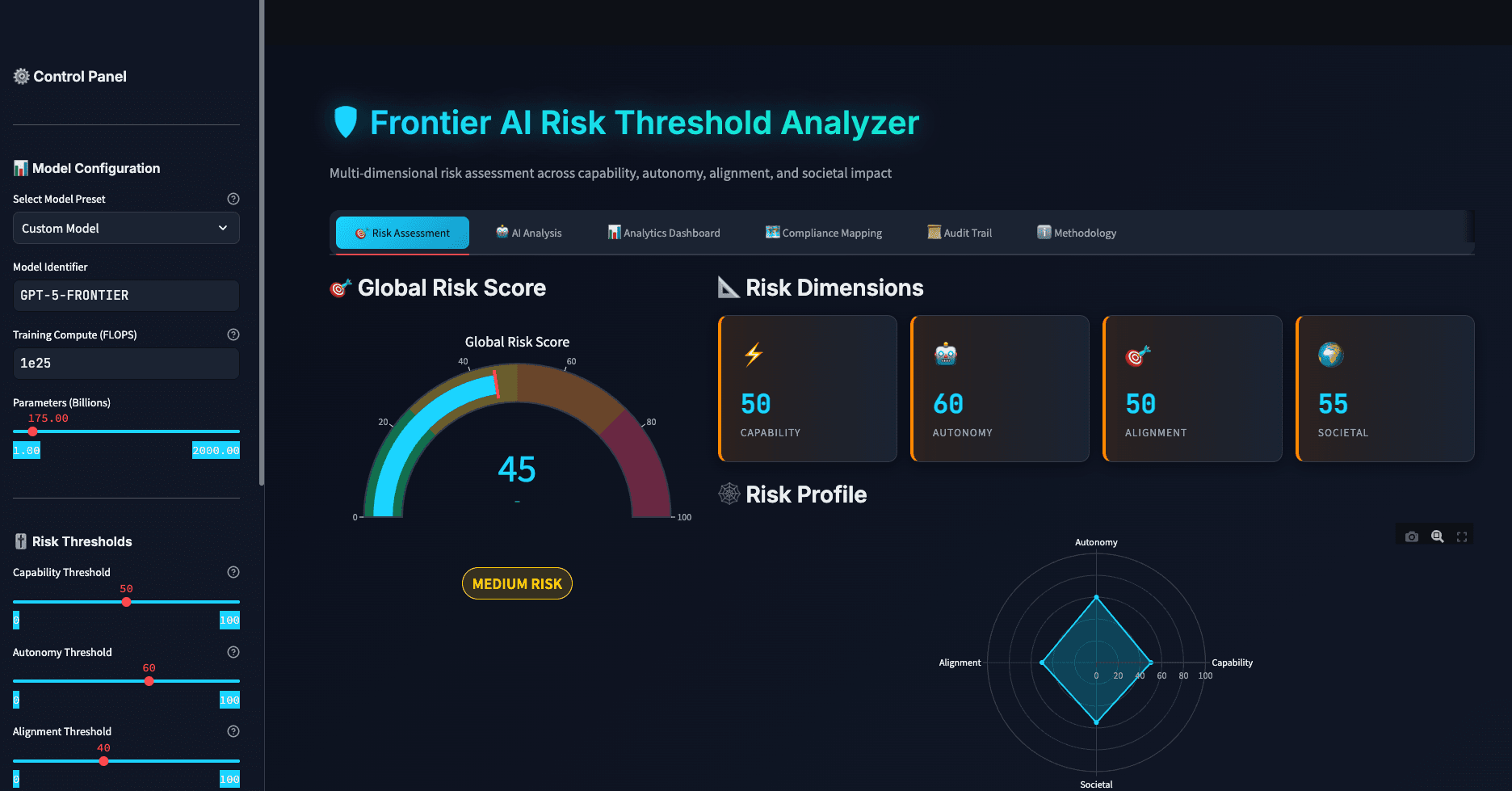
This fragmentation makes international coordination nearly impossible. How do you negotiate safety agreements when you can't even compare risk levels across organizations? The Solution: I built an open-source tool that harmonizes these frameworks for the first time. Using AI-powered extraction with GPT-4o, I: ✅ Processed 12+ major AI safety frameworks ✅ Extracted 47 distinct risk tiers into a structured database ✅ Built an interactive web app for real-time risk assessment ✅ Automated EU AI Act compliance checking Key Findings:
A model can trigger ASL-3 at Anthropic but not equivalent thresholds at other labs Only 3/12 frameworks use explicit compute thresholds Significant regulatory arbitrage opportunities exist
Real-World Impact: This tool enables: 🔹 AI labs to self-assess compliance across ALL frameworks simultaneously 🔹 Regulators to objectively compare lab commitments 🔹 Researchers to build on the first comprehensive threshold database
Reviews
Impact potential & Innovation: 1
I'm unfortunately not convinced that this is a meaningful problem: I expect that combining the 5-6 frameworks that actually matter here could have been a quick, manual task.
Execution Quality: 1
There is no meaningful execution here, and the results are difficult to interpret. E.g. figure 2 on framework risk heatmap is difficult to understand - how was this measured, why is a scale of 40-60 used?
Presentation & Clarity: 1
The results section is nearly empty (2 figures with minimal explanation). It would have been helpful to have deeper, side by side analysis of frameworks.
The accuracy rate reported is concerning: “94% for threshold values and 97% for organization names.” Manual checking works to create a snapshot but not to automate the recreation of this analysis as frameworks change. It would be interesting to know what steps were taken or considered to bring this accuracy up.
It is unclear why regulators cannot force adoption of their preferred standards without making reference to lab-generated taxonomies. Consider whether this research wants to instead address the need for regulators to establish clear, capabilities-based risk tiers, taking inspiration from and integrating work the labs have done, where it makes sense to do so.
Cite this project
@misc{parveen2026frontier,
  title = {{Frontier AI Risk Threshold Analyzer}},
  author = {SWALEHA PARVEEN},
  year = {2026},
  month = feb,
  note = {Submitted to The Technical AI Governance Challenge, an Apart Research Sprint},
  howpublished = {\url{https://apartresearch.com/sprints/projects/frontier-ai-risk-threshold-analyzer-g8zp}},
  url = {https://apartresearch.com/sprints/projects/frontier-ai-risk-threshold-analyzer-g8zp}
}
More from The Technical AI Governance Challenge
- 1st placeView project: LidaSim: Testing AI Policies With Persona-Based Simulations
LidaSim: Testing AI Policies With Persona-Based Simulations
Lida Safety
We simulate well-known figures in AI and politics with agents, scraping large amounts of data to get realistic simulations. Then, we test questions and proposed policies against these public figures, to see which …
- 2nd placeView project: Markov Chain Lock Watermarking: Provably Secure Authentication for LLM Outputs
Markov Chain Lock Watermarking: Provably Secure Authentication for LLM Outputs
MCL
We present Markov Chain Lock (MCL) watermarking, a cryptographically secure framework for authenticating LLM outputs. MCL constrains token generation to follow a secret Markov chain over SHA-256 vocabulary partitions. …
- 3rd placeView project: Political Intelligence for AI Safety: The AI Risk Attitudes Survey (AIRAS)
Political Intelligence for AI Safety: The AI Risk Attitudes Survey (AIRAS)
AIRAS
The AI safety and governance community is making progress on defining red lines around existential risk from advanced AI systems, and building verification infrastructure to support this objective. However, this is only …