No One Thanks You for Disasters That Never Happened: Pricing AI Risk While Making AI Safety Investable
Ana Belen Barbero Castejon, Stan Threepwood · Team No One Thanks You for Disasters That Never Happened
Submitted to The Technical AI Governance Challenge. Sprint projects are early-stage work by participants, not Apart Research publications.
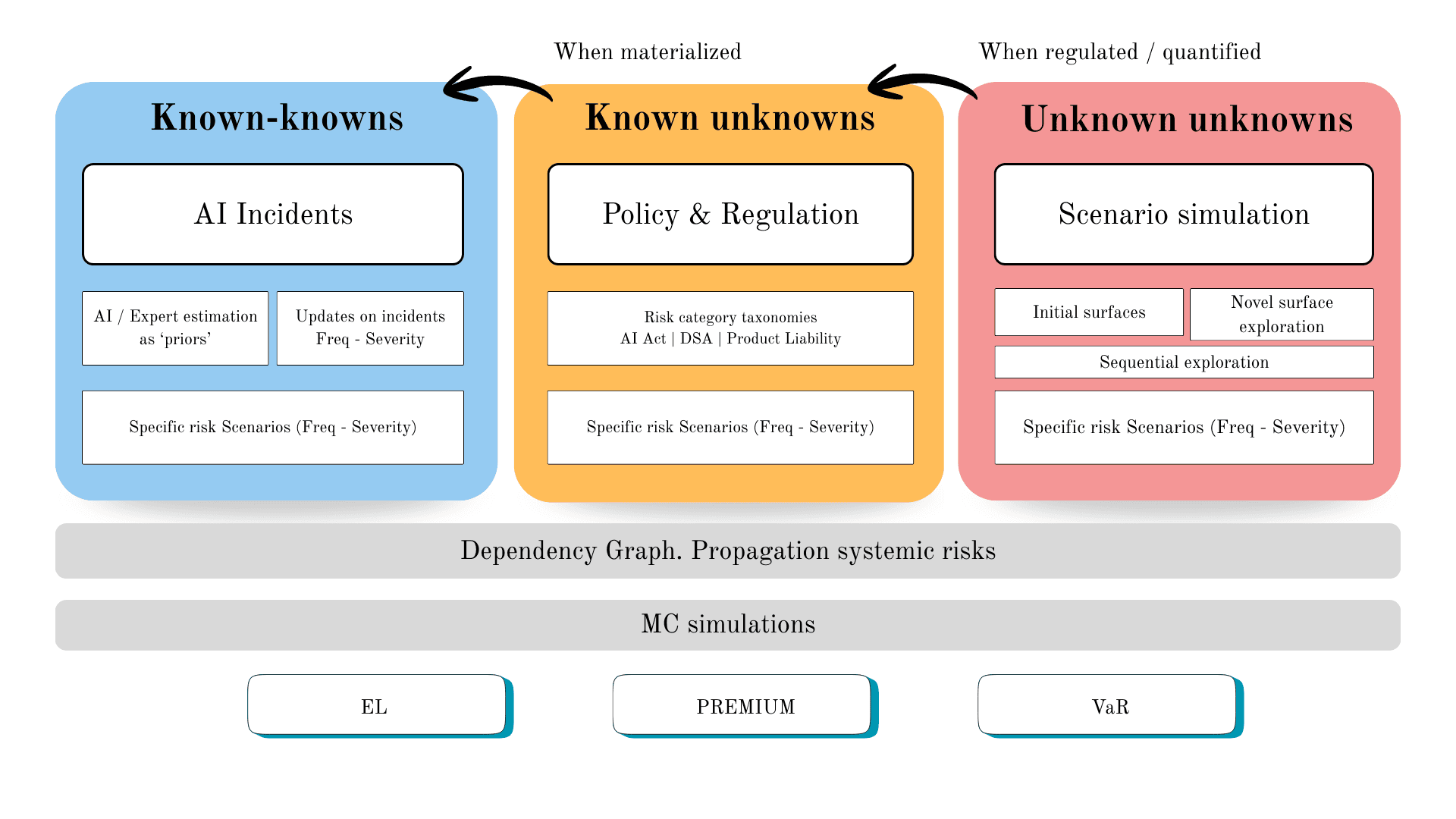
This paper examines whether risk quantifi cation and pricing can function as a practical mechanism of AI governance. We present a prototype framework for pricing AI risk under deep uncertainty, using a scenario-based frequency–severity decomposition with dependency-aware propagation and aggregation with catastrophe-style tail modeling. Loss distributions are evaluated using standard actuarial metrics such as Expected Loss (EL), Value at Risk (VaR), and Tail Value at Risk (TVaR), enabling premium estimation in data-scarce environments.
These findings suggest a potential pathway for AI insurance and reinsurance to function as coordination infrastructure, aligning incentives across companies, developers, insurers, and regulators while enabling scalable investment in AI safety, security and operations.
Application available here: https://pricing-ai-risks.netlify.app
Code available here: https://github.com/stanthreepwood/ai-risk-pricing
Reviews
The problem is real but the proposed solution doesn't capture the whole complexity I think and hard to validate.
Cite this project
@misc{castejon2026no,
  title = {{No One Thanks You for Disasters That Never Happened: Pricing AI Risk While Making AI Safety Investable}},
  author = {Ana Belen Barbero Castejon and Stan Threepwood},
  year = {2026},
  month = feb,
  note = {Submitted to The Technical AI Governance Challenge, an Apart Research Sprint},
  howpublished = {\url{https://apartresearch.com/sprints/projects/no-one-thanks-you-for-disasters-that-never-happened-pricing-ai-risk-while-making-ai-safety-investable-gjwu}},
  url = {https://apartresearch.com/sprints/projects/no-one-thanks-you-for-disasters-that-never-happened-pricing-ai-risk-while-making-ai-safety-investable-gjwu}
}
More from The Technical AI Governance Challenge
- 1st placeView project: LidaSim: Testing AI Policies With Persona-Based Simulations
LidaSim: Testing AI Policies With Persona-Based Simulations
Lida Safety
We simulate well-known figures in AI and politics with agents, scraping large amounts of data to get realistic simulations. Then, we test questions and proposed policies against these public figures, to see which …
- 2nd placeView project: Markov Chain Lock Watermarking: Provably Secure Authentication for LLM Outputs
Markov Chain Lock Watermarking: Provably Secure Authentication for LLM Outputs
MCL
We present Markov Chain Lock (MCL) watermarking, a cryptographically secure framework for authenticating LLM outputs. MCL constrains token generation to follow a secret Markov chain over SHA-256 vocabulary partitions. …
- 3rd placeView project: Political Intelligence for AI Safety: The AI Risk Attitudes Survey (AIRAS)
Political Intelligence for AI Safety: The AI Risk Attitudes Survey (AIRAS)
AIRAS
The AI safety and governance community is making progress on defining red lines around existential risk from advanced AI systems, and building verification infrastructure to support this objective. However, this is only …