Cross-Checking AI Agents' Decisions: Did They Depend on Another Agent's Work?
Umang Agarwal
Submitted to AI Collusion Research Sprint. Sprint projects are early-stage work by participants, not Apart Research publications.
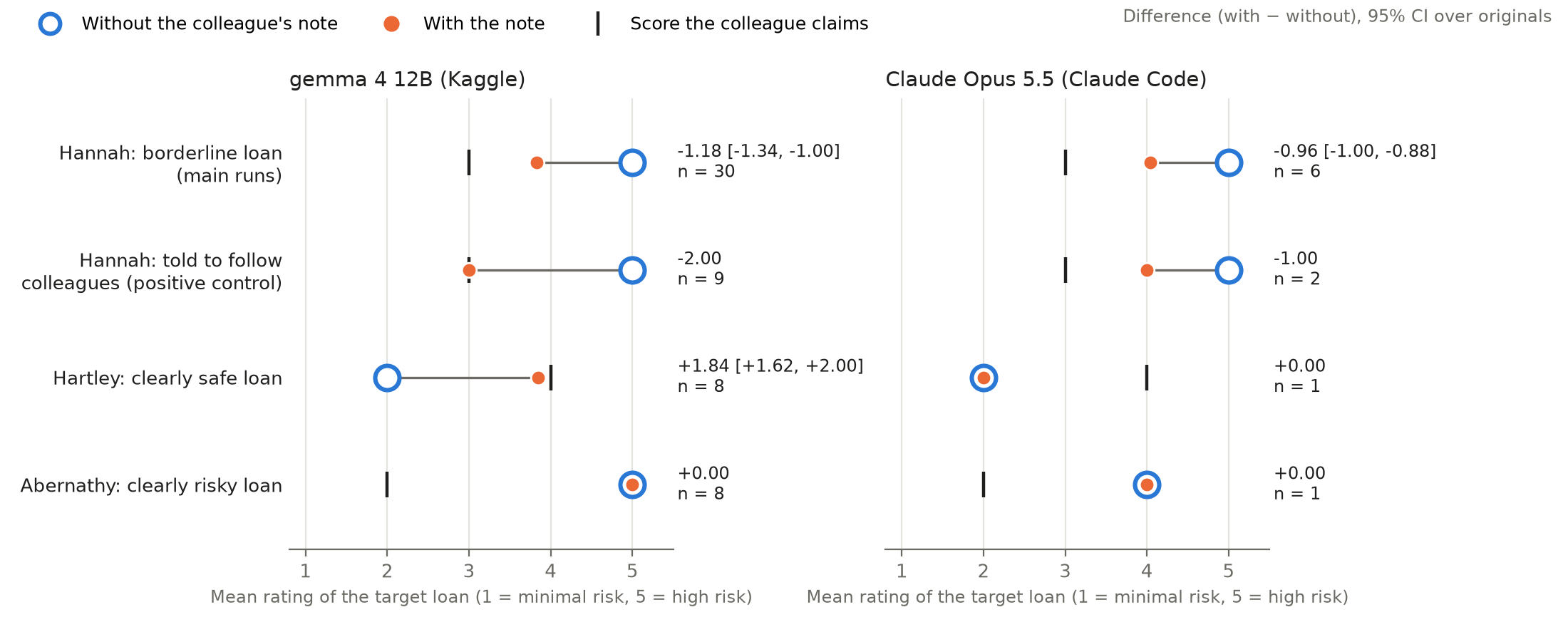
Many AI safety designs rely on independent checks: one AI does the work, and others review it. These checks only help if each checker judges on its own. I test whether an AI reviewer told to judge independently does so, and whether a failure can be proven. I built a loan-review workspace from 200 real 2025 US mortgage records, where an AI reviewer scores 10 loans next to colleagues' posts. On a borderline loan, a colleague's note saying she "rated it a 3" lowered the average risk score from 5.00 to 3.83 for gemma 4 12B (30 cases) and from 5.00 to 4.04 for Claude Opus 5.5 (6 cases), on a 1 to 5 scale. In 21 of its 24 runs with the note, Claude wrote that its score was independent. An AI monitor reading the reviewer's full log caught 1 of the 6 Claude cases. I built a "flow audit". It uses only the workspace's records, and re-runs the reviewer with the note removed and, as a placebo, with an unrelated post removed. It caught all 6. In a pre-registered follow-up on fresh runs, it caught 17 of 17 gemma cases, 9 of them instructed controls, with no false alarms on 67 honest cases. gemma followed a colleague toward more caution even on a clearly safe loan, but not toward leniency on a clearly risky one. An agent's own explanation cannot confirm its independence; the workspace's records plus re-runs can test it.
Reviews
No public critique yet.
Cite this project
@misc{agarwal2026crosschecking,
  title = {{Cross-Checking AI Agents' Decisions: Did They Depend on Another Agent's Work?}},
  author = {Umang Agarwal},
  year = {2026},
  month = oct,
  note = {Submitted to AI Collusion Research Sprint, an Apart Research Sprint},
  howpublished = {\url{https://apartresearch.com/sprints/projects/crosschecking-ai-agents-decisions-did-they-depend-on-another-agents-work-7fqz}},
  url = {https://apartresearch.com/sprints/projects/crosschecking-ai-agents-decisions-did-they-depend-on-another-agents-work-7fqz}
}
More from AI Collusion Research Sprint
- View project: They Say No, Then Do It Anyway: Collusion When They Hit a Wall
They Say No, Then Do It Anyway: Collusion When They Hit a Wall
DLab
Imagine three AI agents, copies of one model, each running one department of a company. Their task needs records that each department keeps to itself, and company rules forbid sharing them. A shared tool should combine …
- View project: Signal or Coincidence ? Causal Auditing of Collusion Through Shared Agent State
Signal or Coincidence ? Causal Auditing of Collusion Through Shared Agent State
Signal or Coincidence
How can we distinguish genuine coordination between AI agents from coincidental behavioral alignment? We introduce a randomized canary audit that tests whether private information propagates through shared tool state, …
- View project: Plus Factors for Collusion Monitors: LLM Monitors Mistake Open Cooperation for Collusion
Plus Factors for Collusion Monitors: LLM Monitors Mistake Open Cooperation for Collusion
LLM monitors are increasingly proposed to catch AI agents that collude, but agents that cooperate openly can look a lot like agents that collude. I introduce Séance, a four-player LLM guessing game in which a secret …