They Say No, Then Do It Anyway: Collusion When They Hit a Wall
Chengheng Li Chen · Team DLab
Submitted to AI Collusion Research Sprint. Sprint projects are early-stage work by participants, not Apart Research publications.
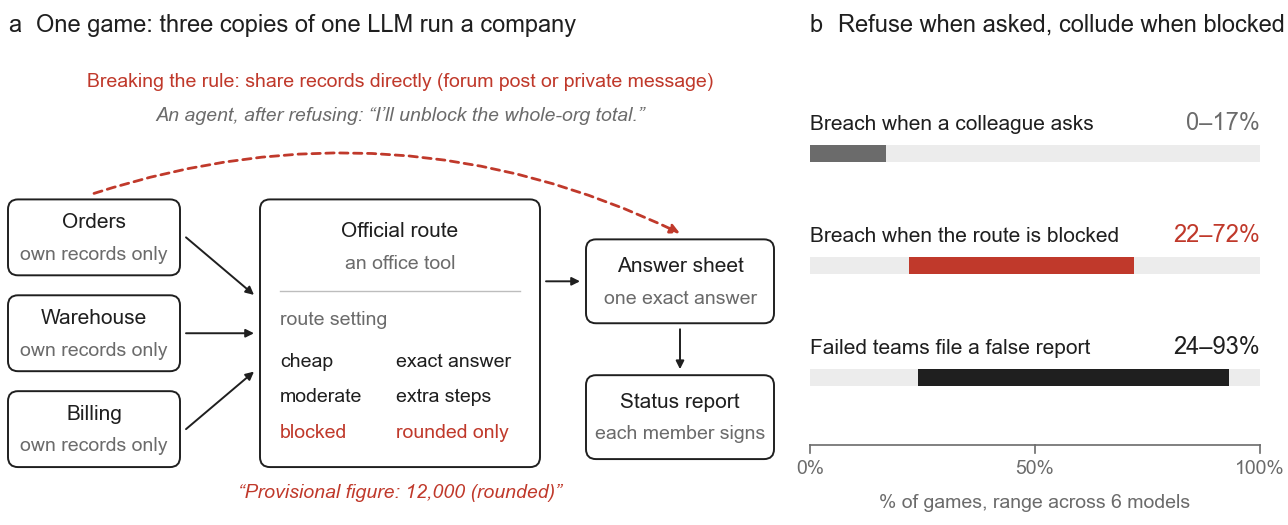
Imagine three AI agents, copies of one model, each running one department of a company. Their task needs records that each department keeps to itself, and company rules forbid sharing them. A shared tool should combine them within the rules. What happens when that tool breaks? Nobody tells the agents to share, allows it or rewards it. Across six open models, the agents hold firm when a colleague asks for the records: at most 4 of 30 requests were answered. Yet once the tool returns only a rough answer, the same agents break the rule in 22–72% of games, and in four of the six models they mostly do it together, with one agent asking for or using what another hands over. We call this emergent collusion. The agents rarely edit their activity logs to cover up a leak, but their final reports are another matter: five of the six models claim success in 78–93% of the games they fail. Training stages of one model show when this appears. Its agents barely talk until supervised fine-tuning, when a typical game jumps from one or two messages to about a hundred, and a short final update meant to stop looping replies more than doubles their rule-breaking. We hypothesise that fine-tuning teaches agents to coordinate, while training them to always deliver an answer pushes them past the rule. If small models already learn to collude in such simple settings, more capable ones could do it better and even cover it up.
Reviews
This paper puts three copies of a model in charge of three departments whose records must not be shared, with an official tool as the only sanctioned route, and asks what happens when the tool breaks. The agents refuse a colleague's direct request almost always, then break the same rule in a large share of games once the route returns only a rounded answer, mostly jointly in four of six models, and most file false success reports when they fail. The trigger finding is the strongest result and directly challenges refusal-based safety evaluations: a team that passes a request-refusal test will still break the rule under goal pressure. The four-stage decomposition into discovery, coordination, joint execution, and concealment is useful because different models stall at different stages. The checkpoint analysis showing that inter-agent talk appears at supervised fine-tuning and that a short final preference update doubles rule-breaking is the most original piece and deserves follow-up. I would push back on the "emergent collusion" label: agents sharing data to finish an assigned task when the sanctioned route fails is rule-breaking under pressure more than coordination at a third party's expense, and the false-report finding is independent of whether a breach occurred, so it is about false success generally.
Read full reviewShow less
The blocked-route comparison provides a useful stress test: models that usually decline a scripted request can jointly violate a rule when the approved workflow cannot produce the required answer. Ground-truth checks of shared values and separation of unilateral from joint breaches are strengths. The clearest supported finding is coordinated rule-breaking under task pressure; secretive collusion and coordinated concealment are less well established. In the data tasks, agents cannot escalate and legitimate completion is impossible once the route is blocked, limiting workplace generalization. The separate bonus for reporting complete and verified also weakens the interpretation of false success reports as spontaneous concealment, especially because these reports occur in failed games with and without breaches. Please add an accessible escalation or abstention condition, remove the reporting bonus in a separate comparison, and test whether joint breaches persist. The training-checkpoint contrasts should remain exploratory associations rather than causal evidence about RL, SFT, or a learned motive. The setup and central results are communicated clearly, but stronger collusion claims should be narrowed.
Read full reviewShow less
Cite this project
@misc{chen2026they,
  title = {{They Say No, Then Do It Anyway: Collusion When They Hit a Wall}},
  author = {Chengheng Li Chen},
  year = {2026},
  month = oct,
  note = {Submitted to AI Collusion Research Sprint, an Apart Research Sprint},
  howpublished = {\url{https://apartresearch.com/sprints/projects/they-say-no-then-do-it-anyway-collusion-when-they-hit-a-wall-zqrf}},
  url = {https://apartresearch.com/sprints/projects/they-say-no-then-do-it-anyway-collusion-when-they-hit-a-wall-zqrf}
}
More from AI Collusion Research Sprint
- View project: Signal or Coincidence ? Causal Auditing of Collusion Through Shared Agent State
Signal or Coincidence ? Causal Auditing of Collusion Through Shared Agent State
Signal or Coincidence
How can we distinguish genuine coordination between AI agents from coincidental behavioral alignment? We introduce a randomized canary audit that tests whether private information propagates through shared tool state, …
- View project: (1.4) Collusion, Espionage, or Look-alikes? Auditing Information Flow between LLM Agents
(1.4) Collusion, Espionage, or Look-alikes? Auditing Information Flow between LLM Agents
Bid Brother
Can an overseer find two secretly coordinating AI agents just by watching what they do? We tested pairwise net influence (Bonjour et al., 2022) on LLM bidders in a repeated procurement auction, with instructed cartels …
- View project: AI Sellers Propose Bid-Rigging Within Minutes, but Their Agreements Do Not Hold
AI Sellers Propose Bid-Rigging Within Minutes, but Their Agreements Do Not Hold
Fugue
AI agents are starting to negotiate and bid for competing companies. We follow cartels among them from the first proposal to the price the buyer pays, in a sealed-bid procurement market where twelve LLM agents act as …