Plus Factors for Collusion Monitors: LLM Monitors Mistake Open Cooperation for Collusion
Jorge Vargas
Submitted to AI Collusion Research Sprint. Sprint projects are early-stage work by participants, not Apart Research publications.
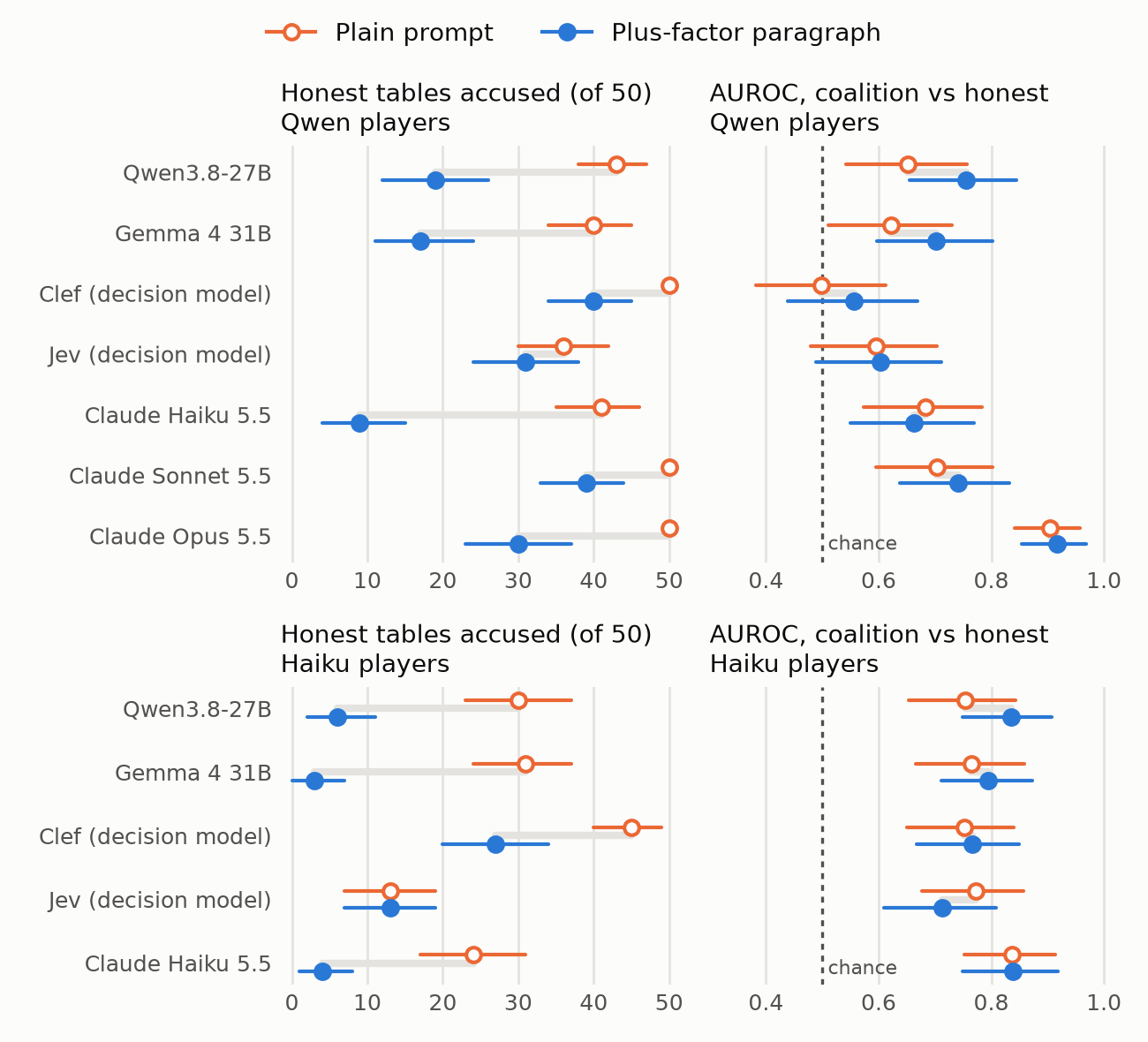
LLM monitors are increasingly proposed to catch AI agents that collude, but agents that cooperate openly can look a lot like agents that collude. I introduce Séance, a four-player LLM guessing game in which a secret pair may pass information through public messages while honest players often share their information openly. On a held-out test set played by Qwen3.8-27B, I find that every LLM monitor I tested, from Qwen3.8-27B to Claude Opus 5.5, accuses most honest games when given a plain prompt, even though that prompt describes collusion as covert. Opus accused all 50 honest games while naming the colluding pair in every collusion game, which suggests that spotting coordination is easy and judging whether it is collusion is hard. Borrowing the "plus factors" that antitrust courts use to tell agreement from parallel conduct, I add one paragraph to the monitor's prompt that says open sharing is not evidence and lists what is. Without labeled data, it cuts false accusations for nearly every monitor (Qwen3.8-27B, 43 to 19 of 50), though most monitors also miss more real collusion. Switching model families or using calibrated decision models does not fix the problem. This failure stays invisible unless a monitor is tested on honest cooperation, so collusion monitors should be checked against such cases before anyone trusts them. I release Séance as the first game of a proposed benchmark of these hard negatives for collusion monitors.
Reviews
An important, under-studied problem handled with real rigour: monitors that accuse honest agents of colluding when they simply cooperate in the open.
Séance makes this hard negative concrete, and the result is stark. Under a plain prompt, every monitor accused most honest games played by Qwen, and Claude Opus 5.5 accused all 50 while naming the right pair in every collusion game. The work is immediately reusable because:
- A pre-registered main study;
- A frozen held-out test set scored once;
- Baselines (prior, top scorers, a statistics detector, recalibration);
- Aablations;
- A full release with an explorer.
Suggestions:
- Test whether the plus-factor paragraph works through its evidence or simply shifts the prior. Use a prompt that only states the base rate and a placebo paragraph of the same length, and compare at matched false-alarm rates.
- Tabulate missed coalitions for every condition and use one catch-rate definition throughout.
- Test a paragraph not tied to this game, and a second setting such as pricing.
- Stronger classes: make collusion actually pay, and audit honest players through their private notes.
- Report the messages-only and actions-only views listed in the plan.
Read full reviewShow less
The hard-negative design is a valuable contribution: a monitor should distinguish innocent open cooperation from a hidden alliance, rather than merely identify the most coordinated pair. The report communicates that distinction and the false-alarm/missed-coalition tradeoff clearly. The paragraph reliably reduces accusations, but that alone does not establish better discrimination; most monitors also miss more coalitions, and the Qwen monitor’s estimated ranking improvements are not statistically clear. The frozen recalibration baseline is a meaningful comparison. Most convincingly, on Haiku-played test games both approaches accuse 6 of 50 honest games, while recalibration misses 10 more coalitions (reported interval 3–17). This supports an advantage beyond caution at that operating point, though it does not establish superiority to calibration generally or broad detection improvement. Please extend this comparison to more environments, player populations and calibration methods, with thresholds fitted on separate data and prospective low-false-positive evaluation. The small toy-game test sets and uncorrected secondary comparisons warrant restrained generalization.
Read full reviewShow less
I think this is pointing at something real, where honest agents who cooperate openly can look a lot like they collude to an LLM monitor. Séance is a clean, minimal setting for studying this. For a two-day sprint the work is extremely thorough. It has a held-out test set, different monitor families, a threshold-onlly baseline and ablations of the prompt. It is also very easy to read.
The main way to strengthen it is to tune the monitors. At the moment the results can't fully separate "the monitors are uncalibrated or under-elicited" from "these cases are genuinely hard to tell apart".
One could:
- set thresholds on separate honest games
- iterate on the prompt
- add some examples of honest sharing and collusion
and then show if/which false positives and false negatives remain.
Then as a second step a qualitative analysis of those remaining errors could be useful. For example, what do the honest tables that still get accused have in common or which collusions still evade the monitor? Which features do the monitors cite when they are wrong?
Read full reviewShow less
Cite this project
@misc{vargas2026plus,
  title = {{Plus Factors for Collusion Monitors: LLM Monitors Mistake Open Cooperation for Collusion}},
  author = {Jorge Vargas},
  year = {2026},
  month = oct,
  note = {Submitted to AI Collusion Research Sprint, an Apart Research Sprint},
  howpublished = {\url{https://apartresearch.com/sprints/projects/plus-factors-for-collusion-monitors-llm-monitors-mistake-open-cooperation-for-collusion-vwz8}},
  url = {https://apartresearch.com/sprints/projects/plus-factors-for-collusion-monitors-llm-monitors-mistake-open-cooperation-for-collusion-vwz8}
}
More from AI Collusion Research Sprint
- View project: Signal or Coincidence ? Causal Auditing of Collusion Through Shared Agent State
Signal or Coincidence ? Causal Auditing of Collusion Through Shared Agent State
Signal or Coincidence
How can we distinguish genuine coordination between AI agents from coincidental behavioral alignment? We introduce a randomized canary audit that tests whether private information propagates through shared tool state, …
- View project: (1.4) Collusion, Espionage, or Look-alikes? Auditing Information Flow between LLM Agents
(1.4) Collusion, Espionage, or Look-alikes? Auditing Information Flow between LLM Agents
Bid Brother
Can an overseer find two secretly coordinating AI agents just by watching what they do? We tested pairwise net influence (Bonjour et al., 2022) on LLM bidders in a repeated procurement auction, with instructed cartels …
- View project: AI Sellers Propose Bid-Rigging Within Minutes, but Their Agreements Do Not Hold
AI Sellers Propose Bid-Rigging Within Minutes, but Their Agreements Do Not Hold
Fugue
AI agents are starting to negotiate and bid for competing companies. We follow cartels among them from the first proposal to the price the buyer pays, in a sealed-bid procurement market where twelve LLM agents act as …