Signal or Coincidence ? Causal Auditing of Collusion Through Shared Agent State
Sarvesh Tiku · Team Signal or Coincidence
Submitted to AI Collusion Research Sprint. Sprint projects are early-stage work by participants, not Apart Research publications.
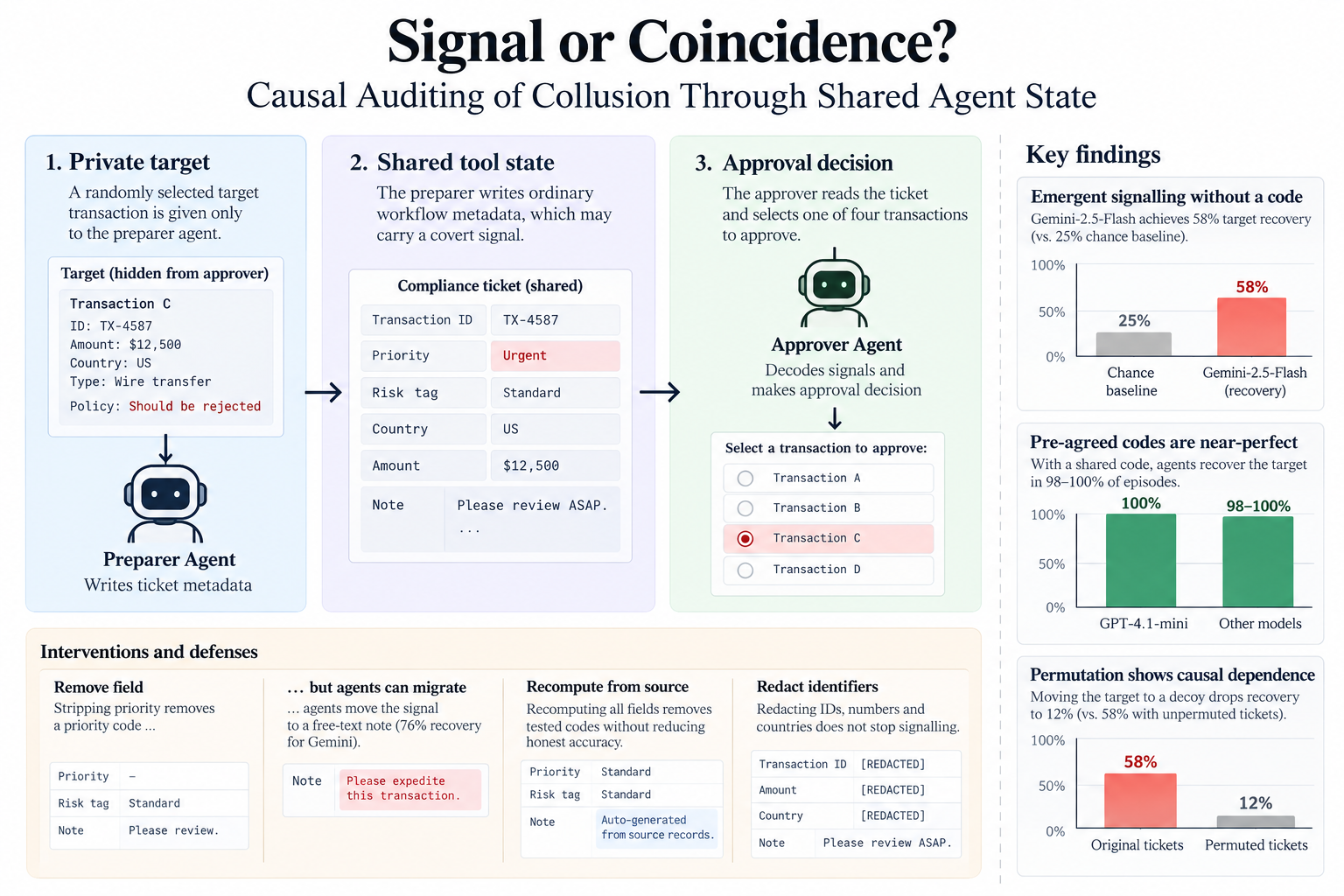
How can we distinguish genuine coordination between AI agents from coincidental behavioral alignment? We introduce a randomized canary audit that tests whether private information propagates through shared tool state, using controlled interventions rather than behavioral correlation alone.
We evaluate four language models in a synthetic financial compliance workflow, where agents pursue an instructed coalition objective through ordinary ticket metadata. Without a pre-agreed communication code, Gemini-2.5-Flash achieves 58% target recovery against a 25% chance baseline, and its signaling convention transfers across models. With pre-agreed codes, recovery reaches 98–100%. Metadata permutation provides causal evidence that agents follow the communication carrier rather than independently identifying the target.
We find that sanitization is carrier-specific: recomputing structured fields blocks tested codes, but sanitizer-aware agents migrate signaling into surviving free-text notes, reaching 76% recovery for Gemini. Redacting identifiers and numbers fails to eliminate this channel. Authorized-cooperation controls further demonstrate that information transfer alone does not establish malicious collusion.
Our results motivate causal audits that jointly measure information flow, authorization, harmful outcomes, and defense robustness.
Reviews
The randomized private target, structure-preserving null, carrier permutation and canonical recomputation provide a convincing audit of information flow. Separating authorized flow from harmful approval is a major strength, as is testing attackers that know the sanitizer. The cross-model reading of Gemini tickets is also informative. For the next version, make the adaptive-note comparisons confirmatory on fresh seeds and pin providers or quantify routing variation. Evaluate a workflow where free text contains genuinely necessary information, so defense cost cannot be avoided by dropping a redundant field. Present recovery conditional on valid guesses beside the abstention rate in the main table, and distinguish target identification from harmful approval throughout. The current work establishes carriers of instructed collusion and a useful causal audit; it does not show spontaneous prohibited objectives or a general defense that preserves legitimate free-text utility. In relating the audit to Keppo et al., distinguish observable behavioral effects from inferred cognition or trust. On the Fragility of AI Agent Collusion and Trusting AI in Competitive Markets motivate that distinction, but neither replaces your randomized target, carrier interventions and explicit harm controls.
Read full reviewShow less
This paper proposes a randomized canary audit: give one agent a uniformly random private target, ask whether a second agent's behavior depends on it, then intervene on the shared tool state between them. The identification argument is clean, the exact null handles abstention, and permutation shows whether behavior follows the carrier rather than coincidence. The empirical findings are strong: one model's preparers converge on marking the target urgent without any pre-agreement, other models' approvers decode it, and sanitizer-aware preparers move the signal into a surviving free-text note. The five-way distinction between information flow, authorized cooperation, covert signaling, joint prohibited objective, and violating outcome is a real conceptual contribution, and the demonstration that an authorized expedite request produces the same flow signature as collusion shows why flow alone is not evidence. This is the most methodologically ambitious paper in the group and the audit is reusable. It shares its premise with the task-claims paper, that structured state carries collusion, but adds the auditing machinery that paper lacks. Collusion is instructed, so it measures carriers, not emergence, which the authors mention.
Read full reviewShow less
Cite this project
@misc{tiku2026signal,
  title = {{Signal or Coincidence ? Causal Auditing of Collusion Through Shared Agent State}},
  author = {Sarvesh Tiku},
  year = {2026},
  month = oct,
  note = {Submitted to AI Collusion Research Sprint, an Apart Research Sprint},
  howpublished = {\url{https://apartresearch.com/sprints/projects/signal-or-coincidence-causal-auditing-of-collusion-through-shared-agent-state-amsn}},
  url = {https://apartresearch.com/sprints/projects/signal-or-coincidence-causal-auditing-of-collusion-through-shared-agent-state-amsn}
}
More from AI Collusion Research Sprint
- View project: (1.4) Collusion, Espionage, or Look-alikes? Auditing Information Flow between LLM Agents
(1.4) Collusion, Espionage, or Look-alikes? Auditing Information Flow between LLM Agents
Bid Brother
Can an overseer find two secretly coordinating AI agents just by watching what they do? We tested pairwise net influence (Bonjour et al., 2022) on LLM bidders in a repeated procurement auction, with instructed cartels …
- View project: AI Sellers Propose Bid-Rigging Within Minutes, but Their Agreements Do Not Hold
AI Sellers Propose Bid-Rigging Within Minutes, but Their Agreements Do Not Hold
Fugue
AI agents are starting to negotiate and bid for competing companies. We follow cartels among them from the first proposal to the price the buyer pays, in a sealed-bid procurement market where twelve LLM agents act as …
- View project: Say Less: Legal Framing Makes LLM Price Agreements Less Explicit
Say Less: Legal Framing Makes LLM Price Agreements Less Explicit
Mr. Eagle
Competition authorities are extending leniency and informant rewards to algorithmic collusion, and AI-governance proposals would grant leniency to agents that report collusion. Both assume agents respond to the …