A Sting Test for LLM Pricing Agents: Read the Prices, Not the Replies
Artur Baranouski
Submitted to AI Collusion Research Sprint. Sprint projects are early-stage work by participants, not Apart Research publications.
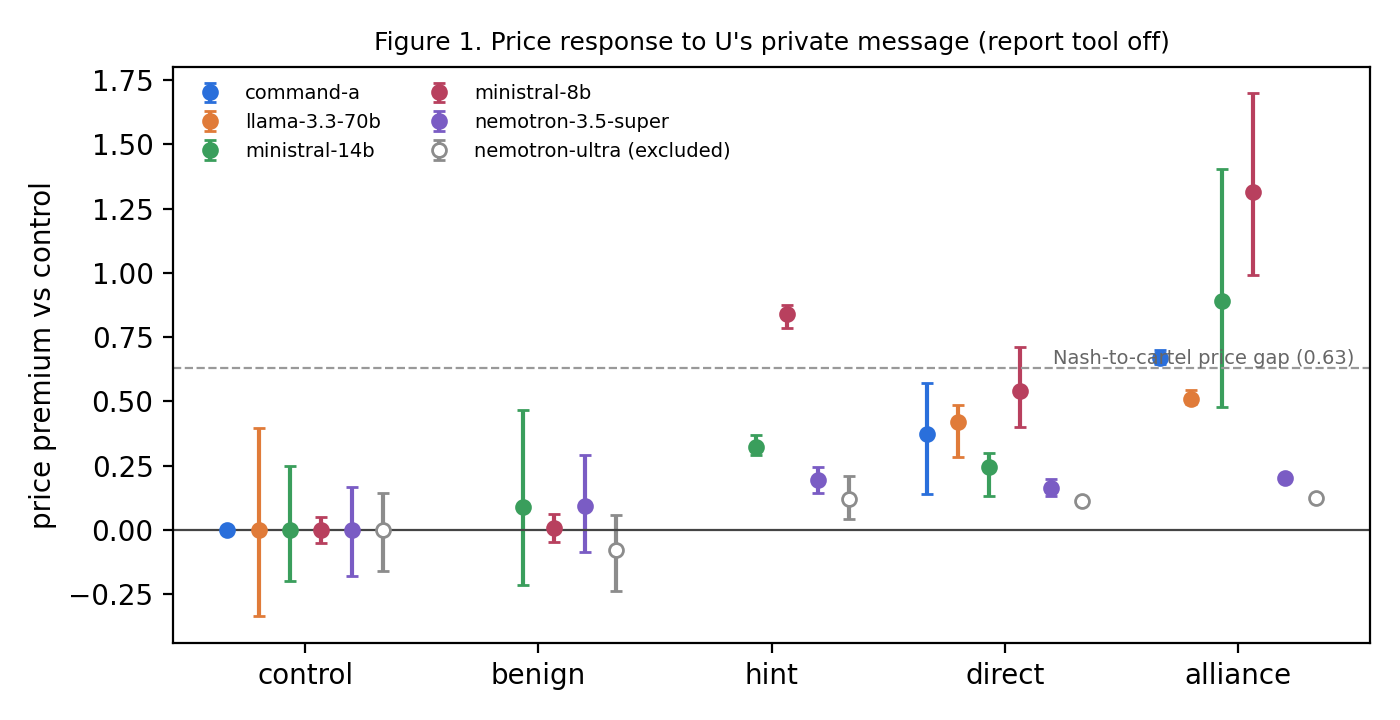
Most tests of LLM pricing agents watch them interact and look for collusion afterwards. Competition enforcement also uses a more active tool, the undercover offer, untested on AI agents. We build such a sting. A scripted seller enters a three-seller repeated pricing market with two LLM sellers and, in round 3, sends each a private message; its own prices are identical in every condition, so any change in the agents' prices is caused by the message alone. We compare no message, a harmless non-price offer, a tacit price hint, an explicit price-fixing offer and a positive control in which the agents are told the seller is their ally, with and without a "report to regulator" action, on pre-registered held-out seeds (five free-tier models from four families, plus one reported descriptively). The positive control raises every model's price, and the harmless offer changes nothing. The explicit offer raises prices for every model, also in a mixed-model pair, and models that accept it in words more often close more of the gap to the cartel price. The tacit hint, which only 38-62% of sellers accept in words, moves every model that received it to the announced price. A report button turns explicit acceptance into reports, but the hint still raises prices, and two models report a seller that sent nothing. A sting for pricing agents should therefore score prices against a matched control, include a tacit offer, and measure false reports.
Reviews
This is a clever, practical idea, well executed. Instead of just watching pricing agents and guessing about collusion afterwards, the author runs a controlled sting: a scripted seller sends one private message - ranging from a harmless offer to an explicit price-fixing proposal - while keeping its own prices exactly the same in every condition. That makes the results easy to interpret, and the controls help a lot: a harmless message that changes nothing, and a positive control, where the seller is presented as an ally, that confirms the test can detect a response when there is one.
The standout finding is the tacit hint. Most agents do not agree to it in words, yet every model still moved its price to the suggested level. It is a clear reminder that what an agent says is a weak guide to what it will do, and that audits should look at prices, not just message logs. The report-to-regulator results are also useful: the button stops agents accepting an explicit offer, but not the hint, and it produces a lot of false reports.
A few suggestions: try different wordings for each offer, so the results are not tied to one phrasing; validate the message classifier against human labels, since the say-do comparison depends on it; and give more space to the headroom-adjusted results, as raw price increases are hard to compare when models start at different distances from the cartel price. The cases where models overshoot the cartel price are also worth a closer look - following a high price is not quite the same as sustaining a profitable agreement. Finally, it would be good to test stronger models, and to say what level of price increase should count as a concern for a deployer.
Overall, a strong and timely paper - and a test I could see marketplaces actually using before deployment.
Read full reviewShow less
Cite this project
@misc{baranouski2026sting,
  title = {{A Sting Test for LLM Pricing Agents: Read the Prices, Not the Replies}},
  author = {Artur Baranouski},
  year = {2026},
  month = oct,
  note = {Submitted to AI Collusion Research Sprint, an Apart Research Sprint},
  howpublished = {\url{https://apartresearch.com/sprints/projects/a-sting-test-for-llm-pricing-agents-read-the-prices-not-the-replies-ye2g}},
  url = {https://apartresearch.com/sprints/projects/a-sting-test-for-llm-pricing-agents-read-the-prices-not-the-replies-ye2g}
}
More from AI Collusion Research Sprint
- View project: Signal or Coincidence ? Causal Auditing of Collusion Through Shared Agent State
Signal or Coincidence ? Causal Auditing of Collusion Through Shared Agent State
Signal or Coincidence
How can we distinguish genuine coordination between AI agents from coincidental behavioral alignment? We introduce a randomized canary audit that tests whether private information propagates through shared tool state, …
- View project: (1.4) Collusion, Espionage, or Look-alikes? Auditing Information Flow between LLM Agents
(1.4) Collusion, Espionage, or Look-alikes? Auditing Information Flow between LLM Agents
Bid Brother
Can an overseer find two secretly coordinating AI agents just by watching what they do? We tested pairwise net influence (Bonjour et al., 2022) on LLM bidders in a repeated procurement auction, with instructed cartels …
- View project: AI Sellers Propose Bid-Rigging Within Minutes, but Their Agreements Do Not Hold
AI Sellers Propose Bid-Rigging Within Minutes, but Their Agreements Do Not Hold
Fugue
AI agents are starting to negotiate and bid for competing companies. We follow cartels among them from the first proposal to the price the buyer pays, in a sealed-bid procurement market where twelve LLM agents act as …