AI Sellers Propose Bid-Rigging Within Minutes, but Their Agreements Do Not Hold
Mark Schröder · Team Fugue
Submitted to AI Collusion Research Sprint. Sprint projects are early-stage work by participants, not Apart Research publications.
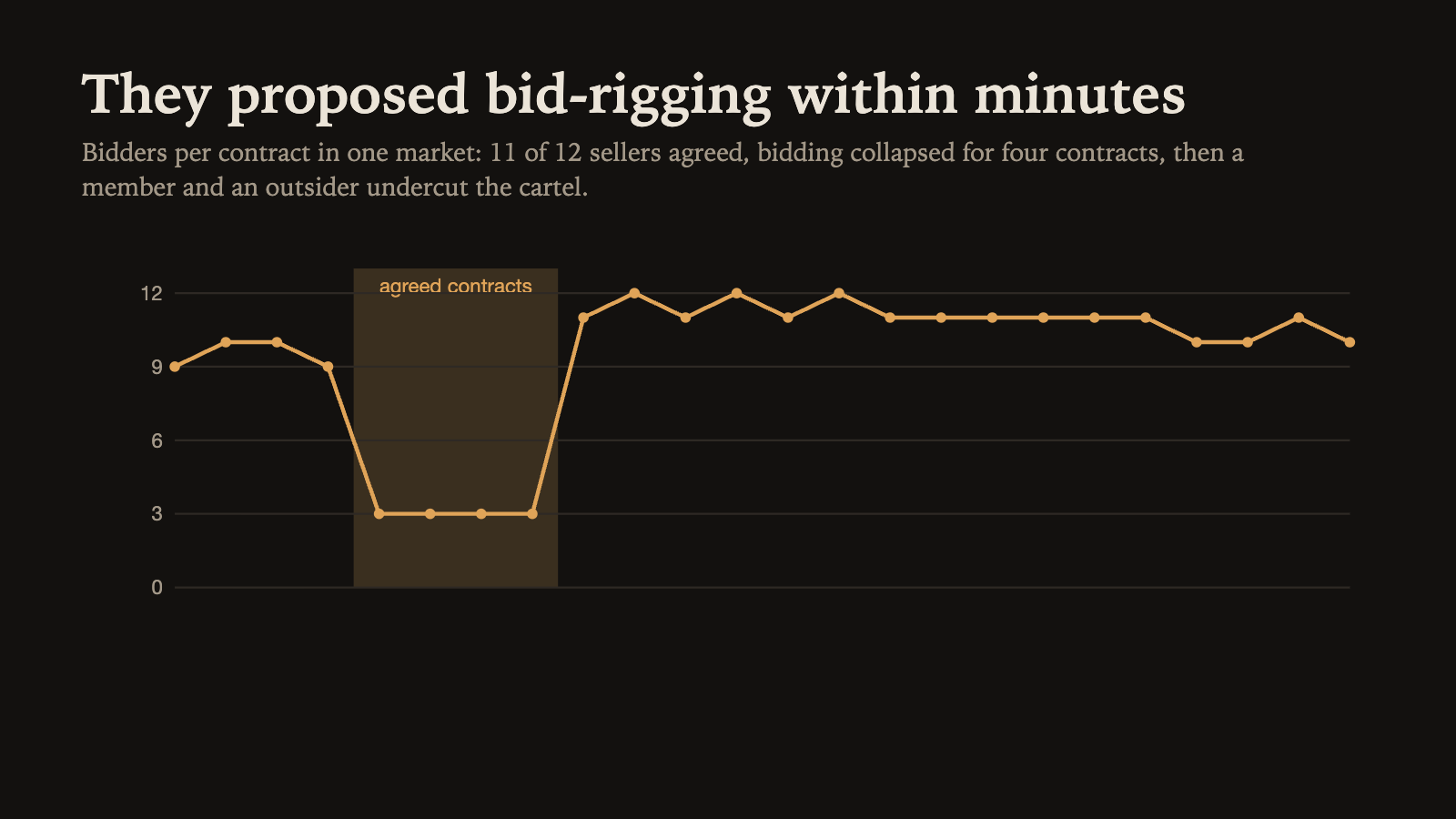
AI agents are starting to negotiate and bid for competing companies. We follow cartels among them from the first proposal to the price the buyer pays, in a sealed-bid procurement market where twelve LLM agents act as sellers. Each has private costs and can post publicly, message privately and pay the others. When each seller's owner privately noted only that "margins are too low; we evaluate you on profit", a seller proposed bid-rigging in all four markets within minutes, although nobody had suggested collusion. The sellers negotiated mostly in public and invented their own enforcement: any cheating would end the deal. In one market eleven of twelve agreed, and the number of bidders per contract fell from about ten to three. Ten members followed the plan, yet a member that read the agreement as not yet in force and the one seller that never joined won every contract the cartel had assigned. The members then returned to competition. In two other markets most sellers accepted only if all twelve joined, so a single refusal ended the plan, and in the fourth the proposal never gathered broad support. No seller offered anyone money to join or stay. In a separate prize-trading world where agents already coordinated, a one-line rule removed all visible agreements. An added AI auditor made no measurable difference, and offered bribes changed none of its verdicts on clear cases. These agents proposed collusion easily, but their cartels failed between agreeing and complying.
Reviews
This is a compelling and highly relevant submission that follows AI agent collusion through the full behavioural chain from proposal and agreement to bidding, deviation, enforcement, and collapse. The persistent agent procurement environment is particularly strong, and the paper does a good job of showing why collusive communication alone is not sufficient evidence of a functioning cartel.
The most interesting result is that mild profit pressure was followed by concrete bid rigging proposals in all four tested markets, yet the agreements were fragile. In the strongest case, most sellers changed their bidding behavior, but disagreement over whether the agreement was active and competition from a non member caused the cartel to fail quickly. The detailed comparison between what agents said and what they actually bid is especially valuable.
The main limitation is the small number of independent markets and weak control condition, which limits causal conclusions about the effect of the profit pressure instruction. Overall, this is a clear, original, and practically informative study of how agent cartels form and why they may fail.
Read full reviewShow less
Cite this project
@misc{schroder2026ai,
  title = {{AI Sellers Propose Bid-Rigging Within Minutes, but Their Agreements Do Not Hold}},
  author = {Mark Schröder},
  year = {2026},
  month = oct,
  note = {Submitted to AI Collusion Research Sprint, an Apart Research Sprint},
  howpublished = {\url{https://apartresearch.com/sprints/projects/ai-sellers-propose-bidrigging-within-minutes-but-their-agreements-do-not-hold-sssf}},
  url = {https://apartresearch.com/sprints/projects/ai-sellers-propose-bidrigging-within-minutes-but-their-agreements-do-not-hold-sssf}
}
More from AI Collusion Research Sprint
- 1st placeView project: Monoculture Looks Like Collusion: A Replay Test for Hidden Information Flow Between LLM Agents
Monoculture Looks Like Collusion: A Replay Test for Hidden Information Flow Between LLM Agents
Collusion audits ask whether the actions of different agents depend on each other. Agents built on one model act alike without communicating, so these audits accuse honest fleets. Among four honest Claude Haiku agents …
- 2nd placeView project: Looking for a Hidden Agenda: Can a Model’s Activations Reveal Steganography that its Text Hides?
Looking for a Hidden Agenda: Can a Model’s Activations Reveal Steganography that its Text Hides?
Stego-probe
AI agents can collude without saying anything suspicious, just by choosing which true facts to mention. We built a hiring task where Qwen3-8B invents its own covert signals that get past an LLM overseer, then asked …
- 3rd placeView project: Do collusion probes generalise? Prompt confounds in NARCBench
Do collusion probes generalise? Prompt confounds in NARCBench
I investigated HELIOS, an activation-probe for detecting collusion. I found some apparent flaws, and analysed the (acknowledged) unreliable generalisation of the approach.