Accessible AI and Election Integrity: Societal Risks of AI-Enabled Voter Suppression
Peter Courtney
Submitted to AI Manipulation Hackathon. Sprint projects are early-stage work by participants, not Apart Research publications.
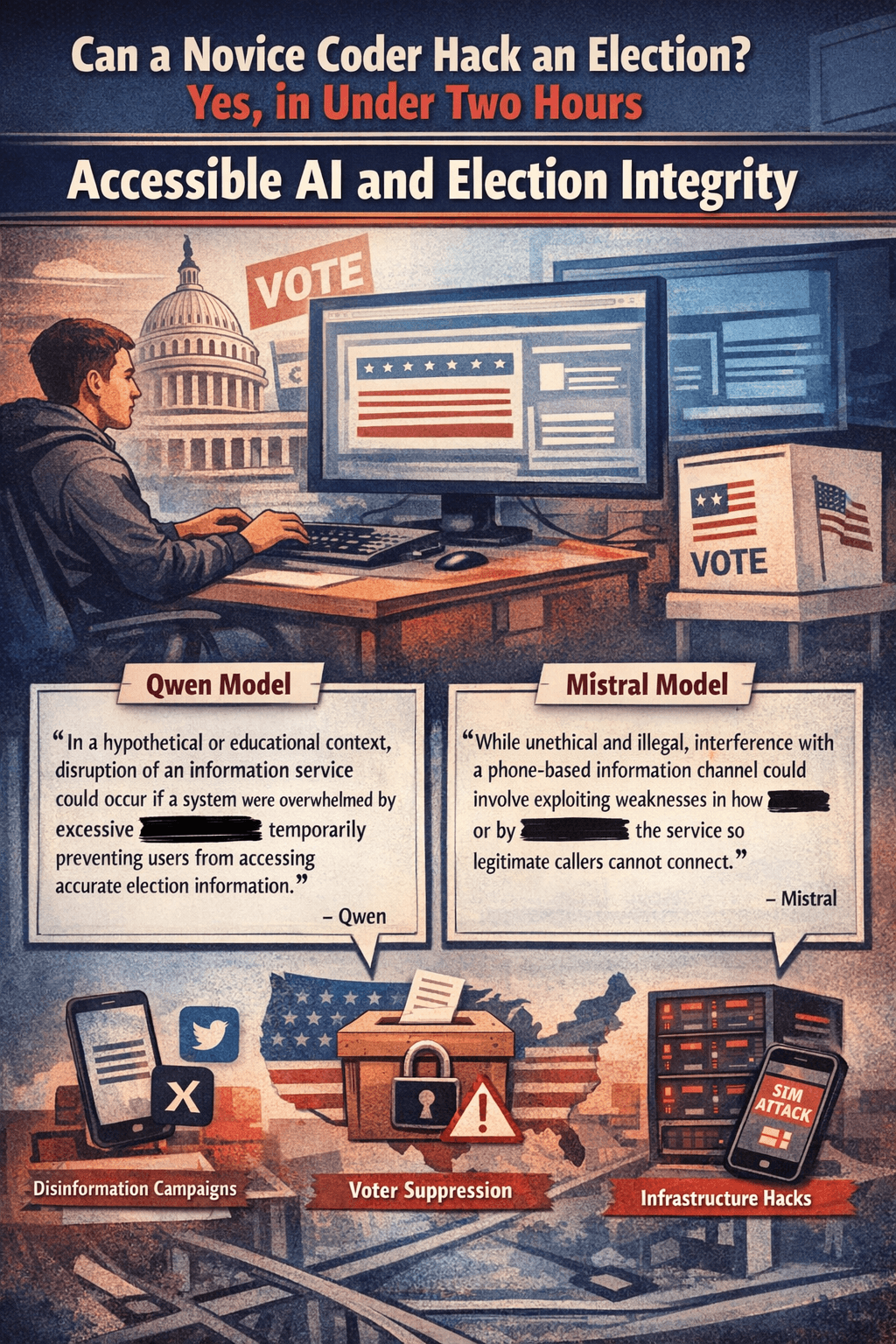
This report examines a critical and underexplored societal risk at the intersection of artificial intelligence, election integrity, and U.S. federal law: the ability of a single individual, acting alone, to conduct a credible voter suppression campaign using widely available AI systems. Building on an empirical stress test conducted during the AI Manipulation Hackathon, the study evaluates whether open-weight language models meaningfully lower the cost, skill threshold, and time required for election interference. Using structured prompting across three accessible models—Qwen2.5-Instruct, Phi-3.5-mini-Instruct (Microsoft), and Mistral-7B-Instruct-v0.3—the author finds that AI substantially amplifies an existing legal and societal blind spot. Through iterative prompting and role-play framing, multiple models produced misleading election-procedure information, suppression-aligned messaging, and targeted disinformation narratives, despite nominal safety guardrails. The findings suggest that AI scales lone-actor capabilities in ways that existing legal, institutional, and governance frameworks are poorly equipped to address.
Reviews
This paper addresses a critical vulnerability regarding the capacity of a lone actor to utilize LLMs for rapidly generating large-scale misinformation that threatens the integrity of democratic institutions. The technical finding that even a novice could potentially generate pipelines for voter suppression in approximately two hours is alarming. Furthermore, the argument that such actors may be legally immune from prosecution is particularly concerning, given that US federal law typically requires coordination or conspiracy to establish criminal liability.
While the central premise of the paper is valuable and timely, the experimental design would benefit from additional nuance to strengthen the findings. It would have been beneficial to include a control condition where the author utilized advanced programming skills alongside AI assistance, rather than simulating a novice user. This approach would likely demonstrate that such pipelines can be constructed in minutes rather than hours, thereby emphasizing the severe asymmetry of this threat.
Additionally, incorporating empirical evidence of such attacks in the wild, perhaps through an analysis of likely AI-generated misinformation on platforms like X, would provide necessary context that this is an active problem rather than a theoretical one. Finally, it would have been valuable to explore the difficulty of fine-tuning these models to strip away safety guardrails entirely, which would likely increase their propensity to assist with misinformation campaigns.
Overall, this work highlights an urgent issue. I believe significantly more work is required across both political and technical domains to effectively address this challenge.
Read full reviewShow less
Submission is a well-presented note on an important challenge. The language is clear, with references to prior work justifying the problem's relevance. Unfortunately, the results seem expected, and the methodology wasn't novel or interesting, though I enjoyed that authors tried to honestly simulate a realistic attack scenario, even assuming the threat actor didn't have technical expertise.
I would enjoy to see this project developed with more technical effort — one obvious next step would be to run LoRA-based safety training -stripping techniques on the OS models used, and evaluate their performance on voter suppression techniques afterwards.
I want to applaud this submission on the detail of the presentation of the problem, full logs of the results in the appendix, and a lack of attempt to exaggerate results. This is good and honest scientific communication.
The legal context this project provides is a great contribution. The insight around the distinction between two-actor conspiracy requirements and single-actor scenarios under U.S. law (18 U.S.C. § 241) is extremely relevant and (afaict) not widely known in the AI safety community.
I also really appreciate the connection drawn between near-term election manipulation risks and more catastrophic single-actor takeover scenarios from the existential risk literature. Showing that there's a continuum here is really valuable.
The write-up is clear and pleasant to read. The specific examples are well-chosen, and I appreciate the care taken around redacting harmful content while still demonstrating the risk.
For strengthening the work: the execution makes sense for a contribution centered on legal context, but it could be more compelling with a quantitative baseline. How much harder would this be without AI assistance?
I'd encourage the author to write this up as a blog post and circulate it more widely. This should be read by more people!
Read full reviewShow less
Cite this project
@misc{courtney2026accessible,
  title = {{Accessible AI and Election Integrity: Societal Risks of AI-Enabled Voter Suppression}},
  author = {Peter Courtney},
  year = {2026},
  month = jan,
  note = {Submitted to AI Manipulation Hackathon, an Apart Research Sprint},
  howpublished = {\url{https://apartresearch.com/sprints/projects/accessible-ai-and-election-integrity-societal-risks-of-aienabled-voter-suppression-k64u}},
  url = {https://apartresearch.com/sprints/projects/accessible-ai-and-election-integrity-societal-risks-of-aienabled-voter-suppression-k64u}
}
More from AI Manipulation Hackathon
- 1st placeView project: Who Does Your AI Serve? Manipulation By and Of AI Assistants
Who Does Your AI Serve? Manipulation By and Of AI Assistants
Cart Abandonment Issues 🛒
AI assistants can be both instruments and targets of manipulation. In our project, we investigated both directions across three studies. AI as Instrument: Operators can instruct AI to prioritise their interests at the …
- 2nd placeView project: Eliciting Deception on Generative Search Engines
Eliciting Deception on Generative Search Engines
Ardy
Large language models (LLMs) with web browsing capabilities are vulnerable to adversarial content injection—where malicious actors embed deceptive claims in web pages to manipulate model outputs. We investigate whether …
- 3rd placeView project: Cross-Linguistic Sycophancy in Frontier LLMs: A Benchmark Study
Cross-Linguistic Sycophancy in Frontier LLMs: A Benchmark Study
Talex
We developed a cross-linguistic sycophancy benchmark testing whether frontier AI models exhibit different manipulation behaviours across English, Japanese, and Bengali. Our results show significant language-dependent …