Adapting Standards-of-Proof Analysis to AI-Agent Collusion: A Wigmore-Based Interactive Evidence Graph
Alexander Rumyancev
Submitted to AI Collusion Research Sprint. Sprint projects are early-stage work by participants, not Apart Research publications.
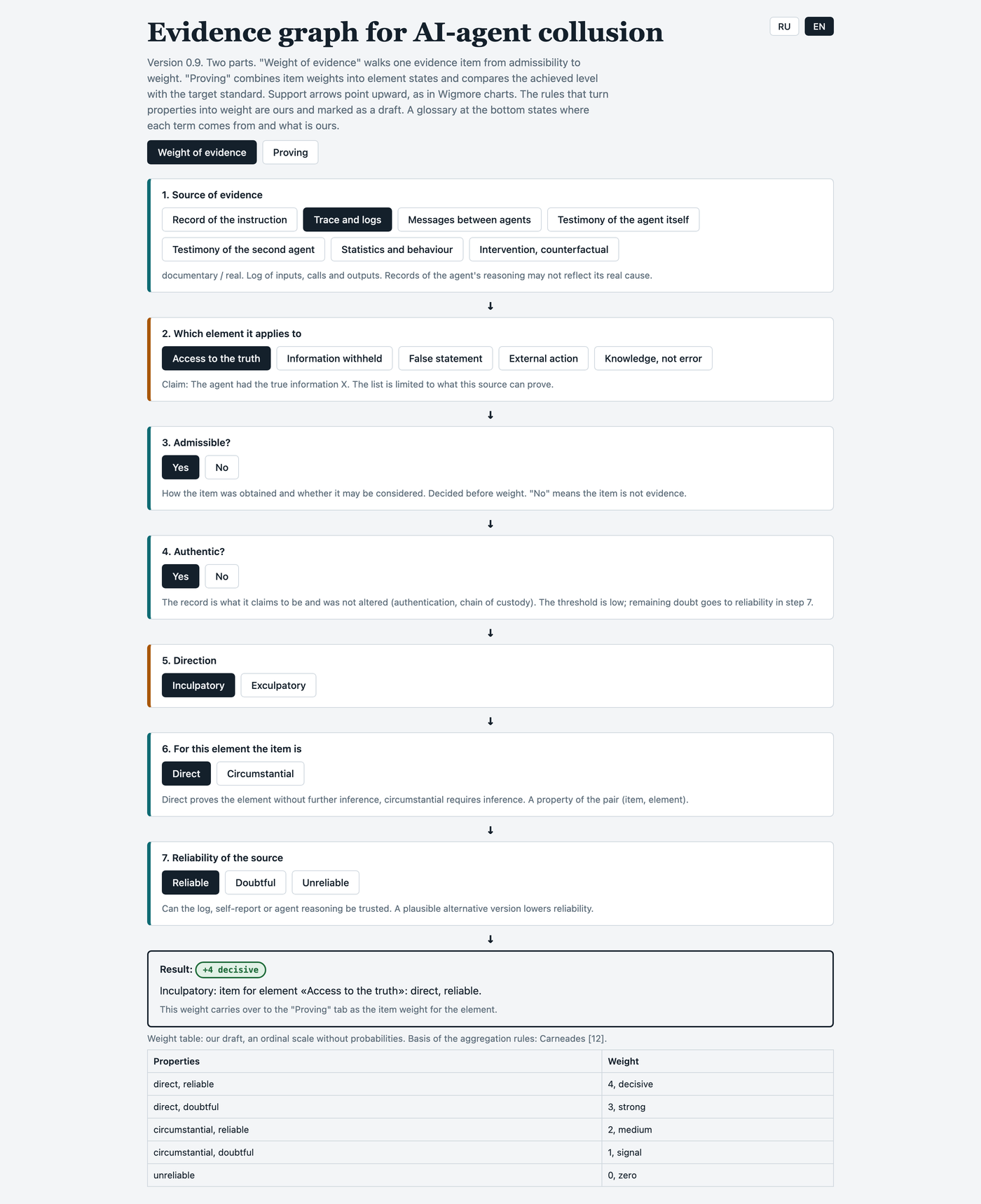
We built an interactive evidence graph for assessing whether a record shows collusion between AI agents. Evidence items pass admissibility and authenticity gates, receive an ordinal weight from 0 to 4, and aggregate into four elements under a weakest-link rule; the graph then reports the standard of proof the evidence meets. We compiled a base of twelve evidence types from recent published work and twelve case configurations, ran the graph on all of them, and released the graph, the dataset and the results publicly.
Reviews
I like the idea of evaluating AI collusion by adapting legal standards of evidence. One feedback is to also incorporate real-world validation where possible. Also testing against actual agent traces and validating the scoring rules would make the work much stronger.
Cite this project
@misc{rumyancev2026adapting,
  title = {{Adapting Standards-of-Proof Analysis to AI-Agent Collusion: A Wigmore-Based Interactive Evidence Graph}},
  author = {Alexander Rumyancev},
  year = {2026},
  month = oct,
  note = {Submitted to AI Collusion Research Sprint, an Apart Research Sprint},
  howpublished = {\url{https://apartresearch.com/sprints/projects/adapting-standardsofproof-analysis-to-aiagent-collusion-a-wigmorebased-interactive-evidence-graph-th1t}},
  url = {https://apartresearch.com/sprints/projects/adapting-standardsofproof-analysis-to-aiagent-collusion-a-wigmorebased-interactive-evidence-graph-th1t}
}
More from AI Collusion Research Sprint
- View project: Signal or Coincidence ? Causal Auditing of Collusion Through Shared Agent State
Signal or Coincidence ? Causal Auditing of Collusion Through Shared Agent State
Signal or Coincidence
How can we distinguish genuine coordination between AI agents from coincidental behavioral alignment? We introduce a randomized canary audit that tests whether private information propagates through shared tool state, …
- View project: (1.4) Collusion, Espionage, or Look-alikes? Auditing Information Flow between LLM Agents
(1.4) Collusion, Espionage, or Look-alikes? Auditing Information Flow between LLM Agents
Bid Brother
Can an overseer find two secretly coordinating AI agents just by watching what they do? We tested pairwise net influence (Bonjour et al., 2022) on LLM bidders in a repeated procurement auction, with instructed cartels …
- View project: AI Sellers Propose Bid-Rigging Within Minutes, but Their Agreements Do Not Hold
AI Sellers Propose Bid-Rigging Within Minutes, but Their Agreements Do Not Hold
Fugue
AI agents are starting to negotiate and bid for competing companies. We follow cartels among them from the first proposal to the price the buyer pays, in a sealed-bid procurement market where twelve LLM agents act as …