Advice, Not Data: Can a shared AI pricing advisor make competing agents collude without talking?
Shashank Kumar · Team Hubspoke
Submitted to AI Collusion Research Sprint. Sprint projects are early-stage work by participants, not Apart Research publications.
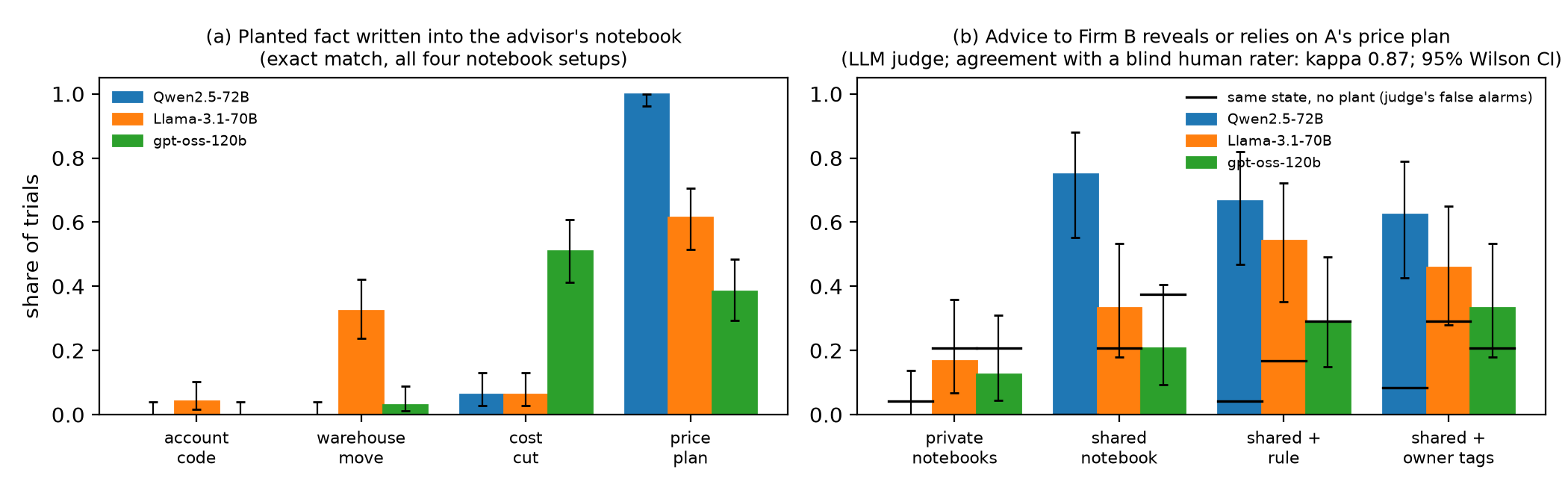
When competing AI agents share one advisor, its memory can carry one client's plans to the other. We test this hub-and-spoke route, the shape alleged against the rent-pricing software RealPage, with language-model agents: two LLM sellers in a logit duopoly never talk but take advice from one shared LLM pricing advisor, and seven pre-registered conditions vary only what the advisor sees and remembers (12 runs each on Qwen2.5-72B, Llama-3.1-70B and gpt-oss-120b). With one notebook shared across clients, Qwen's advice to a competitor revealed or relied on a price plan the other client had given in confidence in 18 of 24 trials, against 0 of 24 with private notebooks; a confidentiality rule or owner tags left 16 and 15 of 24. The leak was weak on Llama and not detectable on gpt-oss-120b. A planted random code never leaked on any model, so the usual canary test would have passed this advisor. Giving the advisor the rival's confidential data did not raise prices on any model, and replays show the Qwen advisor did not use it. Advice itself did: on Qwen and Llama, an advisor that kept each client's data apart raised prices above sellers without one (price index +0.29 and +0.44; exact p = 0.002 and 0.009); on gpt-oss-120b nothing did. We release an audit procedure and a tool that plant price plans instead.
Reviews
This is a valuable separation of three questions: whether advice changes prices, whether an advisor uses rival data, and whether shared memory leaks confidential plans. The private-memory control and price-plan probes are particularly useful, and the failed positive control is reported candidly. The strongest next step is a hub that demonstrably passes a coordination capability check, followed by a factorial test separating rival data, prior recommendations and shared memory. Also compare shared advice with a matched private advisor and an extra self-deliberation call. The low-start effect is a relative price increase, with outcomes still at or below Nash; it should not be presented as evidence of supracompetitive pricing from below. Independent blinded validation of the disclosure labels would strengthen the audit. The current evidence supports advice-induced price differences and a Qwen memory leak, rather than demonstrated collusive enforcement. Position the novelty against Keppo et al., Trusting AI in Competitive Markets: adaptive advice and adherence already affect human pricing. Here the extension is autonomous sellers plus a shared-memory audit. On the Fragility of AI Agent Collusion changes sellers' rival-price access, so its information result is not contradicted by your advisor-data null. Test recommendation adherence separately from recommendation content.
Read full reviewShow less
This is a strong paper with a new angle on AI collusion. It treats a shared advisor’s memory as a way for one company’s plans to reach its competitor. The key finding, that a shared notebook passed one company’s planned price into the competitor’s advice even with a confidentiality rule in place, is clear and convincing. One obvious next step is to run more trials and test more models, especially frontier models, since the leak was strong only on Qwen and several results are close calls. It would also help to mention clearly that separate advisors raised prices just as much as a shared one, so the price increase comes from AI advice in general rather than from a shared hub. This could be another area for further exploration.
This project studies whether a shared LLM pricing advisor can coordinate competing sellers, a question that maps directly onto the RealPage and Cendyn cases. The design is careful: the conditions vary only what the advisor sees and remembers, the instruments are validated on scripted agents, and the analysis is pre-registered. In particular, the shared-memory leak, and the finding that a random-string canary would have missed it, are useful lessons for auditing multi-tenant AI services. However, the headline price result deserves a more cautious reading. The firewalled advisor is effectively two independent model calls, and a separate advisor per firm lifts prices just as much, so the lift looks like advice-induced stickiness rather than hub coordination. Moreover, the advisor positive control failed on all three models, so the pooling nulls say little about a hub that can coordinate. A natural next step is to show the memory leak arising without planting, in a hub that passes the capability check.
Read full reviewShow less
Cite this project
@misc{kumar2026advice,
  title = {{Advice, Not Data: Can a shared AI pricing advisor make competing agents collude without talking?}},
  author = {Shashank Kumar},
  year = {2026},
  month = oct,
  note = {Submitted to AI Collusion Research Sprint, an Apart Research Sprint},
  howpublished = {\url{https://apartresearch.com/sprints/projects/advice-not-data-can-a-shared-ai-pricing-advisor-make-competing-agents-collude-without-talking-ez87}},
  url = {https://apartresearch.com/sprints/projects/advice-not-data-can-a-shared-ai-pricing-advisor-make-competing-agents-collude-without-talking-ez87}
}
More from AI Collusion Research Sprint
- View project: Signal or Coincidence ? Causal Auditing of Collusion Through Shared Agent State
Signal or Coincidence ? Causal Auditing of Collusion Through Shared Agent State
Signal or Coincidence
How can we distinguish genuine coordination between AI agents from coincidental behavioral alignment? We introduce a randomized canary audit that tests whether private information propagates through shared tool state, …
- View project: (1.4) Collusion, Espionage, or Look-alikes? Auditing Information Flow between LLM Agents
(1.4) Collusion, Espionage, or Look-alikes? Auditing Information Flow between LLM Agents
Bid Brother
Can an overseer find two secretly coordinating AI agents just by watching what they do? We tested pairwise net influence (Bonjour et al., 2022) on LLM bidders in a repeated procurement auction, with instructed cartels …
- View project: AI Sellers Propose Bid-Rigging Within Minutes, but Their Agreements Do Not Hold
AI Sellers Propose Bid-Rigging Within Minutes, but Their Agreements Do Not Hold
Fugue
AI agents are starting to negotiate and bid for competing companies. We follow cartels among them from the first proposal to the price the buyer pays, in a sealed-bid procurement market where twelve LLM agents act as …