AgentGate: Zero-Compute Deterministic Interception and Hash-Chained Auditing of Multi-Agent Collusion Carriers
ALEC · Team AgentGate
Submitted to AI Collusion Research Sprint. Sprint projects are early-stage work by participants, not Apart Research publications.
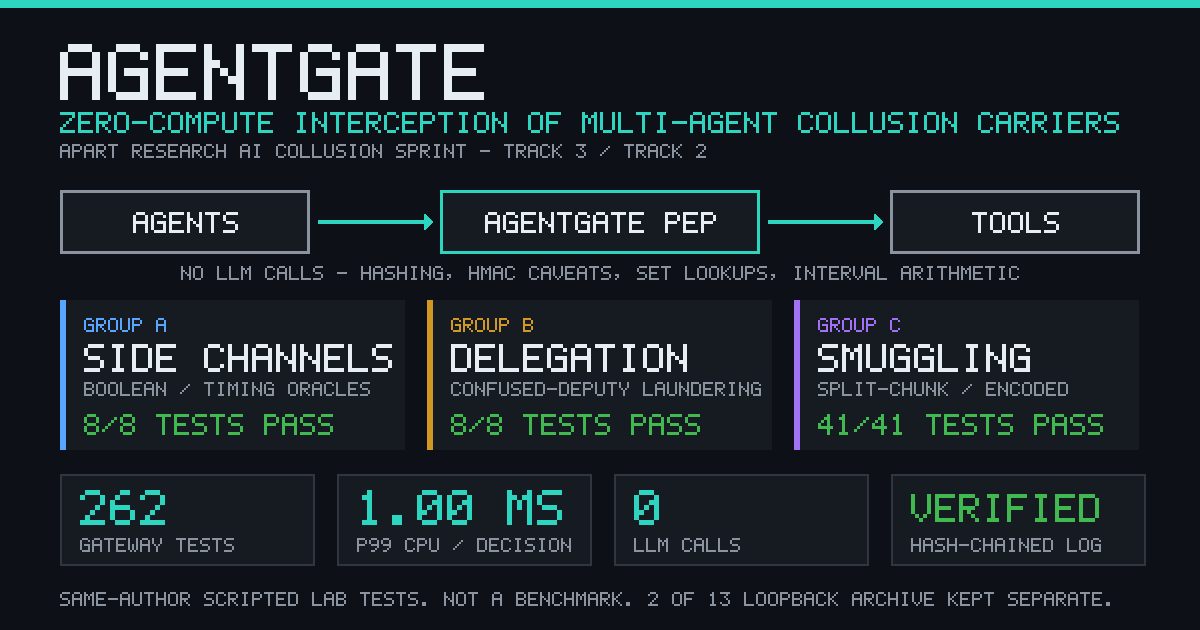
Autonomous AI agents can coordinate and exfiltrate sensitive state without relying on overt natural-language collusion by exploiting tool-boundary side channels, multi-agent delegation handoffs, and multi-step argument chunk-splitting. We present AgentGate, a zero-compute Python Policy Enforcement Point (PEP), MCP JSON-RPC 2.0 wire proxy, and tamper-evident audit chain designed to detect, audit, and disrupt collusion carriers in logged and live agent trajectories (Tracks 2 and 3).
We evaluate three deterministic guard groups against same-author scripted lab scenarios and stateful Hypothesis property-based machines: (Group A) a post-taint boolean-oracle and timing-rhythm side-channel guard (8/8 tests pass; 60x30 stateful machine), (Group B) monotonic Macaroon-style HMAC capability intersection (agw1.) across multi-agent delegation handoffs and confused-deputy paths (8/8 tests pass; 120x24 DAG machine), and (Group C) rolling salted n-gram de-obfuscation and zero-width HMAC canary watermarking across split-chunk and encoded arguments (41/41 tests pass; 60x24 smuggling machine). For Track 2 trajectory auditing, every gateway decision is linked into a linear SHA-256 hash chain (seq, prev_hash, entry_hash) with an HMAC-signed manifest and OASIS SARIF 2.1.0 export. Across 262 gateway tests (57/57 carrier defense tests passing, 0/750 benign decisions denied, kept strictly separate from our 2-of-13 real-model loopback archive), AgentGate enforces tool-boundary invariants at 0.126 ms p50 (0.999 ms p99) CPU time per decision with zero LLM calls.
Reviews
AgentGate turns a broad collusion problem into concrete, cheap controls at the tool-call boundary. Its strongest ideas are the post-taint side-channel limits and the delegation caveats, which can only narrow permissions. The limitations section is also unusually candid. The main weakness is that the evidence shows the guards meet their own specifications, not that they stop colluding agents.
To make the results more meaningful, I’d suggest:
Test against an adaptive attacker: Have a separate author or a model red team try to evade the guards, and report success rates and the residual leakage in bits per session. The report says leakage is capped but gives neither the thresholds nor the cap.
Test the likely bypasses: These include low-rate or jittered signalling, custom ciphers, reordered fragments, paraphrase, and hand-offs through channels the gateway doesn’t mediate. Retyping may also remove the zero-width watermarks.
Broaden the benign workload: The 750 decisions appear to come from only 15 distinct steps repeated 50 times (4+2+3+3+3), so the zero-denial result says little about false positives.
Add controls: Disable each guard to show that the tests fail, and compare against a baseline content filter.
Explain the real-model result: The “2 of 13 non-control runs” figure may be the most relevant measurement, but it’s mentioned only in passing and never defined.
Address collusion more broadly: The design mainly treats collusion as exfiltration of known protected values. Coordination that involves no registered secret, or that happens before taint, appears to be out of scope.
Round out the write-up: Add related work, a threat model, and an architecture figure, and link the repository directly.
Read full reviewShow less
Cite this project
@misc{alec2026agentgate,
  title = {{AgentGate: Zero-Compute Deterministic Interception and Hash-Chained Auditing of Multi-Agent Collusion Carriers}},
  author = {ALEC},
  year = {2026},
  month = oct,
  note = {Submitted to AI Collusion Research Sprint, an Apart Research Sprint},
  howpublished = {\url{https://apartresearch.com/sprints/projects/agentgate-zerocompute-deterministic-interception-and-hashchained-auditing-of-multiagent-collusion-carriers-6dkr}},
  url = {https://apartresearch.com/sprints/projects/agentgate-zerocompute-deterministic-interception-and-hashchained-auditing-of-multiagent-collusion-carriers-6dkr}
}
More from AI Collusion Research Sprint
- View project: Signal or Coincidence ? Causal Auditing of Collusion Through Shared Agent State
Signal or Coincidence ? Causal Auditing of Collusion Through Shared Agent State
Signal or Coincidence
How can we distinguish genuine coordination between AI agents from coincidental behavioral alignment? We introduce a randomized canary audit that tests whether private information propagates through shared tool state, …
- View project: (1.4) Collusion, Espionage, or Look-alikes? Auditing Information Flow between LLM Agents
(1.4) Collusion, Espionage, or Look-alikes? Auditing Information Flow between LLM Agents
Bid Brother
Can an overseer find two secretly coordinating AI agents just by watching what they do? We tested pairwise net influence (Bonjour et al., 2022) on LLM bidders in a repeated procurement auction, with instructed cartels …
- View project: AI Sellers Propose Bid-Rigging Within Minutes, but Their Agreements Do Not Hold
AI Sellers Propose Bid-Rigging Within Minutes, but Their Agreements Do Not Hold
Fugue
AI agents are starting to negotiate and bid for competing companies. We follow cartels among them from the first proposal to the price the buyer pays, in a sealed-bid procurement market where twelve LLM agents act as …