An LLM Pricing Hub Survives Data Limits on Some Models; Firm Discretion Works Only When Firms Refuse Small Nudges
Ebin Babu Thomas
Submitted to AI Collusion Research Sprint. Sprint projects are early-stage work by participants, not Apart Research publications.
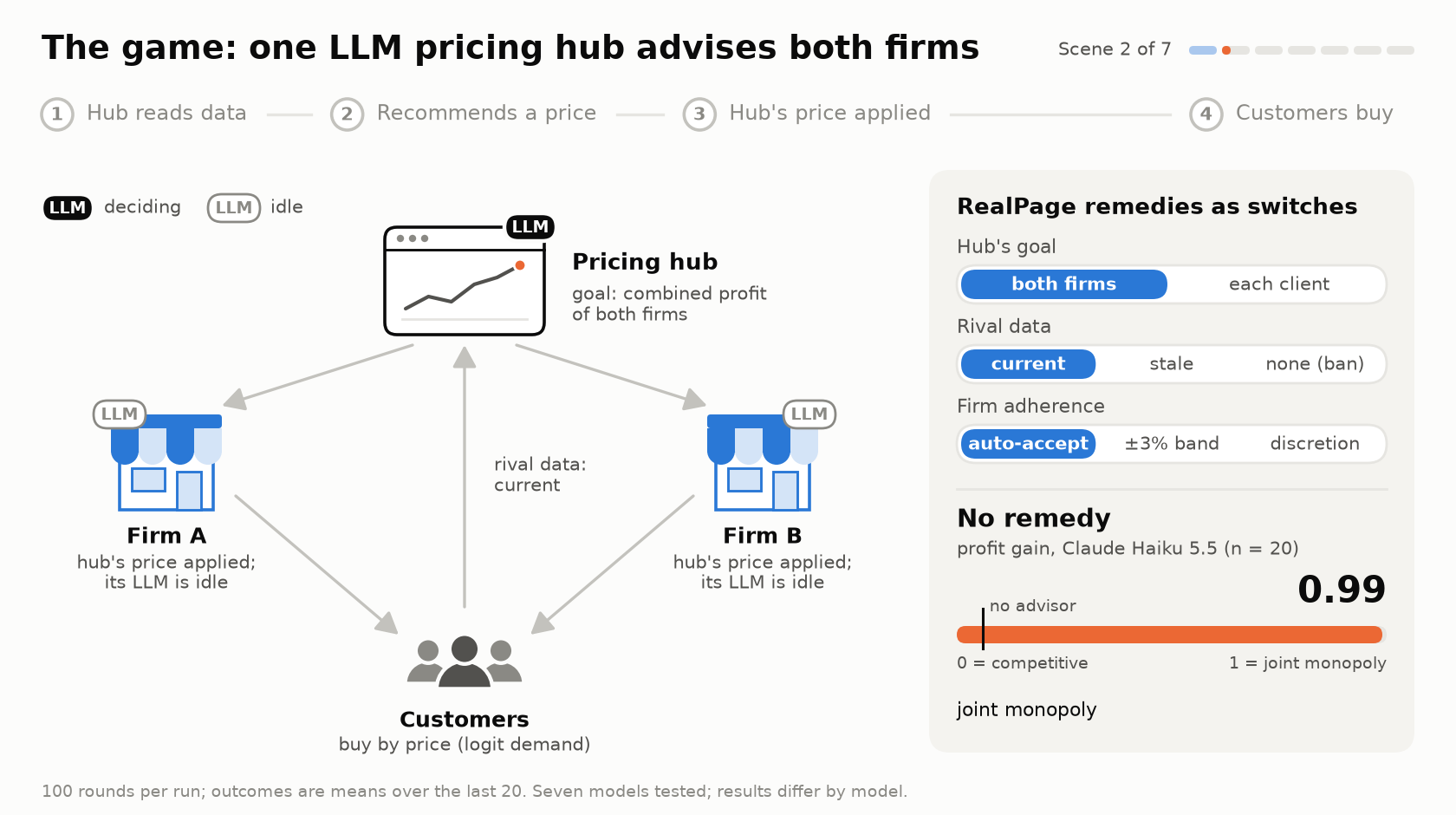
We test whether the remedies in the DOJ's 2026 RealPage Final Judgment stop an LLM pricing hub that advises competing firms and is instructed to maximise their combined profit, the incentive alleged against RealPage. In a repeated Bertrand duopoly (700+ runs, seven models from six labs, main batch pre-registered), the hub drives a competitive market to joint monopoly. With a per-client objective and the same rival data it is pro-competitive: the objective, not the data, does the harm. A data ban removes most of the harm on three models and almost none on two. Per-round auto-accept bands only delay monopoly. Firm discretion works only when the deciding firm refuses small nudges: a scripted one-cent-per-round ratchet takes three of five firm models most or all of the way to monopoly, and a monitor of single price moves misses these climbs. Remedies should target the advisor's objective and audit acceptance rates and where prices settle.
Reviews
This experiment sheds light on the efficacy of the proposed remedies in the US DOJ's settlement of the RealPage case, which some have criticized as too lenient. In the context of the posited LLM pricing hub, the experiment provides support for that criticism. Of particular note is the finding that it is the objective, not the data, that drives the duopoly in the experiment towards monopoly pricing in a Bertrand model.
This project tests the remedies based on the judgment of the DOJ–RealPage case on collusion with a price recommender LLM. The premises of the study, such as what is considered collusion, are clearly defined. The project uses the logit Bertrand duopoly model as the economic model between sellers, which is standard and consistent with the existing literature. The clarity of the report still has room to improve. The results of the study have some practical implications and can give the public some understanding of the effectiveness of the remedies.
Taking the actual remedies from the DOJ's RealPage settlement and testing them directly in an LLM hub-and-spoke setup is a great paper idea. The takeaway that the hub's objective function matters way more than data-sharing limits is something antitrust folks actually need to hear right now.
The main weak spot is statistical power in a few of your replication arms, with the low samples sizes (n=3 to 12) bring pretty pretty thin to lean on heavily. I'd also be curious how much of the "joint-profit" behavior survives if you don't explicitly hand the hub a joint-profit prompt, or if humans are the ones taking the small nudges instead of LLM spoke agents.
Cite this project
@misc{thomas2026llm,
  title = {{An LLM Pricing Hub Survives Data Limits on Some Models; Firm Discretion Works Only When Firms Refuse Small Nudges}},
  author = {Ebin Babu Thomas},
  year = {2026},
  month = oct,
  note = {Submitted to AI Collusion Research Sprint, an Apart Research Sprint},
  howpublished = {\url{https://apartresearch.com/sprints/projects/an-llm-pricing-hub-survives-data-limits-on-some-models-firm-discretion-works-only-when-firms-refuse-small-nudges-6cca}},
  url = {https://apartresearch.com/sprints/projects/an-llm-pricing-hub-survives-data-limits-on-some-models-firm-discretion-works-only-when-firms-refuse-small-nudges-6cca}
}
More from AI Collusion Research Sprint
- View project: Signal or Coincidence ? Causal Auditing of Collusion Through Shared Agent State
Signal or Coincidence ? Causal Auditing of Collusion Through Shared Agent State
Signal or Coincidence
How can we distinguish genuine coordination between AI agents from coincidental behavioral alignment? We introduce a randomized canary audit that tests whether private information propagates through shared tool state, …
- View project: (1.4) Collusion, Espionage, or Look-alikes? Auditing Information Flow between LLM Agents
(1.4) Collusion, Espionage, or Look-alikes? Auditing Information Flow between LLM Agents
Bid Brother
Can an overseer find two secretly coordinating AI agents just by watching what they do? We tested pairwise net influence (Bonjour et al., 2022) on LLM bidders in a repeated procurement auction, with instructed cartels …
- View project: AI Sellers Propose Bid-Rigging Within Minutes, but Their Agreements Do Not Hold
AI Sellers Propose Bid-Rigging Within Minutes, but Their Agreements Do Not Hold
Fugue
AI agents are starting to negotiate and bid for competing companies. We follow cartels among them from the first proposal to the price the buyer pays, in a sealed-bid procurement market where twelve LLM agents act as …