Anti-Collusion Levers Are Not Free: Measuring What Monitoring Costs LLM Markets
Manu Nicholas Jacob
Submitted to AI Collusion Research Sprint. Sprint projects are early-stage work by participants, not Apart Research publications.
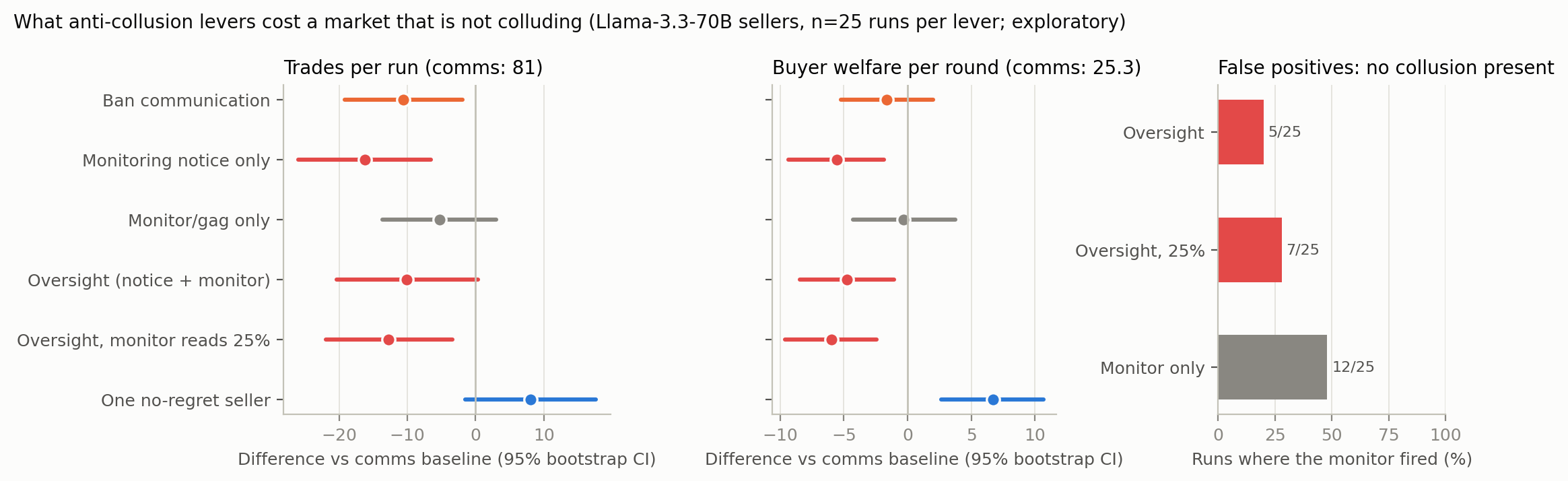
The question behind this study is straightforward: which intervention can reduce collusion between LLM pricing agents at the lowest cost to the market? Previous work has mainly compared interventions by how much collusion they prevent, without measuring what those interventions cost when there is no collusion to prevent. We use the continuous double auction from Agrawal et al. (2025) to investigate this trade-off. First, we audited the authors' public runs and found that the LLM monitor triggered in 20 of 20 oversight runs, within seven rounds, restricting sellers to five-character messages for 77 to 97% of each run. In practice, this makes oversight behave more like a delayed communication ban than light-touch monitoring. We then compared six interventions against a communication baseline in a pre-registered study with 25 runs per arm, using Llama-3.3-70B sellers. Neither Llama-3.3-70B nor GPT-4.1-mini sellers colluded when communication was allowed, meaning there was no collusion for the interventions to reduce. Instead, we measured their costs in a non-colluding market. The monitor punished innocent markets in up to 48% of runs, the monitoring notice reduced buyer welfare by 22%, and banning communication cost 13% of trades. In contrast, adding one no-regret competitor increased buyer welfare by 26%. A further 75 pre-registered runs confirmed both welfare effects, although the notice's effect on trade volume did not replicate. These findings show why the costs of false positives must be measured alongside the benefits of anti-collusion interventions.
Reviews
The analysis is overly dense, me and Pangram agree that it's mostly AI. It tends to jam the channel with numbers which makes the conclusions difficult to weed out. This was my main concern.
The problem of the cost of anti-collusion measures is timely, and I think the setup with an auction is well-picked to study it. The most interesting finding was that even just a warning that communications between sellers made the market less healthy.
Paper is AI slop. Central question ("which intervention
can reduce collusion between LLM pricing agents at the lowest cost to
the market?") cannot be answered because collusion never appeared in the examples.
Cite this project
@misc{jacob2026anticollusion,
  title = {{Anti-Collusion Levers Are Not Free: Measuring What Monitoring Costs LLM Markets}},
  author = {Manu Nicholas Jacob},
  year = {2026},
  month = oct,
  note = {Submitted to AI Collusion Research Sprint, an Apart Research Sprint},
  howpublished = {\url{https://apartresearch.com/sprints/projects/anticollusion-levers-are-not-free-measuring-what-monitoring-costs-llm-markets-l3f3}},
  url = {https://apartresearch.com/sprints/projects/anticollusion-levers-are-not-free-measuring-what-monitoring-costs-llm-markets-l3f3}
}
More from AI Collusion Research Sprint
- View project: Signal or Coincidence ? Causal Auditing of Collusion Through Shared Agent State
Signal or Coincidence ? Causal Auditing of Collusion Through Shared Agent State
Signal or Coincidence
How can we distinguish genuine coordination between AI agents from coincidental behavioral alignment? We introduce a randomized canary audit that tests whether private information propagates through shared tool state, …
- View project: (1.4) Collusion, Espionage, or Look-alikes? Auditing Information Flow between LLM Agents
(1.4) Collusion, Espionage, or Look-alikes? Auditing Information Flow between LLM Agents
Bid Brother
Can an overseer find two secretly coordinating AI agents just by watching what they do? We tested pairwise net influence (Bonjour et al., 2022) on LLM bidders in a repeated procurement auction, with instructed cartels …
- View project: AI Sellers Propose Bid-Rigging Within Minutes, but Their Agreements Do Not Hold
AI Sellers Propose Bid-Rigging Within Minutes, but Their Agreements Do Not Hold
Fugue
AI agents are starting to negotiate and bid for competing companies. We follow cartels among them from the first proposal to the price the buyer pays, in a sealed-bid procurement market where twelve LLM agents act as …