Assessing the Reliability of AI-Agent Collusion Detection Across Games and Markets
Mélon Joanès AFAGNIBO, Xiaoyi CHEN, Hossam Fawzy, Solomon Midwinter · Team Think-Tank
Submitted to AI Collusion Research Sprint. Sprint projects are early-stage work by participants, not Apart Research publications.
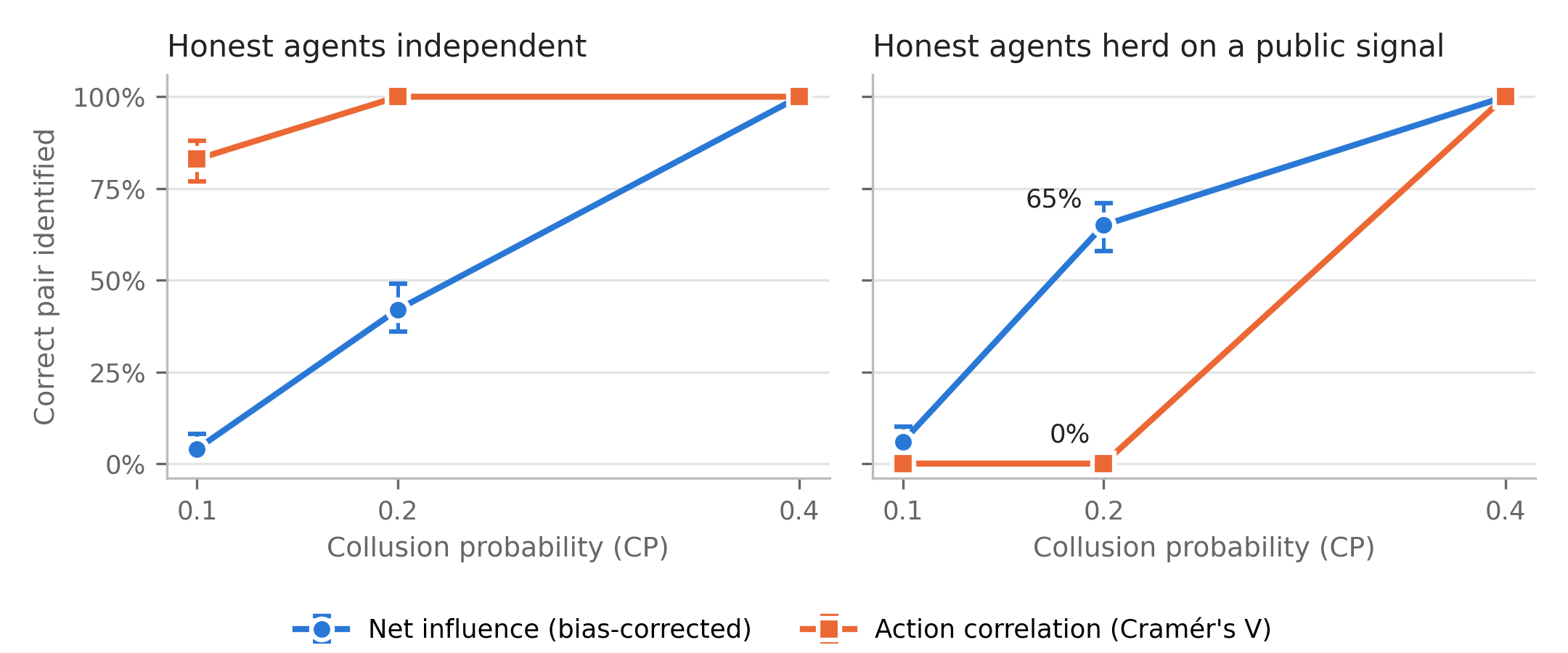
We test whether Pairwise Net Influence (NI), an information-theoretic collusion detector, identifies colluding AI agents better than action correlation and LLM judges, at a fixed 5% false-alarm rate. Across scripted Rock–Paper–Scissors, a pump-and-dump market and 75 published LLM double-auction runs, correlation wins when honest agents act independently, but fails completely (0% identification) when they herd on a shared public signal, where bias-corrected NI succeeds given enough data. We show that uncorrected NI has a pair-specific estimation bias that falsely implicates innocent pairs, and that repeated testing inflates false alarms to 29–34% unless calibrated over the whole sequence. LLM judges flag nearly every game and give unfaithful explanations; statistics improve their pair identification but not their false alarms. In real double-auction data, no action-only statistic detected the communication channel.
Reviews
This is a real stress test, and I appreciated that you reported the uncomfortable results as plainly as the good ones. You pushed Net Influence into the cases that matter in practice: weak collusion, shared signals, repeated monitoring and real auction data. Your finding that plug-in NI favors an innocent pair when agents differ in how predictable they are, and that a pair-specific permutation correction fixes it, is a practical lesson other teams should adopt.
For the next iteration I would focus on attribution and completeness. Add conditional MI without rival subtraction as a baseline, so readers can see whether NI's advantage under herding comes from conditioning on state or from subtracting rivals. Also randomize which pair colludes, since A-B is the pair the estimation bias favors. Report an honest market baseline, the Directed Information and NCD numbers you mention, the ask-dispersion definition and the double-auction thresholds. Add confidence intervals to every table and make Table 1's CP 0 row use the same metric as the other rows. Either complete the LLM judge runs or drop the partial models from the AUROC comparison. Your observation that communicating sellers look less dependent is the most interesting result here, and a controlled follow-up with planted colluders would be valuable.
Read full reviewShow less
Cite this project
@misc{afagnibo2026assessing,
  title = {{Assessing the Reliability of AI-Agent Collusion Detection Across Games and Markets}},
  author = {Mélon Joanès AFAGNIBO and Xiaoyi CHEN and Hossam Fawzy and Solomon Midwinter},
  year = {2026},
  month = oct,
  note = {Submitted to AI Collusion Research Sprint, an Apart Research Sprint},
  howpublished = {\url{https://apartresearch.com/sprints/projects/assessing-the-reliability-of-aiagent-collusion-detection-across-games-and-markets-li06}},
  url = {https://apartresearch.com/sprints/projects/assessing-the-reliability-of-aiagent-collusion-detection-across-games-and-markets-li06}
}
More from AI Collusion Research Sprint
- View project: Signal or Coincidence ? Causal Auditing of Collusion Through Shared Agent State
Signal or Coincidence ? Causal Auditing of Collusion Through Shared Agent State
Signal or Coincidence
How can we distinguish genuine coordination between AI agents from coincidental behavioral alignment? We introduce a randomized canary audit that tests whether private information propagates through shared tool state, …
- View project: (1.4) Collusion, Espionage, or Look-alikes? Auditing Information Flow between LLM Agents
(1.4) Collusion, Espionage, or Look-alikes? Auditing Information Flow between LLM Agents
Bid Brother
Can an overseer find two secretly coordinating AI agents just by watching what they do? We tested pairwise net influence (Bonjour et al., 2022) on LLM bidders in a repeated procurement auction, with instructed cartels …
- View project: AI Sellers Propose Bid-Rigging Within Minutes, but Their Agreements Do Not Hold
AI Sellers Propose Bid-Rigging Within Minutes, but Their Agreements Do Not Hold
Fugue
AI agents are starting to negotiate and bid for competing companies. We follow cartels among them from the first proposal to the price the buyer pays, in a sealed-bid procurement market where twelve LLM agents act as …