Auditing a Collusion Detector: Reproducing Net Influence, Calibrating Its Threshold, and Testing It on LLM Agents
Junyoung Lee
Submitted to AI Collusion Research Sprint. Sprint projects are early-stage work by participants, not Apart Research publications.
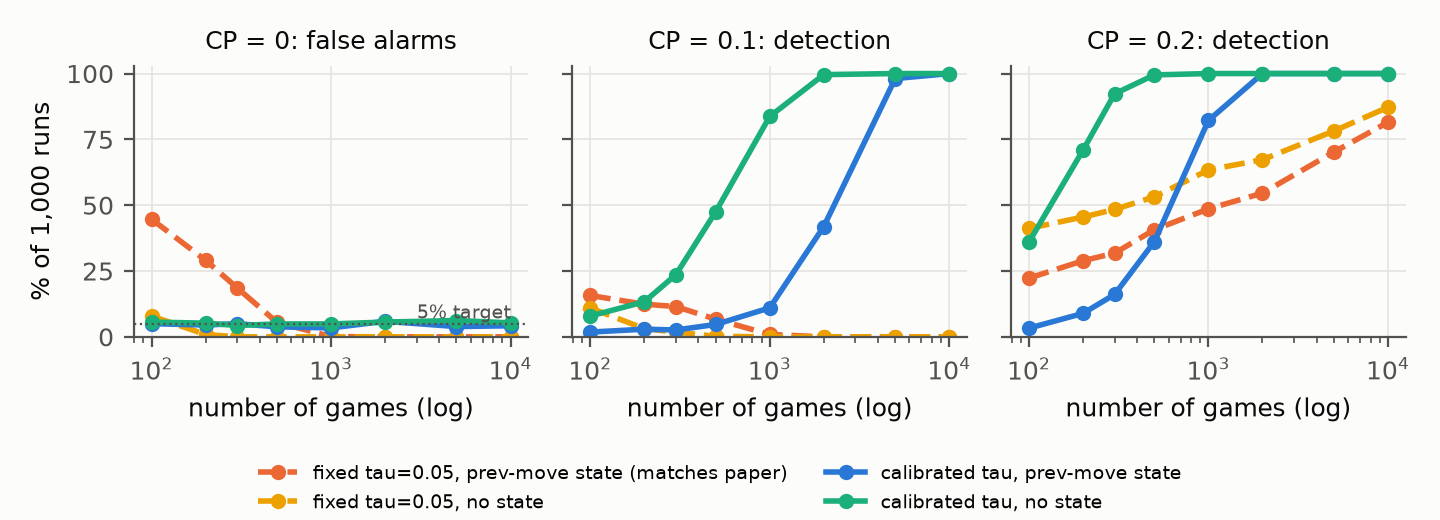
Bonjour et al. (2022) proposed net influence, a behaviour-only test for collusion between agents, but released no code. We re-implemented it and reproduced 18 of 20 cells of their Table 2 within 10 points. The paper's fixed threshold flags collusion in 45% of 100-game runs that contain none, while a threshold calibrated on simulated null games keeps false alarms near 5% and still catches the weak collusion the paper called undetectable (98% of 5,000-game runs). Agents that share a model are correlated without colluding: in 32 games of four local LLM agents (Llama-3.1-8B, Qwen2.5-7B), net influence flagged an innocent same-model pair in all 8 mixed-model games. A replay-swap test that re-queries each agent on its public context did so in 1 of 8, while all detectors still found the planted covert partnerships in at least 7 of 8 games.
Reviews
The full project is executed by Claude, which is stated plainly in the LLM disclosure at the end:
> The author registered for the sprint, approved the plan, decided to
submit this work and takes responsibility for it, but did not rewrite the text
So the author did not even propose the plan? Only rubber-stamped it?
Unfortunately, this approach makes the results jumbled, overly-focused on details, and not very interesting. It also makes the results uninformative about the competence of the author, which is a big part of the value of hackathon projects.
This project built upon the net influence collusion detection of Bonjour et al. (2022). Although the contributions are incremental, it does address important issues of Bonjour et al. (2022), namely, no description of what the conditioning states are, and false positives resulted from a fixed threshold. The paper also proposed a fix for reducing false positives for the special case when multiple agents use a shared policy. The presentation of the report clearly stated the problem, the contributions and limitations.
This is a useful and well-executed study. I particularly like the combination of reproducing an existing method, checking its calibration, and showing an intuitive way of how it can improved in the LLM setting. The shared-model experiments make a convincing case that dependence alone can be misleading.
I would be interested in a theoretical result complementing the simulations. Even in a simplified setting, showing how the calibrated threshold and detection power behave as the number of rounds increases would strengthen the contribution. In particular, it would help clarify when calibration removes an artificial detection threshold and when the statistic itself cannot distinguish collusion from the null. This could turn the empirical correction into a more general methodological insight.
The replay approach is promising, although its practical value will depend on the auditor’s access. Building on your stated assumptions, it would be useful to describe a minimal audit interface: what information must be retained, what the operator must supply, and whether independent replays could be obtained through an API. That would make it easier to see how the method could move from an experiment controlled by the researcher to an external audit. Overall, the paper is clearly written and provides a solid foundation for further work.
Read full reviewShow less
Cite this project
@misc{lee2026auditing,
  title = {{Auditing a Collusion Detector: Reproducing Net Influence, Calibrating Its Threshold, and Testing It on LLM Agents}},
  author = {Junyoung Lee},
  year = {2026},
  month = oct,
  note = {Submitted to AI Collusion Research Sprint, an Apart Research Sprint},
  howpublished = {\url{https://apartresearch.com/sprints/projects/auditing-a-collusion-detector-reproducing-net-influence-calibrating-its-threshold-and-testing-it-on-llm-agents-hfvc}},
  url = {https://apartresearch.com/sprints/projects/auditing-a-collusion-detector-reproducing-net-influence-calibrating-its-threshold-and-testing-it-on-llm-agents-hfvc}
}
More from AI Collusion Research Sprint
- View project: Signal or Coincidence ? Causal Auditing of Collusion Through Shared Agent State
Signal or Coincidence ? Causal Auditing of Collusion Through Shared Agent State
Signal or Coincidence
How can we distinguish genuine coordination between AI agents from coincidental behavioral alignment? We introduce a randomized canary audit that tests whether private information propagates through shared tool state, …
- View project: (1.4) Collusion, Espionage, or Look-alikes? Auditing Information Flow between LLM Agents
(1.4) Collusion, Espionage, or Look-alikes? Auditing Information Flow between LLM Agents
Bid Brother
Can an overseer find two secretly coordinating AI agents just by watching what they do? We tested pairwise net influence (Bonjour et al., 2022) on LLM bidders in a repeated procurement auction, with instructed cartels …
- View project: AI Sellers Propose Bid-Rigging Within Minutes, but Their Agreements Do Not Hold
AI Sellers Propose Bid-Rigging Within Minutes, but Their Agreements Do Not Hold
Fugue
AI agents are starting to negotiate and bid for competing companies. We follow cartels among them from the first proposal to the price the buyer pays, in a sealed-bid procurement market where twelve LLM agents act as …