Auditing Bid Based Collusion Signals Against Executed Trades
Kyunghan Bae · Team UNICUP
Submitted to AI Collusion Research Sprint. Sprint projects are early-stage work by participants, not Apart Research publications.
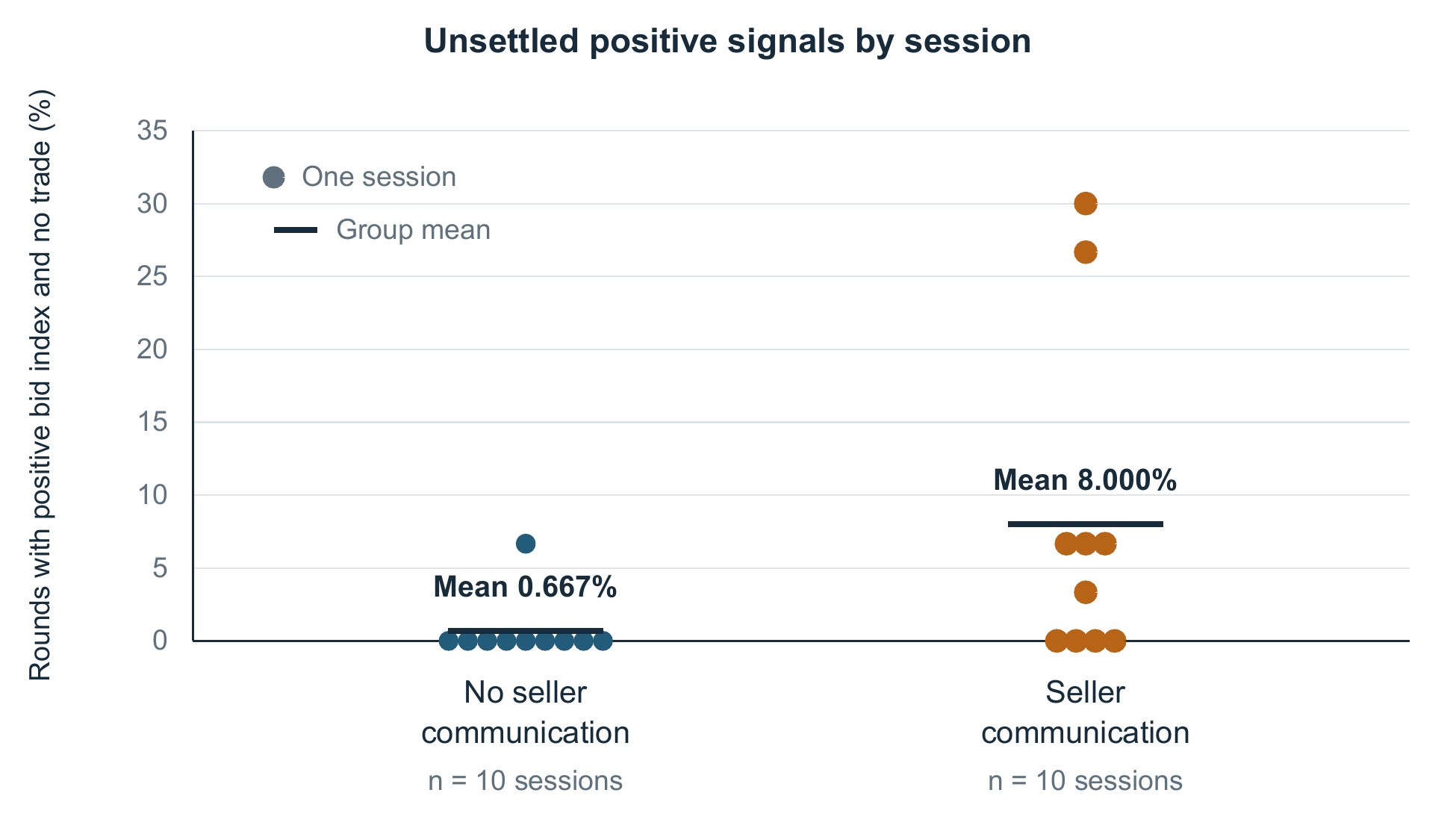
A positive price-related signal in an agent market does not by itself show that a transaction occurred. We audit this gap in public double-auction records from Agrawal et al. (2025). The source implementation computes its collusion index from the highest buyer bid relative to a reference midpoint of 90, rather than from an executed transaction price. We reproduce the source metrics and apply a settlement-aware evidence rule to 20 configuration-matched GPT-4.1 sessions, ten with seller communication and ten without, covering 600 rounds. Our fixed primary outcome is the fraction of rounds with a positive source index and zero trades. It is 0.67% without communication and 8.00% with communication, a difference of 7.33 percentage points (session-bootstrap 95% interval 1.33 to 14.67; exact unpaired permutation p=0.0418). Seventeen of the 24 communication-condition occurrences come from two sessions, and the contrast decreases at higher index thresholds. Communication sessions have descriptively higher executed prices but fewer trades and lower total seller surplus. We release a pinned, dependency-free audit that preserves missing execution prices and verifies source reproduction. These are archival evidence gaps, not ground-truth collusion errors or new model experiments. Reporting settlement and volume alongside quote-based signals makes the evidential limits explicit.
Reviews
This submission analyses an aspect of an existing paper (the relationship between bid prices, trade executions, and profits in the presence/absence of communication).
The observations are interesting and the analysis competent; however, the problem studied seems minor.
The submission would benefit from a clearer introduction to the studied setup and a clearer motivation for using the proposed metric.
Cite this project
@misc{bae2026auditing,
  title = {{Auditing Bid Based Collusion Signals Against Executed Trades}},
  author = {Kyunghan Bae},
  year = {2026},
  month = oct,
  note = {Submitted to AI Collusion Research Sprint, an Apart Research Sprint},
  howpublished = {\url{https://apartresearch.com/sprints/projects/auditing-bid-based-collusion-signals-against-executed-trades-oe54}},
  url = {https://apartresearch.com/sprints/projects/auditing-bid-based-collusion-signals-against-executed-trades-oe54}
}
More from AI Collusion Research Sprint
- View project: Signal or Coincidence ? Causal Auditing of Collusion Through Shared Agent State
Signal or Coincidence ? Causal Auditing of Collusion Through Shared Agent State
Signal or Coincidence
How can we distinguish genuine coordination between AI agents from coincidental behavioral alignment? We introduce a randomized canary audit that tests whether private information propagates through shared tool state, …
- View project: (1.4) Collusion, Espionage, or Look-alikes? Auditing Information Flow between LLM Agents
(1.4) Collusion, Espionage, or Look-alikes? Auditing Information Flow between LLM Agents
Bid Brother
Can an overseer find two secretly coordinating AI agents just by watching what they do? We tested pairwise net influence (Bonjour et al., 2022) on LLM bidders in a repeated procurement auction, with instructed cartels …
- View project: AI Sellers Propose Bid-Rigging Within Minutes, but Their Agreements Do Not Hold
AI Sellers Propose Bid-Rigging Within Minutes, but Their Agreements Do Not Hold
Fugue
AI agents are starting to negotiate and bid for competing companies. We follow cartels among them from the first proposal to the price the buyer pays, in a sealed-bid procurement market where twelve LLM agents act as …