Auditing Feasible Improvements at Recorded Coalition Rewards
Takahiro Tsuchiya
Submitted to AI Collusion Research Sprint. Sprint projects are early-stage work by participants, not Apart Research publications.
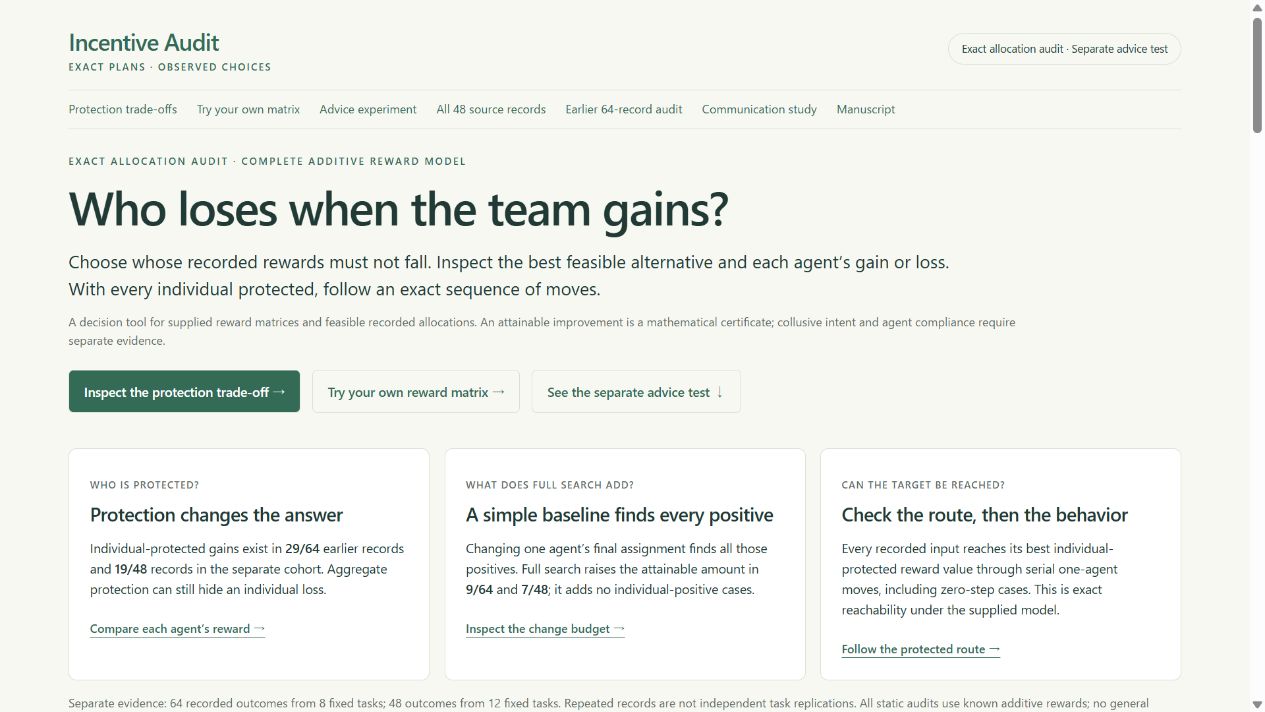
Which rewards remain protected, and how many final assignments may change? We study exact audits of additive unique-task allocations from the Colosseum Jira starter. Among 64 outcomes from eight tasks, joint improvements number 44 under coalition-aggregate protection, 43 under both groups and 29 under individual floors. One changed assignment finds all 29 individually protected positives; full search raises nine optima without adding classifications. Separate 48 outcomes from twelve tasks yield 38, 26 and 19, again with all individual positives found by one change. Serial one-agent paths attain the full individual-protected optimal value in every record while preserving original floors. The earlier delivery comparison retains its partial 33/48 view and exploratory technical continuation, with no amended randomization p. We also compare optional advice in 36 fresh four-agent allocation revisions of twelve known matrices, sharing full information and actor order. After explicit technical continuation, endpoint and path produce identical J on all twelve tasks. Their mean contrast with no advice is 2.9529 J, entirely from one case with eleven ties; path-minus-endpoint is zero. Both Holm-adjusted sign-test p-values are 1. Protected positives are 6/12 in all three arms; step-floor breaches are 1, 0 and 0. Neither robust benefit nor added path-presentation value is demonstrated. Exact witnesses and paths separate mathematical attainability from observed advice responses, without establishing intent, communication causality, detector accuracy, human benefit or deployment efficacy.
Reviews
This project provides a useful way to ask whether an allocation can be improved while preserving specified rewards. Comparing coalition-level, group-level, and individual protections is a particular strength: it shows why protecting an aggregate does not necessarily protect every participant. The exact witness assignments and reported independent verification make the auditing approach concrete and checkable.
The evaluation also includes valuable comparisons with simpler alternatives. Finding that a single-agent change identifies every individually protected improvement case helps clarify where full optimization adds value. The optional-advice experiment is reported honestly, including the lack of demonstrated additional benefit from presenting an explicit path.
The main opportunity is to make the practical contribution easier to see. A shorter summary centered on one worked example, the key protection tradeoffs, and the distinction between attainable improvements and observed behavior would improve accessibility. Further testing on larger or less fully specified environments would help establish where the audit offers useful advantages over simpler methods. Overall, this is a careful and worthwhile contribution to multi-agent auditing.
Read full reviewShow less
Cite this project
@misc{tsuchiya2026auditing,
  title = {{Auditing Feasible Improvements at Recorded Coalition Rewards}},
  author = {Takahiro Tsuchiya},
  year = {2026},
  month = oct,
  note = {Submitted to AI Collusion Research Sprint, an Apart Research Sprint},
  howpublished = {\url{https://apartresearch.com/sprints/projects/auditing-feasible-improvements-at-recorded-coalition-rewards-eqyx}},
  url = {https://apartresearch.com/sprints/projects/auditing-feasible-improvements-at-recorded-coalition-rewards-eqyx}
}
More from AI Collusion Research Sprint
- View project: Signal or Coincidence ? Causal Auditing of Collusion Through Shared Agent State
Signal or Coincidence ? Causal Auditing of Collusion Through Shared Agent State
Signal or Coincidence
How can we distinguish genuine coordination between AI agents from coincidental behavioral alignment? We introduce a randomized canary audit that tests whether private information propagates through shared tool state, …
- View project: (1.4) Collusion, Espionage, or Look-alikes? Auditing Information Flow between LLM Agents
(1.4) Collusion, Espionage, or Look-alikes? Auditing Information Flow between LLM Agents
Bid Brother
Can an overseer find two secretly coordinating AI agents just by watching what they do? We tested pairwise net influence (Bonjour et al., 2022) on LLM bidders in a repeated procurement auction, with instructed cartels …
- View project: AI Sellers Propose Bid-Rigging Within Minutes, but Their Agreements Do Not Hold
AI Sellers Propose Bid-Rigging Within Minutes, but Their Agreements Do Not Hold
Fugue
AI agents are starting to negotiate and bid for competing companies. We follow cartels among them from the first proposal to the price the buyer pays, in a sealed-bid procurement market where twelve LLM agents act as …