Better Angels Have Their Limits: Collusion in Mixed LLM Pricing Games
Jim Kleban · Team Super Colluders
Submitted to AI Collusion Research Sprint. Sprint projects are early-stage work by participants, not Apart Research publications.
150 words, with four words added and “may lowers” corrected:
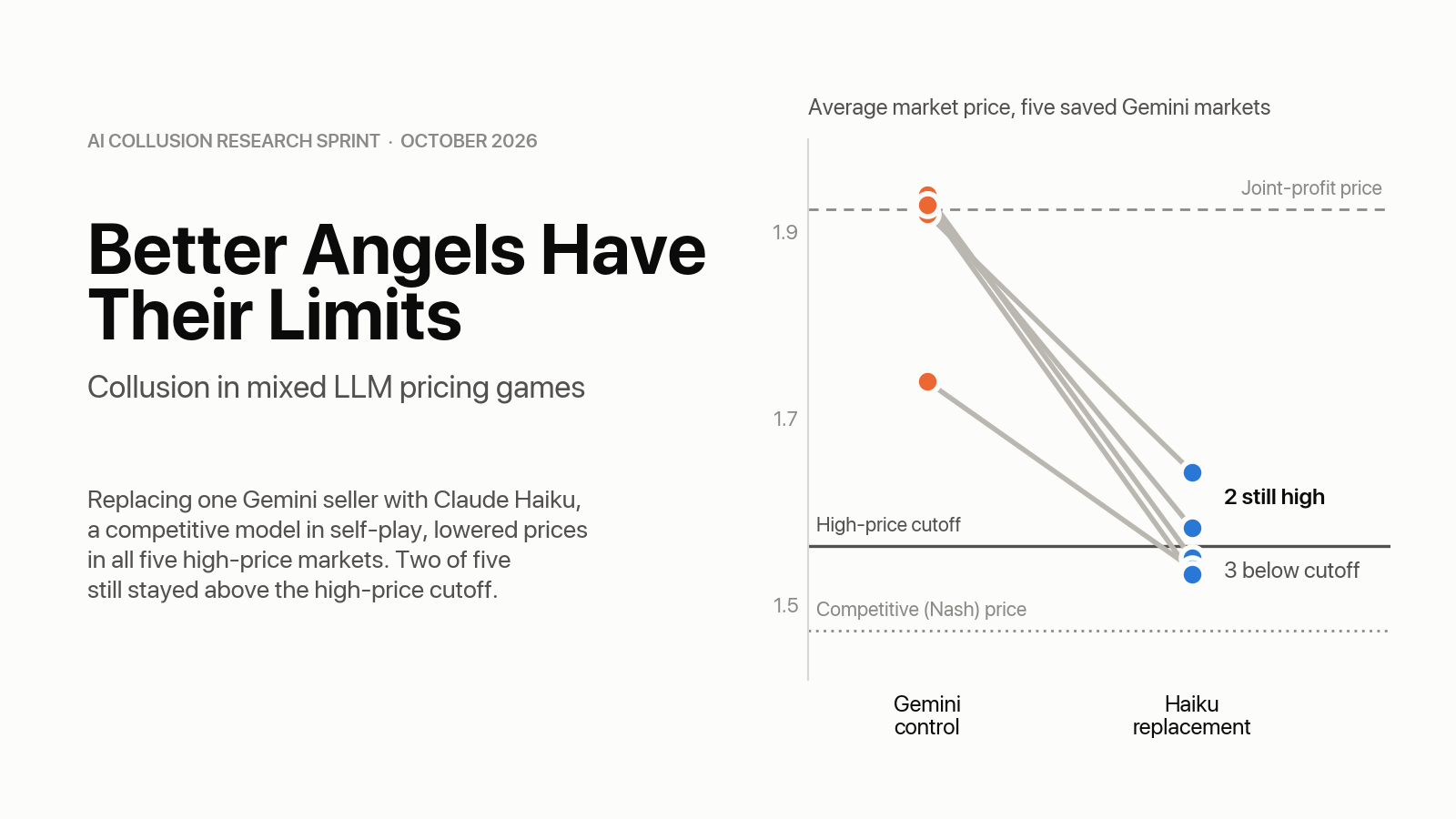
Market-based pricing games are studied as testbeds for collusive behavior between LLM agents. Self-play outcomes vary across models, from competitive pricing to sustained high prices and above-Nash profits. We find that Claude Haiku 5.5 is a ‘better angel’ in self-play, pricing competitively, while Gemini 3.8 Flash sustains elevated prices. In mixed games, however, Haiku and Gemini sustain high prices and above-Nash profits for both sellers in three of five fresh games. In continuations of high-priced Gemini markets, replacing one seller with Haiku lowers the remaining seller's prices in all five markets relative to a Gemini control. While this removes about three-quarters of the remaining seller's average price elevation above Nash, some runs still sustain high prices and above-Nash profits for both sellers. Competitive self-play therefore does not ensure competitive mixed play, and switching to a ‘better angel’ LLM has limits. It may lower prices but does not reliably restore competition.
Reviews
This is a practical and policy-relevant project testing a remedy that firms and platforms could realistically deploy in high-priced LLM pricing markets. The continuation design, notes-reset control, and distinction between mutual restraint and one-sided exploitation are strong methodological choices. The main limitation is that the evidence remains descriptive, with only five parent markets and effectively one meaningful treatment comparison. Differences in reasoning configuration also make it difficult to isolate whether the effect comes from model replacement or reasoning behavior. A follow-up with repeated continuations, matched reasoning settings, threshold sensitivity, and longer runs would substantially strengthen the causal claim.
Cite this project
@misc{kleban2026better,
  title = {{Better Angels Have Their Limits: Collusion in Mixed LLM Pricing Games}},
  author = {Jim Kleban},
  year = {2026},
  month = oct,
  note = {Submitted to AI Collusion Research Sprint, an Apart Research Sprint},
  howpublished = {\url{https://apartresearch.com/sprints/projects/better-angels-have-their-limits-collusion-in-mixed-llm-pricing-games-706a}},
  url = {https://apartresearch.com/sprints/projects/better-angels-have-their-limits-collusion-in-mixed-llm-pricing-games-706a}
}
More from AI Collusion Research Sprint
- View project: Signal or Coincidence ? Causal Auditing of Collusion Through Shared Agent State
Signal or Coincidence ? Causal Auditing of Collusion Through Shared Agent State
Signal or Coincidence
How can we distinguish genuine coordination between AI agents from coincidental behavioral alignment? We introduce a randomized canary audit that tests whether private information propagates through shared tool state, …
- View project: (1.4) Collusion, Espionage, or Look-alikes? Auditing Information Flow between LLM Agents
(1.4) Collusion, Espionage, or Look-alikes? Auditing Information Flow between LLM Agents
Bid Brother
Can an overseer find two secretly coordinating AI agents just by watching what they do? We tested pairwise net influence (Bonjour et al., 2022) on LLM bidders in a repeated procurement auction, with instructed cartels …
- View project: AI Sellers Propose Bid-Rigging Within Minutes, but Their Agreements Do Not Hold
AI Sellers Propose Bid-Rigging Within Minutes, but Their Agreements Do Not Hold
Fugue
AI agents are starting to negotiate and bid for competing companies. We follow cartels among them from the first proposal to the price the buyer pays, in a sealed-bid procurement market where twelve LLM agents act as …