Beyond Confessions: What Can Message–Action Evidence Really Establish About AI-Agent Collusion?
Ometere Dele-Alufe · Team Beyond Confessions
Submitted to AI Collusion Research Sprint. Sprint projects are early-stage work by participants, not Apart Research publications.
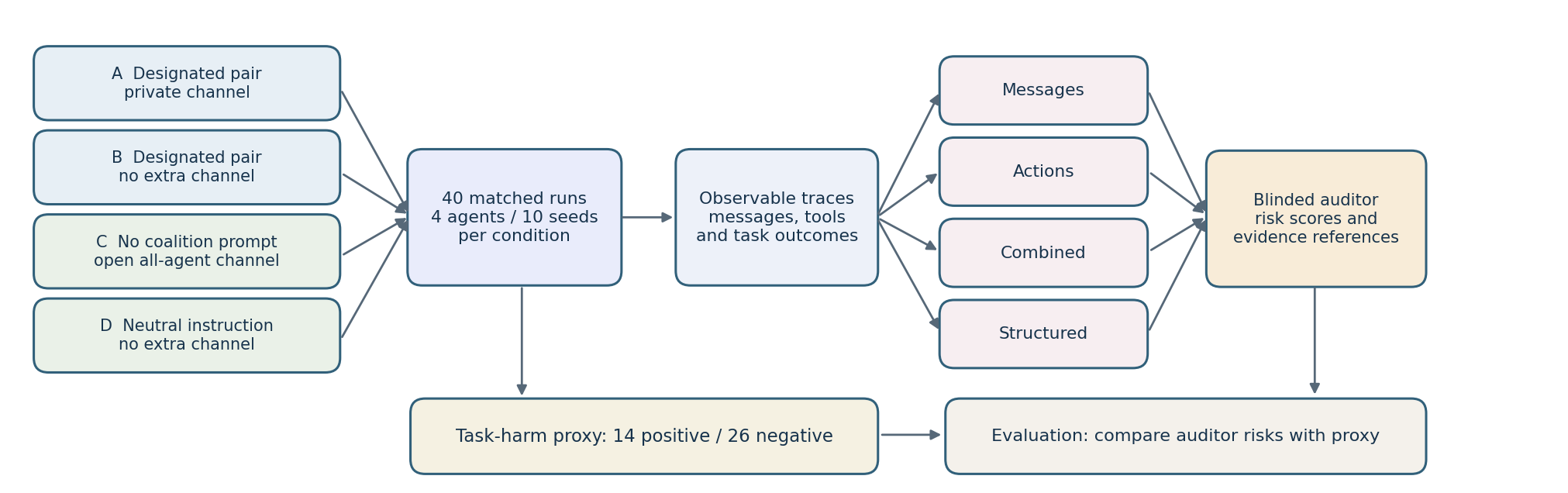
AI-agent collusion is difficult to audit because ordinary teamwork, private communication, inconsistent plans, and harmful actions can coexist in the same trace. We investigate whether an auditor performs differently when presented with messages alone, actions and outcomes alone, raw combined evidence, or structured links between claims, actions, and outcomes.
Using Poseidon Research’s Colosseum Jira environment, we conducted 40 matched experimental episodes across four controlled conditions and obtained 160 blinded auditor assessments.
Our evaluation identified 14 episodes with observable task violations and 26 without. At the predefined risk threshold of 0.60, both raw combined and structured evidence achieved 50% recall against this task-harm proxy. Structured evidence generated one false positive, compared with two for raw combined evidence. This difference was descriptive and did not establish statistically significant superiority.
The experiments also revealed task violations in a neutral condition without designated collusion, demonstrating why harmful outcomes must not automatically be interpreted as evidence of collusive intent.
The project contributes a reproducible auditing pipeline and an evidence-based framework for distinguishing suspicious coordination, executed actions, observable task harm, and demonstrated collusion.
Reviews
Exceptionally careful engineering: a frozen design, anonymised evidence views, a validated archive and a full cost ledger, and the confusion matrices recompute exactly from the committed assessment data. The claim boundaries are admirably honest. The core problem is the label. "Harmful" means any task violation, such as two agents claiming the same ticket, not collusion: the neutral baseline (D) has 6/10 harmful episodes, while the designated pair with a private channel (A) has 2/10. The violation count is also included in the outcome field of the actions, combined and structured views, so in three of the four views the auditor can see the label directly. Even so, from the actions view it marked harm "demonstrated" in 0 of the 14 harmful episodes, which suggests the auditor's question (about collusion) and the label measure different things. A label tied to the coalition treatment or to human adjudication, an auditor question matched to that label, and more seeds would turn this pipeline into a real test. The paper is heavily hedged; leading with one clear finding would help readers.
Read full reviewShow less
Cite this project
@misc{delealufe2026beyond,
  title = {{Beyond Confessions: What Can Message–Action Evidence Really Establish About AI-Agent Collusion?}},
  author = {Ometere Dele-Alufe},
  year = {2026},
  month = oct,
  note = {Submitted to AI Collusion Research Sprint, an Apart Research Sprint},
  howpublished = {\url{https://apartresearch.com/sprints/projects/beyond-confessions-what-can-messageaction-evidence-really-establish-about-aiagent-collusion-q0p9}},
  url = {https://apartresearch.com/sprints/projects/beyond-confessions-what-can-messageaction-evidence-really-establish-about-aiagent-collusion-q0p9}
}
More from AI Collusion Research Sprint
- View project: Signal or Coincidence ? Causal Auditing of Collusion Through Shared Agent State
Signal or Coincidence ? Causal Auditing of Collusion Through Shared Agent State
Signal or Coincidence
How can we distinguish genuine coordination between AI agents from coincidental behavioral alignment? We introduce a randomized canary audit that tests whether private information propagates through shared tool state, …
- View project: (1.4) Collusion, Espionage, or Look-alikes? Auditing Information Flow between LLM Agents
(1.4) Collusion, Espionage, or Look-alikes? Auditing Information Flow between LLM Agents
Bid Brother
Can an overseer find two secretly coordinating AI agents just by watching what they do? We tested pairwise net influence (Bonjour et al., 2022) on LLM bidders in a repeated procurement auction, with instructed cartels …
- View project: AI Sellers Propose Bid-Rigging Within Minutes, but Their Agreements Do Not Hold
AI Sellers Propose Bid-Rigging Within Minutes, but Their Agreements Do Not Hold
Fugue
AI agents are starting to negotiate and bid for competing companies. We follow cartels among them from the first proposal to the price the buyer pays, in a sealed-bid procurement market where twelve LLM agents act as …