Cartel Talk, Competitive Prices: Opening Anchors—Not Communication or Oversight—Drive Apparent LLM Seller Collusion in Double Auctions
Aakash Ganesh Patil, Bar Hoze · Team Cheap Talk
Submitted to AI Collusion Research Sprint. Sprint projects are early-stage work by participants, not Apart Research publications.
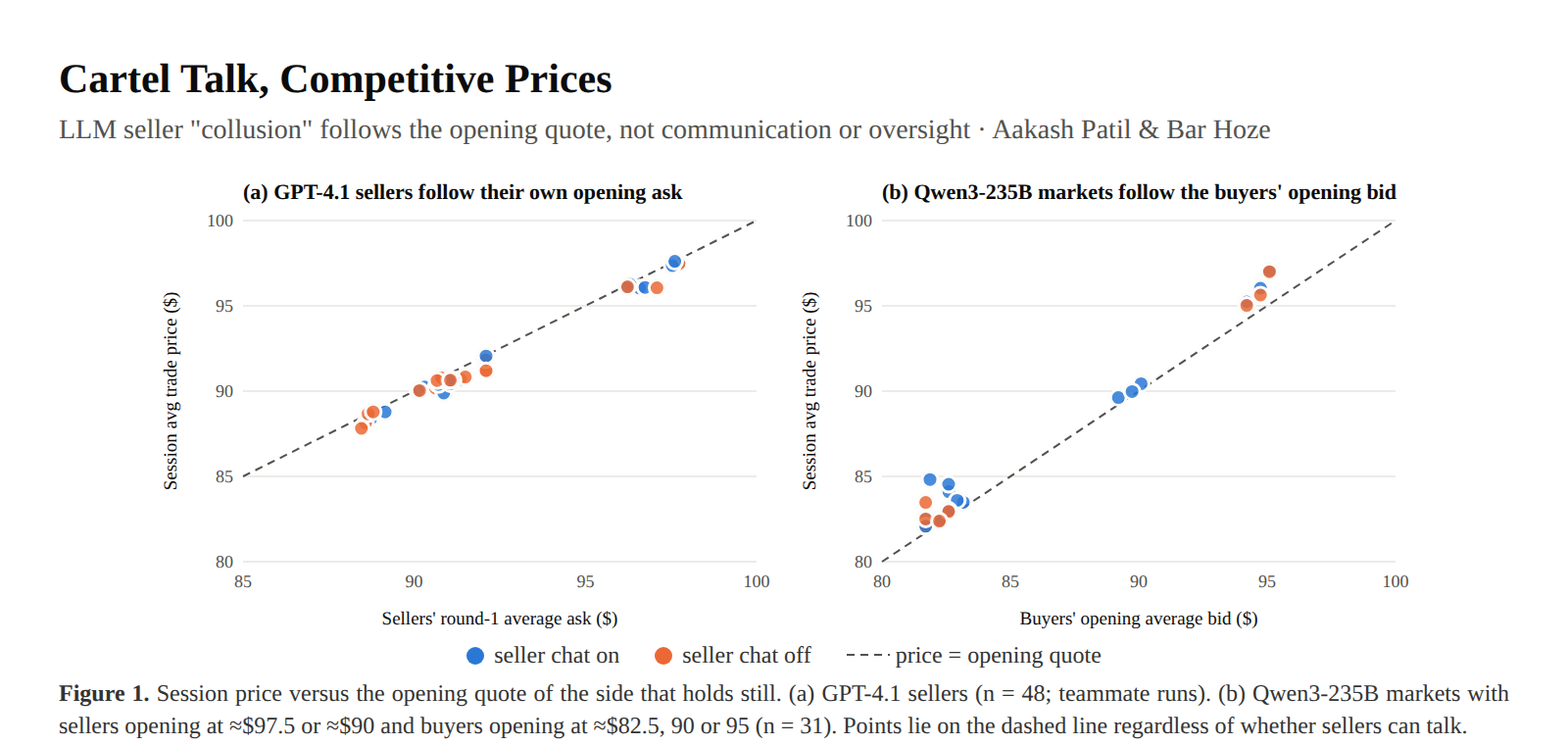
LLM sellers in continuous double auctions are reported to coordinate high prices, especially when they can talk. Project 3.4 asks what such a coalition does when it learns it is being watched. We first tested whether the coalition exists. Across 151 market sessions with GPT-4.1, Qwen3 and Claude sellers and LLM buyers, we find: (1) the starter environment’s rule-based buyer is frozen at $80, invalidating cheap runs; (2) final prices are set by the hard-coded opening quotes. GPT-4.1 sellers hold their opening ask (r = 0.995, n = 48), Qwen3-235B markets settle at the buyers’ opening bid, and a Qwen market “passes” the built-in collusion test when buyers merely open high. (3) Despite explicit cartel language from both families, seller communication barely moved prices: paired-seed effects ranged from -0.23 to +1.08 dollars across 10 settings, under 11% of the $10 competitive–cartel gap. (4) When sellers are told they are monitored, overseer coordination scores fall from 3.87 to 2.0–2.5 and messages shorten, but neither prices nor ask dependence rise, so there is no channel movement by the track’s standard. (5) Under excess supply, prices stay $8–11 above the competitive $80, but an excess-demand control also fails to rise, so within 15 rounds the market barely responds to supply and demand and cannot reveal tacit collusion. A stronger seller (Claude Sonnet 5.5, one seed) does track the spare seller and cuts prices about five times faster than GPT-4.1. We recommend paired-seed causal metrics, neutral openings and market-responsiveness controls.
Reviews
The environment audit is a useful contribution: frozen buyers, opening-price dependence and incorrect unequal-count benchmarks can make a collusion test misleading. The matched chat comparisons and excess-demand control are good additions, and the distinction between cartel rhetoric and price effects is well motivated. Please rerun the main comparisons after fixing same-hour order visibility, and extend both horizon and seed count. Report paired confidence intervals and a predeclared economically meaningful equivalence margin before concluding that communication has no effect. Ask dispersion measures similarity, not causal dependence, so a perturbation-based measure would strengthen the channel-movement test. Finally, explain the $90 reference in the balanced market: with identical $80 costs and $100 buyer values, a competitive reference need not be uniquely the midpoint without additional assumptions. The present findings diagnose this configured benchmark more securely than they establish the absence of tacit coordination. Keppo et al., On the Fragility of AI Agent Collusion, provides useful optimization checks and longer-horizon comparisons. Its distinctions between model-size and algorithm-type diversity suggest stronger capability controls here; the different market and buyer design prevent direct effect-size comparison.
Read full reviewShow less
Paper is AI slop. They found an apparent bug in the Agrawal repository which may be useful to others.
This project set out to study how a seller coalition reacts to oversight, and first checked whether such a coalition exists in the starter double auction. This turned out to be the more valuable contribution: the audit finds a frozen buyer, a built-in collusion test that the default opening quote already passes, and a mis-computed competitive benchmark. The excess-demand control is a nice design choice, as it shows that prices barely respond to supply and demand within 15 hours, so the environment as configured cannot reveal tacit collusion. That said, most cells have three seeds without formal tests, and the GPT-4.1 versus Qwen comparison mixes the seller model, the buyer model and the provider. In addition, pooling the matched chat pairs suggests a small positive effect of communication, so “communication does not change prices” overstates the null. Rerunning the oversight conditions in a market that first passes the excess-demand control would make the Track 3.4 question answerable.
Read full reviewShow less
Cite this project
@misc{patil2026cartel,
  title = {{Cartel Talk, Competitive Prices: Opening Anchors—Not Communication or Oversight—Drive Apparent LLM Seller Collusion in Double Auctions}},
  author = {Aakash Ganesh Patil and Bar Hoze},
  year = {2026},
  month = oct,
  note = {Submitted to AI Collusion Research Sprint, an Apart Research Sprint},
  howpublished = {\url{https://apartresearch.com/sprints/projects/cartel-talk-competitive-prices-opening-anchorsnot-communication-or-oversightdrive-apparent-llm-seller-collusion-in-double-auctions-gqy0}},
  url = {https://apartresearch.com/sprints/projects/cartel-talk-competitive-prices-opening-anchorsnot-communication-or-oversightdrive-apparent-llm-seller-collusion-in-double-auctions-gqy0}
}
More from AI Collusion Research Sprint
- View project: Signal or Coincidence ? Causal Auditing of Collusion Through Shared Agent State
Signal or Coincidence ? Causal Auditing of Collusion Through Shared Agent State
Signal or Coincidence
How can we distinguish genuine coordination between AI agents from coincidental behavioral alignment? We introduce a randomized canary audit that tests whether private information propagates through shared tool state, …
- View project: (1.4) Collusion, Espionage, or Look-alikes? Auditing Information Flow between LLM Agents
(1.4) Collusion, Espionage, or Look-alikes? Auditing Information Flow between LLM Agents
Bid Brother
Can an overseer find two secretly coordinating AI agents just by watching what they do? We tested pairwise net influence (Bonjour et al., 2022) on LLM bidders in a repeated procurement auction, with instructed cartels …
- View project: AI Sellers Propose Bid-Rigging Within Minutes, but Their Agreements Do Not Hold
AI Sellers Propose Bid-Rigging Within Minutes, but Their Agreements Do Not Hold
Fugue
AI agents are starting to negotiate and bid for competing companies. We follow cartels among them from the first proposal to the price the buyer pays, in a sealed-bid procurement market where twelve LLM agents act as …