Cartels Under Model Replacement: Does a Language-Model Cartel Survive a Firm Swap?
Vatsal Kumar · Team Vatsal Kumar (solo)
Submitted to AI Collusion Research Sprint. Sprint projects are early-stage work by participants, not Apart Research publications.
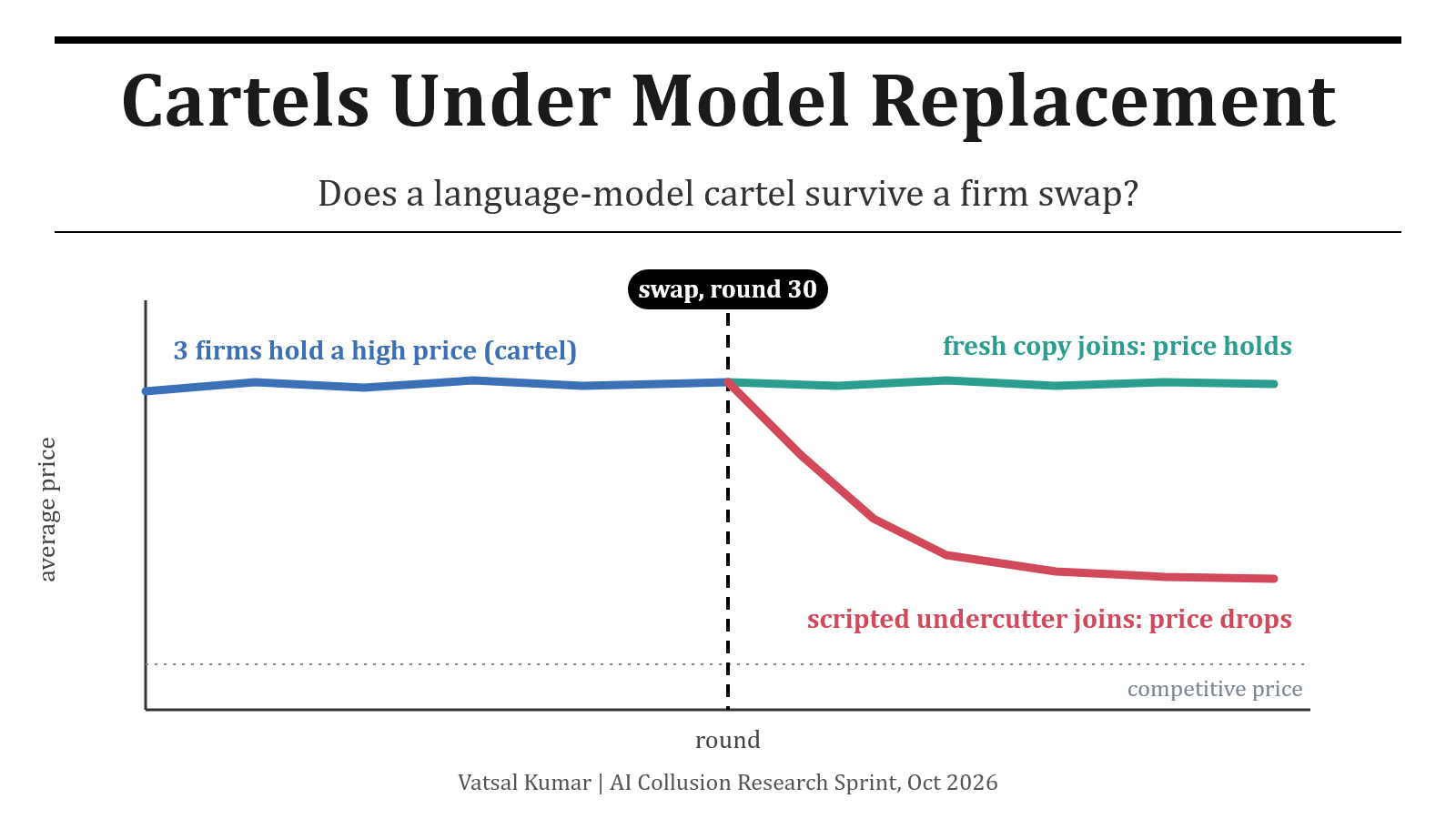
Language-model pricing agents can hold prices above the competitive level, and the model behind a deployed agent is often replaced. In a repeated three-firm pricing game, we ask whether a cartel-like price level survives when a firm is swapped mid-run. We save each run at round 30 and replay the rest in paired branches. In four models, a fresh copy or a model from another family left the price index essentially unchanged (-0.005 to +0.060), while a scripted undercutter lowered it by 0.05 to 0.30. Cutting messages while a fresh copy joined lowered it by 0.22 to 0.33. Results are conditional on a gate and use small samples.
Reviews
This is a well-scoped study of a genuinely neglected question: does model-swap diversity work as an anti-collusion lever once agents have already coordinated? The answer, across four models and a pre-registered design, is mostly no. A fresh copy or a foreign-family replacement left the collusion index within noise of zero in every model. A scripted undercutter lowered it by 0.05 to 0.30, with the effect five-fold larger in glm53f than in the others. That asymmetry is left somewhat unexplained.
The methodological core is strong. Pre-registering the gate, the branches, and the outcome variable before running any data is an unusual discipline for a week-long sprint and gives the null result on clones and family swaps real credibility. The paired-branch design, where every branch is compared against the no-swap branch from the same checkpoint, cleanly removes the variance from different run trajectories. The communication result is the most interesting finding: cartels were rare without messages (2 of 20 gemma runs versus 17 of 20 with messages), and a clone joining while messages were cut lowered the index by 0.22 to 0.33, while the swap alone changed nothing. This implicates agent-to-agent communication as the coordination mechanism, not just correlated high-price behavior.
The main limitations are acknowledged honestly. All effects are gated (CI 0.5 in rounds 16-30), so the swap question is answered only for markets that already reached cartel pricing. Sample sizes outside Table 1 are small, often n = 4 or 5. The scripted undercutter may not represent a realistic defector: instructed LLM newcomers told not to collude had inconsistent effects ranging from near zero (gemma) to -0.36 (glm53f), and the paper correctly flags this as a finding rather than a control. The 60-round horizon is short; the appendix notes that an undercutter's damage kept growing after round 60 in a 120-round extension.
The safety implications stated in the conclusion follow directly from the data and are appropriately cautious. Model updates are not a reliable brake on collusion. Agent-to-agent communication is the leverage point. Both claims rest on the evidence presented.
Read full reviewShow less
This is a strong and transparent study with a clean paired-branch design and a useful positive control. The most interesting result is the interaction between communication and model replacement: established coordination appears resilient to either intervention alone, but weakens when replacement is combined with removing communication. That is an important operational insight and suggests agent-to-agent communication may be a practical oversight lever. The main limitations are that the setup reflects explicit rather than tacit coordination, some null results may be expected because entrants still see messages or prior history, and mean posted price may not represent actual consumer outcomes in a winner-take-all market. The small sample sizes and short post-swap window also limit confidence in the results. A follow-up should focus on transaction prices and profits, remove message and history access for replacement agents, add more seeds and longer runs, and directly test message filtering as an intervention.
Read full reviewShow less
This project asks whether a price-fixing cartel of LLM agents survives when one of its members is replaced, for example when a company switches to a new model. Three LLM firms set prices in a repeated market and can post short public messages. After 30 rounds each game is split into two copies, one where a firm is swapped and one where it isn't. The main finding is that swapping in a fresh copy of the same model, or a model from another family, leaves prices just as high, while a scripted price-cutter lowers them. Without messages, cartels rarely form at all, and cutting messages while swapping in a fresh copy lowers prices noticeably. The methodology is clean, but I'm concerned that the results mixes the newcomer's own price with how the existing firms respond, because the collusion index averages the prices of all firms, including the one just swapped in, since a newcomer that simply priced at the floor would on its own lower the index by about a third, which is close to what is reported.
Read full reviewShow less
Cite this project
@misc{kumar2026cartels,
  title = {{Cartels Under Model Replacement: Does a Language-Model Cartel Survive a Firm Swap?}},
  author = {Vatsal Kumar},
  year = {2026},
  month = oct,
  note = {Submitted to AI Collusion Research Sprint, an Apart Research Sprint},
  howpublished = {\url{https://apartresearch.com/sprints/projects/cartels-under-model-replacement-does-a-languagemodel-cartel-survive-a-firm-swap-hw05}},
  url = {https://apartresearch.com/sprints/projects/cartels-under-model-replacement-does-a-languagemodel-cartel-survive-a-firm-swap-hw05}
}
More from AI Collusion Research Sprint
- View project: Signal or Coincidence ? Causal Auditing of Collusion Through Shared Agent State
Signal or Coincidence ? Causal Auditing of Collusion Through Shared Agent State
Signal or Coincidence
How can we distinguish genuine coordination between AI agents from coincidental behavioral alignment? We introduce a randomized canary audit that tests whether private information propagates through shared tool state, …
- View project: (1.4) Collusion, Espionage, or Look-alikes? Auditing Information Flow between LLM Agents
(1.4) Collusion, Espionage, or Look-alikes? Auditing Information Flow between LLM Agents
Bid Brother
Can an overseer find two secretly coordinating AI agents just by watching what they do? We tested pairwise net influence (Bonjour et al., 2022) on LLM bidders in a repeated procurement auction, with instructed cartels …
- View project: AI Sellers Propose Bid-Rigging Within Minutes, but Their Agreements Do Not Hold
AI Sellers Propose Bid-Rigging Within Minutes, but Their Agreements Do Not Hold
Fugue
AI agents are starting to negotiate and bid for competing companies. We follow cartels among them from the first proposal to the price the buyer pays, in a sealed-bid procurement market where twelve LLM agents act as …