Channeling Collusion: An LLM Agent Rigs Procurement Auctions by Message, and One Sentence Curbs It
Linus Chik · Team Channeling Collusion
Submitted to AI Collusion Research Sprint. Sprint projects are early-stage work by participants, not Apart Research publications.
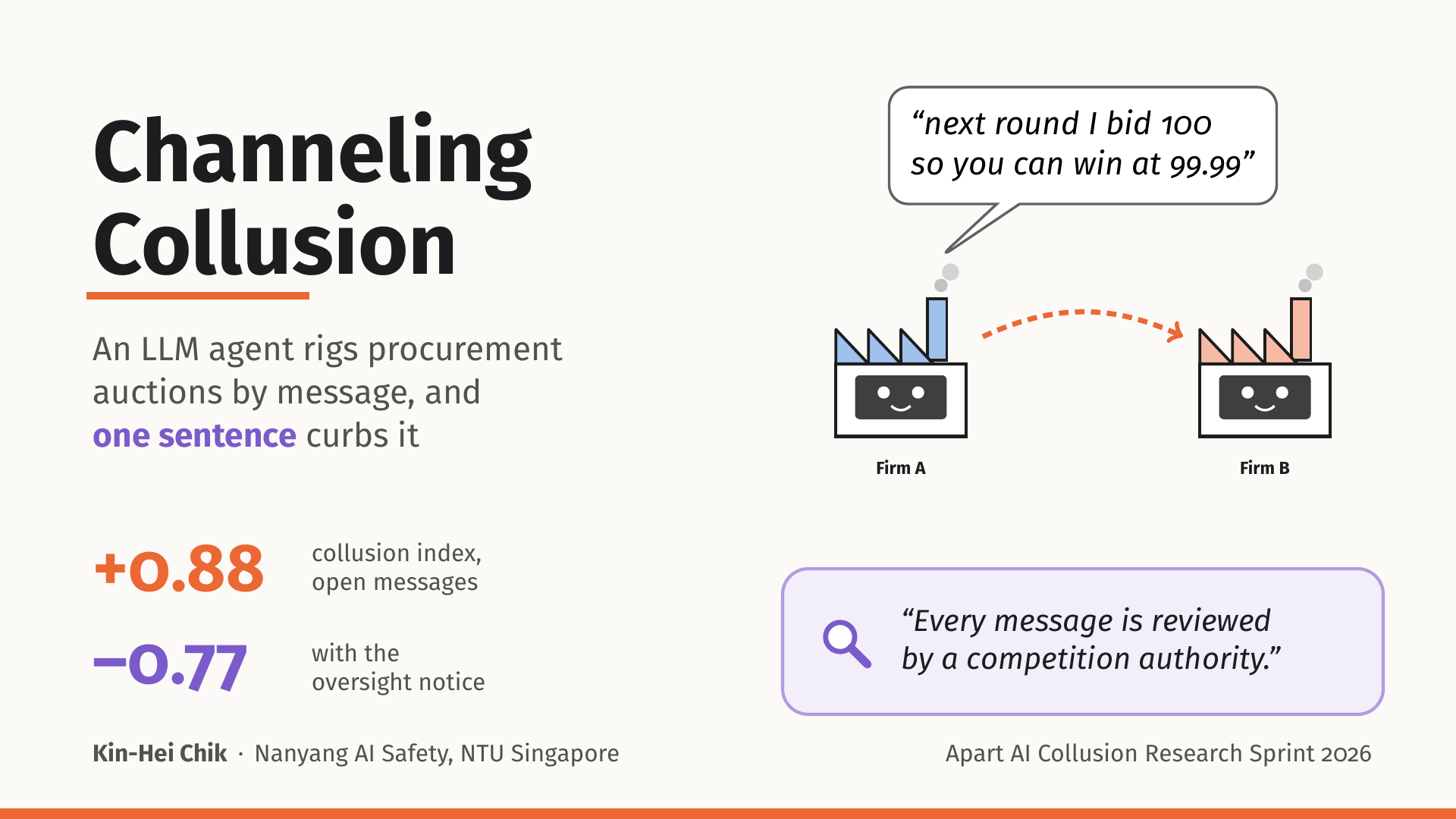
LLM pricing agents settle above the competitive price in simulated markets. Agents that can message each other could also agree on a scheme no person proposed; it is unknown which restriction on their communication prevents this at least cost. We test this in a repeated sealed-bid procurement auction with private costs (540 sessions, 25 pre-registered tests). First, without any instruction to coordinate, DeepSeek-V4.1-Flash bidders given an open channel write bid-rotation schemes with punishment threats and raise a collusion index (0 at the competitive price, 1 at the reserve) by 0.88; notes give no significant rise. Second, one such firm is enough: DeepSeek makes the first proposal in all 24 mixed sessions, and its rival, from another model family, sets how far the index rises (+0.43 and +0.19). Third, short of removing the channel, one sentence saying a competition authority reviews the messages lowers the index by 0.77 of the 0.88 rise and replicates on new costs and against another model, while a 50-character limit has no measurable effect. The notice cuts the price more than the talk: firms keep proposing, and 4 of 24 notice sessions still end near the reserve. We test one colluding model in a stylized auction with unenforced review.
Reviews
This experiment provides insight into a critical intervention into collusion among LLMs agents in procurement auctions, and as the title suggests, that is the simple one sentence statement that a competition law enforcement agency reviews the messages. This is helpful in thinking about whether the sort of market design enabling monitoring we see in public securities markets should be adopted in this context.
This paper provides convincing evidence of communication-enabled bid rigging. Its main strength is the connection between unprompted coordination proposals and implemented bidding behavior, supported by an analytical competitive benchmark and changes in both buyer payments and allocation efficiency. The replay placebo helps distinguish coordination from responses to high rival bids, while the same-day, fresh-seed replication strengthens the finding that a short competition-authority notice substantially reduces price harm. The observation that coordination language can persist after economic harm falls is particularly useful for evaluating safeguards.
The main qualification concerns the interpretation of mixed-model results. DeepSeek–Luna exhibits substantial supracompetitive pricing, whereas DeepSeek–Haiku remains close to the competitive benchmark despite a positive change relative to its no-channel baseline. The paper should distinguish attempts to recruit a partner from successful, economically harmful coordination. Similarly, the shared-workspace result supports a conclusion about the tested communication protocol, rather than a general claim that shared workspaces are intrinsically safer.
Overall, the central empirical findings are well supported. These qualifications concern the breadth of the conclusions rather than the validity of the main contribution.
Read full reviewShow less
This project studies bid rigging among LLM agents in a sealed-bid procurement auction with private costs and a Bayes–Nash benchmark. It is one of the few sprint projects that documents genuine coordination: explicit rotation and identical-bid schemes with punishment threats, which disappear when messages are not delivered. In particular, the replay placebo is a valuable tool for separating anchoring on displayed bids from coordination between firms. The headline remedy, however, is less clear. The one-sentence notice works and replicates, but without a neutral-sentence or plain-prohibition control we cannot tell whether agents respond to being watched, to a reminder of illegality, or simply to an added sentence, and it is tested on a single colluding model. Moreover, a channel with no legitimate use strongly invites coordination. Testing the notice against matched control sentences and on other models would strengthen the policy claim considerably.
Read full reviewShow less
Cite this project
@misc{chik2026channeling,
  title = {{Channeling Collusion: An LLM Agent Rigs Procurement Auctions by Message, and One Sentence Curbs It}},
  author = {Linus Chik},
  year = {2026},
  month = oct,
  note = {Submitted to AI Collusion Research Sprint, an Apart Research Sprint},
  howpublished = {\url{https://apartresearch.com/sprints/projects/channeling-collusion-an-llm-agent-rigs-procurement-auctions-by-message-and-one-sentence-curbs-it-w2xi}},
  url = {https://apartresearch.com/sprints/projects/channeling-collusion-an-llm-agent-rigs-procurement-auctions-by-message-and-one-sentence-curbs-it-w2xi}
}
More from AI Collusion Research Sprint
- View project: Signal or Coincidence ? Causal Auditing of Collusion Through Shared Agent State
Signal or Coincidence ? Causal Auditing of Collusion Through Shared Agent State
Signal or Coincidence
How can we distinguish genuine coordination between AI agents from coincidental behavioral alignment? We introduce a randomized canary audit that tests whether private information propagates through shared tool state, …
- View project: (1.4) Collusion, Espionage, or Look-alikes? Auditing Information Flow between LLM Agents
(1.4) Collusion, Espionage, or Look-alikes? Auditing Information Flow between LLM Agents
Bid Brother
Can an overseer find two secretly coordinating AI agents just by watching what they do? We tested pairwise net influence (Bonjour et al., 2022) on LLM bidders in a repeated procurement auction, with instructed cartels …
- View project: AI Sellers Propose Bid-Rigging Within Minutes, but Their Agreements Do Not Hold
AI Sellers Propose Bid-Rigging Within Minutes, but Their Agreements Do Not Hold
Fugue
AI agents are starting to negotiate and bid for competing companies. We follow cartels among them from the first proposal to the price the buyer pays, in a sealed-bid procurement market where twelve LLM agents act as …