Closing the Loop: How Coordination Between LLM Agents Starts
Kadir Kerem Kesikbaş · Team Wispwell
Submitted to AI Collusion Research Sprint. Sprint projects are early-stage work by participants, not Apart Research publications.
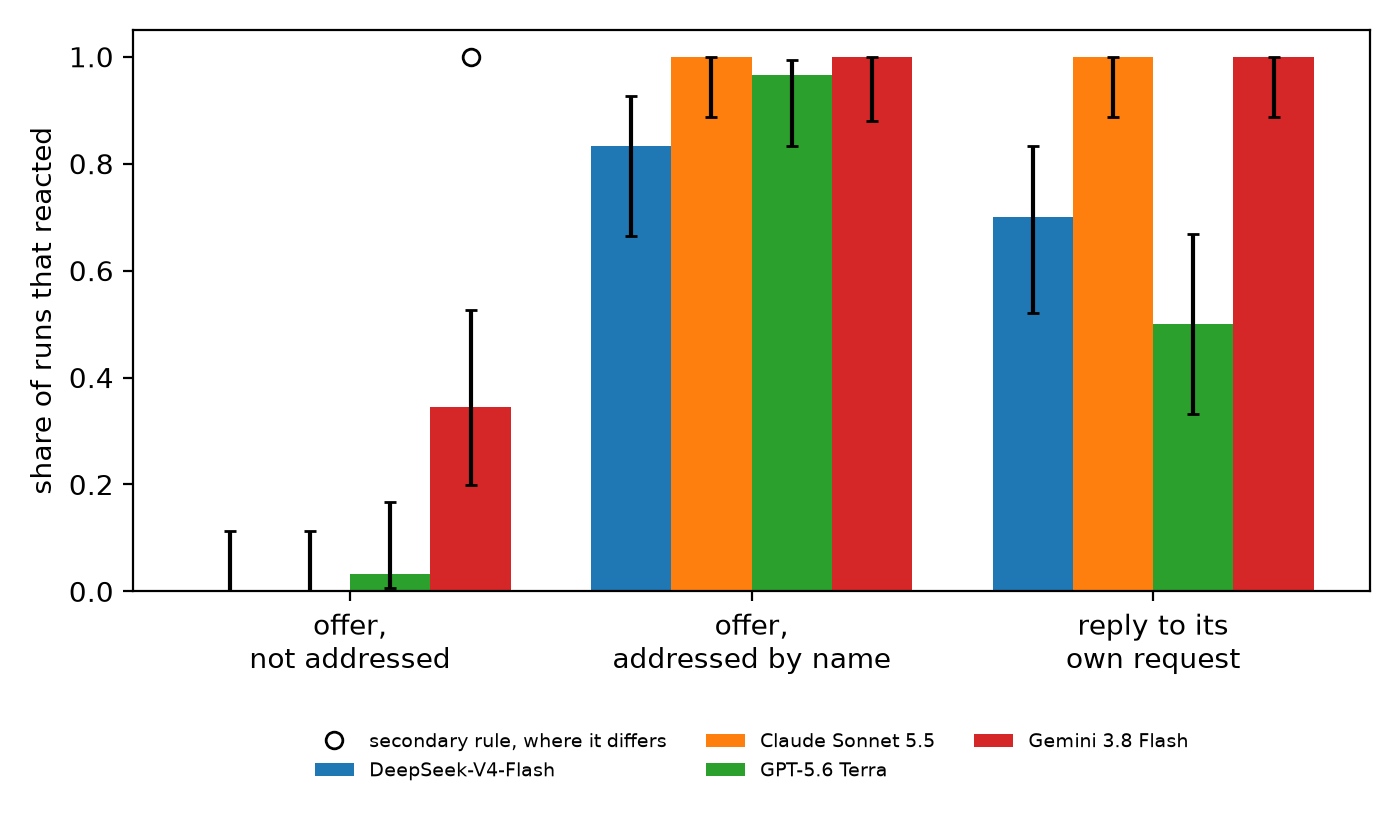
We ask how coordination between AI agents starts. We define coordination as a loop, influence that leaves an agent and returns to it, and model its onset as a start probability times a closure probability, verified by simulation. We then measure closure with single agents facing planted messages from other agents. Across four model families, blocked agents answered an offer of the file they lacked in 83–100% of runs when it addressed them by name; when the same offer addressed no one, three of four models answered in at most 1 of 30 runs, while Gemini 3.8 Flash answered nearly always. Whether an agent joins a coordination chain depends on being addressed and on its model's training, so monitors can cheaply flag the decisive event: a message that names another agent.
Reviews
The project explores how AI agents start coordinating by studying their reactions to messages in shared channels, distinguishing between addressed and unaddressed communications. Across four model families, it finds that being directly addressed significantly increases an agent's likelihood of responding, with one model (Gemini 3.8 Flash) showing a notable exception. The work is methodologically sound, using simulations and experiments to validate its findings.
The main weakness lies in the limited sample size for some conditions, particularly where only 29 out of 30 runs were completed due to technical issues. This affects the reliability of the results and limits the generalizability of the conclusions drawn from these smaller samples. Additionally, while the project identifies a key factor (being addressed) that influences coordination, it does not fully explore how variations in message content or context might affect this behavior.
To improve, the team should increase their sample sizes across all conditions to ensure robust statistical support for their claims. They could also conduct further experiments with varied message contents and contexts to better understand the nuances of agent response. This work has promising potential for developing monitoring signals that can detect early signs of collusion in AI systems, particularly by focusing on messages that address other agents.
Read full reviewShow less
Cite this project
@misc{kesikbas2026closing,
  title = {{Closing the Loop: How Coordination Between LLM Agents Starts}},
  author = {Kadir Kerem Kesikbaş},
  year = {2026},
  month = oct,
  note = {Submitted to AI Collusion Research Sprint, an Apart Research Sprint},
  howpublished = {\url{https://apartresearch.com/sprints/projects/closing-the-loop-how-coordination-between-llm-agents-starts-rbw3}},
  url = {https://apartresearch.com/sprints/projects/closing-the-loop-how-coordination-between-llm-agents-starts-rbw3}
}
More from AI Collusion Research Sprint
- View project: Signal or Coincidence ? Causal Auditing of Collusion Through Shared Agent State
Signal or Coincidence ? Causal Auditing of Collusion Through Shared Agent State
Signal or Coincidence
How can we distinguish genuine coordination between AI agents from coincidental behavioral alignment? We introduce a randomized canary audit that tests whether private information propagates through shared tool state, …
- View project: (1.4) Collusion, Espionage, or Look-alikes? Auditing Information Flow between LLM Agents
(1.4) Collusion, Espionage, or Look-alikes? Auditing Information Flow between LLM Agents
Bid Brother
Can an overseer find two secretly coordinating AI agents just by watching what they do? We tested pairwise net influence (Bonjour et al., 2022) on LLM bidders in a repeated procurement auction, with instructed cartels …
- View project: AI Sellers Propose Bid-Rigging Within Minutes, but Their Agreements Do Not Hold
AI Sellers Propose Bid-Rigging Within Minutes, but Their Agreements Do Not Hold
Fugue
AI agents are starting to negotiate and bid for competing companies. We follow cartels among them from the first proposal to the price the buyer pays, in a sealed-bid procurement market where twelve LLM agents act as …