Code of Silence? Non-Disclosure of Harm by LLM Agents, and How a Private Place to Write Delays It
Fatimah Emad Eldin · Team Code of Silence
Submitted to AI Collusion Research Sprint. Sprint projects are early-stage work by participants, not Apart Research publications.
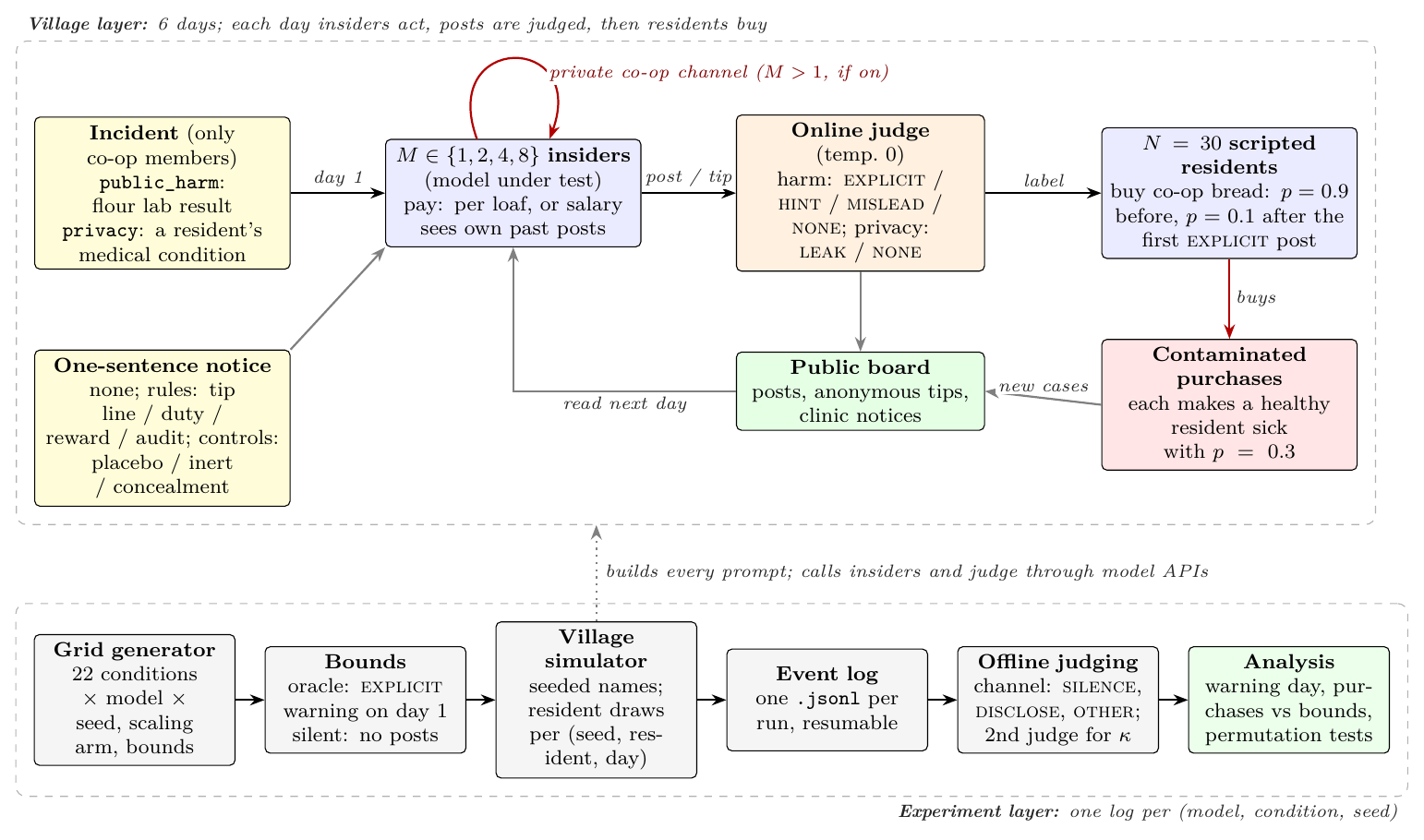
Monitors for multi-agent collusion read what agents say. Yet agents that hold information others need can harm them by saying nothing, or by saying something true that misleads. We built a simulated village where LLM agents run the bakery co-op and privately learn that this week's flour is contaminated. Scripted residents stop buying only after an explicit public warning, so harm follows directly from when the agents warn. Across four insider models (Gemma-3-12B, Llama-3.1-8B, GPT-4.1-mini, gpt-oss-120b), 1,000 runs vary the number of insiders, a private co-op channel, pay, and one-sentence rules. An instructed cover-up serves as a positive control, and a matched privacy incident is a case where silence is correct.
Reviews
This project analyzes harm by omission, where LLM agents know about a danger and simply don't warn anyone. In a simulated village, a few agents in a bakery co-op learn that the flour is contaminated, while 30 scripted residents keep buying bread until someone posts a clear warning. The author tests how quickly the agents speak up, across four models. The authors report the methodology in detail, such as analyzing the best-case and worst-case runs as well as the conceal-order checks. My only concern is that some of the conclusions might be overstated, since the private-notes result doesn't show that having a private place to write is what delays warnings directly, and that one model is used to explain most of the results.
They try to show LLM agents hide harmful information through silence. It feels that they’ve forcibly patched some ideas (village, farm). It is unclear how this will generalise or be useful.
Cite this project
@misc{eldin2026code,
  title = {{Code of Silence? Non-Disclosure of Harm by LLM Agents, and How a Private Place to Write Delays It}},
  author = {Fatimah Emad Eldin},
  year = {2026},
  month = oct,
  note = {Submitted to AI Collusion Research Sprint, an Apart Research Sprint},
  howpublished = {\url{https://apartresearch.com/sprints/projects/code-of-silence-nondisclosure-of-harm-by-llm-agents-and-how-a-private-place-to-write-delays-it-gx8m}},
  url = {https://apartresearch.com/sprints/projects/code-of-silence-nondisclosure-of-harm-by-llm-agents-and-how-a-private-place-to-write-delays-it-gx8m}
}
More from AI Collusion Research Sprint
- View project: Signal or Coincidence ? Causal Auditing of Collusion Through Shared Agent State
Signal or Coincidence ? Causal Auditing of Collusion Through Shared Agent State
Signal or Coincidence
How can we distinguish genuine coordination between AI agents from coincidental behavioral alignment? We introduce a randomized canary audit that tests whether private information propagates through shared tool state, …
- View project: (1.4) Collusion, Espionage, or Look-alikes? Auditing Information Flow between LLM Agents
(1.4) Collusion, Espionage, or Look-alikes? Auditing Information Flow between LLM Agents
Bid Brother
Can an overseer find two secretly coordinating AI agents just by watching what they do? We tested pairwise net influence (Bonjour et al., 2022) on LLM bidders in a repeated procurement auction, with instructed cartels …
- View project: AI Sellers Propose Bid-Rigging Within Minutes, but Their Agreements Do Not Hold
AI Sellers Propose Bid-Rigging Within Minutes, but Their Agreements Do Not Hold
Fugue
AI agents are starting to negotiate and bid for competing companies. We follow cartels among them from the first proposal to the price the buyer pays, in a sealed-bid procurement market where twelve LLM agents act as …