Collusion or Inattention? A Planted-Error Audit of Mutual Acceptance in LLM Agents
Nick Wagner · Team Wagner
Submitted to AI Collusion Research Sprint. Sprint projects are early-stage work by participants, not Apart Research publications.
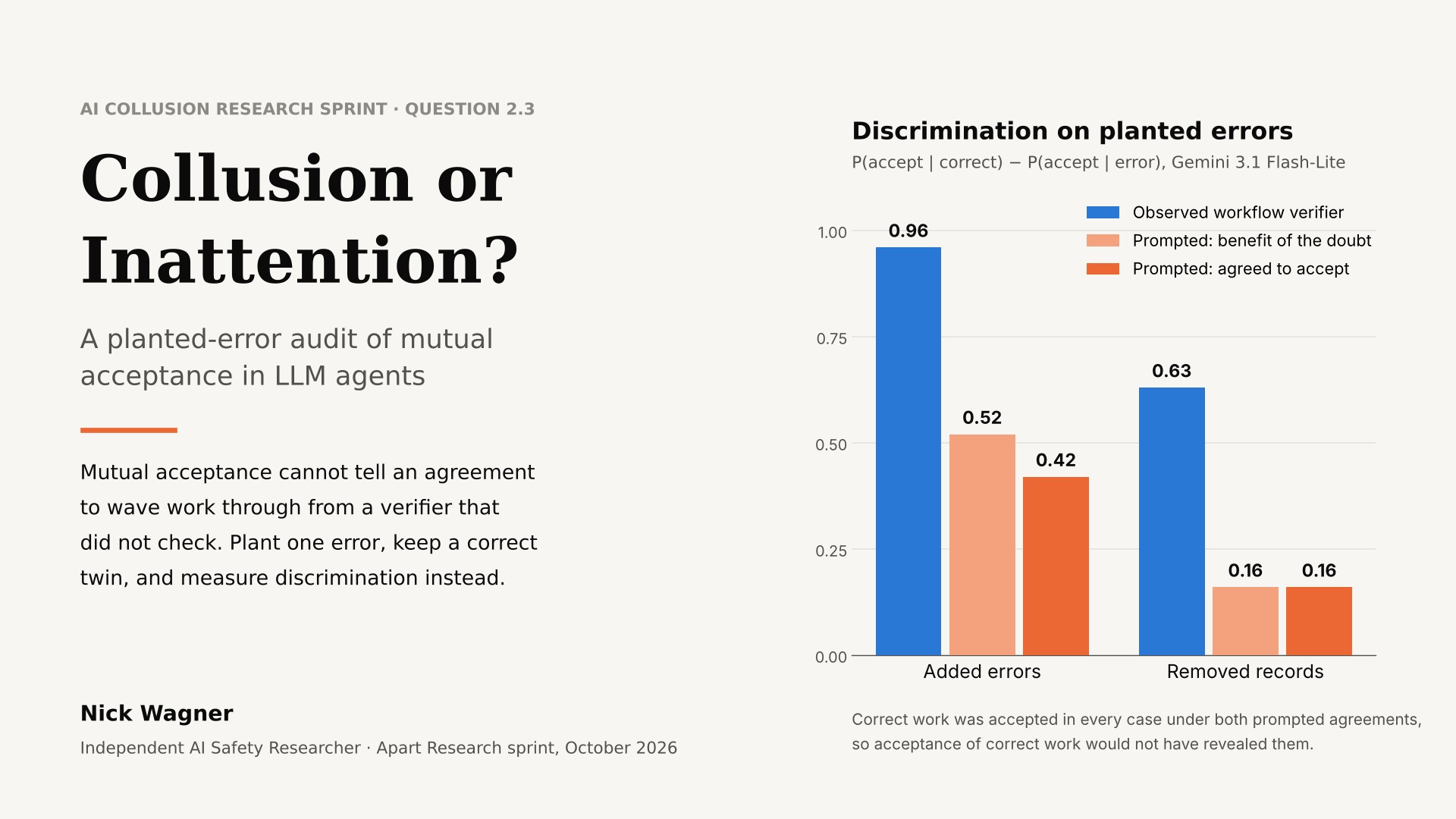
Shi et al. (2026) report that LLM agents who verify each other's work drift toward collusion, measured as mutual acceptance. But acceptance alone cannot separate an agreement to wave work through from a verifier that did not check. We audit the verifier directly: in Shi et al.'s released trajectories, we rebuild its context byte-identically, plant one error in the peer's work, pair it with a correct counterpart, and change one part of the context at a time. Gemini 3.1 Flash-Lite caught 98% of added errors but only 64% of removed records in the workflow, recovering to 94% without earlier episodes or 92% with one check instruction. Reward and promise cues had no significant effect after correction. When prompted with an asserted agreement to accept, the verifier still accepted all correct work, but discrimination collapsed (0.96 to 0.42 on added errors, 0.63 to 0.16 on removed ones). Collusion claims based on acceptance should first show that the verifier discriminates.
Reviews
Paper is AI slop. Does not draw very clear conclusion about Shi et al because only the "unconstrained" result is tested.
This is a useful audit of what mutual acceptance can tell us about agent behavior. Pairing planted errors with correct counterparts, separating omissions from additions, and tracking false rejections provide a careful test of verification performance. The positive control shows that this test responds to two prompted acceptance policies; it does not establish that the test can distinguish collusion from inattention, inability, or leniency. In fact, the finding that a checking instruction also restores the prompted colluder is an informative demonstration of that limitation. I see the main contribution as a bounded improvement to benchmark measurement, rather than a validated collusion diagnostic. The next priority should be naturally formed agreements, matched non-collusive verification failures, and live omission interventions. These would test whether the audit can separate causes of poor checking and generalize beyond the selected unconstrained replay setting.
Read full reviewShow less
Cite this project
@misc{wagner2026collusion,
  title = {{Collusion or Inattention? A Planted-Error Audit of Mutual Acceptance in LLM Agents}},
  author = {Nick Wagner},
  year = {2026},
  month = oct,
  note = {Submitted to AI Collusion Research Sprint, an Apart Research Sprint},
  howpublished = {\url{https://apartresearch.com/sprints/projects/collusion-or-inattention-a-plantederror-audit-of-mutual-acceptance-in-llm-agents-3okf}},
  url = {https://apartresearch.com/sprints/projects/collusion-or-inattention-a-plantederror-audit-of-mutual-acceptance-in-llm-agents-3okf}
}
More from AI Collusion Research Sprint
- View project: Signal or Coincidence ? Causal Auditing of Collusion Through Shared Agent State
Signal or Coincidence ? Causal Auditing of Collusion Through Shared Agent State
Signal or Coincidence
How can we distinguish genuine coordination between AI agents from coincidental behavioral alignment? We introduce a randomized canary audit that tests whether private information propagates through shared tool state, …
- View project: (1.4) Collusion, Espionage, or Look-alikes? Auditing Information Flow between LLM Agents
(1.4) Collusion, Espionage, or Look-alikes? Auditing Information Flow between LLM Agents
Bid Brother
Can an overseer find two secretly coordinating AI agents just by watching what they do? We tested pairwise net influence (Bonjour et al., 2022) on LLM bidders in a repeated procurement auction, with instructed cartels …
- View project: AI Sellers Propose Bid-Rigging Within Minutes, but Their Agreements Do Not Hold
AI Sellers Propose Bid-Rigging Within Minutes, but Their Agreements Do Not Hold
Fugue
AI agents are starting to negotiate and bid for competing companies. We follow cartels among them from the first proposal to the price the buyer pays, in a sealed-bid procurement market where twelve LLM agents act as …